2026-07-20
Corneal Cross-Linking: Is It Really Necessary? | Gangnam Station Eye Clinic
Learn about corneal cross-linking (CXL), its effects, and whether it's essential for you after vision correction surgery. Understand how it strengthens the cornea and prevents complications.


Hello, this is Gangnam Smile Eye Clinic 😊💙
If you've ever consulted about LASIK, LASEK, or SMILE LASIK, you've probably heard of ‘corneal cross-linking’.
However, many eye clinics often move on without explaining ‘corneal cross-linking’ (also known as corneal collagen cross-linking, CXL) in detail.
As a result, even those facing surgery might wonder, ‘Do I really need this?’, or decide to proceed without accurate information.
So today, we'll honestly discuss:
- What are the actual effects of corneal cross-linking?
- Is it truly necessary?
- If so, who absolutely needs it?
- And how does our clinic perform it?
Effects of Corneal Cross-Linking: What is CXL?

Corneal cross-linking, as the name suggests, is a procedure that ‘strengthens the cornea’.
It works by using ultraviolet (UV) light and riboflavin (Vitamin B2) to firmly bind the collagen fibers within the cornea.
Simply put, think of it as ‘adding a reinforcing material’ to a thin or flexible cornea.
Therefore, the effect of corneal cross-linking is to enhance the stability of the cornea after vision correction surgery.
Effects of Corneal Cross-Linking: What is CXL?

Corneal cross-linking is performed as follows:
- For general LASIK: After creating a flap on the upper part of the cornea (epithelial layer), riboflavin is injected into the stromal layer, UV light is applied, and then the flap is closed to finish.
- For LASEK: After removing the entire epithelium, riboflavin is injected into the exposed endothelial cells, UV light is applied, and then a protective contact lens is placed to finish.
- For SMILE LASIK: Riboflavin solution is injected through a tiny 2mm incision, followed by UV light application to complete the procedure.
Only low-intensity UV light is shone onto the cornea, so you don't need to worry about side effects from UV exposure to the eye.
The procedure typically takes about 10 minutes.
Effects of Corneal Cross-Linking: An Invisible Shield

First, the primary effect of corneal cross-linking is to strengthen the corneal structure.
It prevents complications such as corneal thinning or deformation after surgery.
It particularly enhances stability for those with thin corneas, high myopia, or severe astigmatism.
Second, it prevents corneal ectasia.
It helps prevent *corneal ectasia, a rare complication that can occur after vision correction surgery.
*Corneal ectasia: A phenomenon where the thinned cornea gradually bulges forward.
Finally, it improves long-term vision stability.
While initial recovery after vision correction surgery is very important, maintaining clear vision for a long period is paramount.
A structurally strengthened cornea prevents the possibility of vision regression and helps maintain clear vision.
In other words, the effect of corneal cross-linking can be described as ‘insurance for eye health’.
Corneal Cross-Linking is Not Necessary for Everyone.
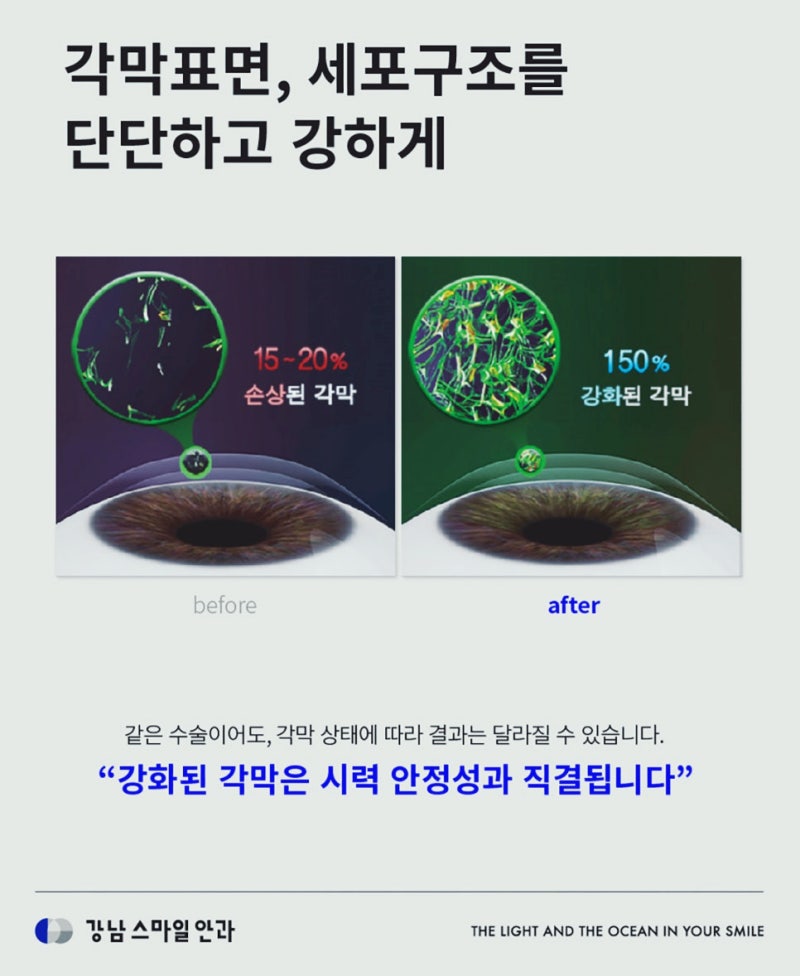
Corneal cross-linking is not a procedure everyone needs.
Its necessity varies completely depending on the results of a precise examination, including corneal thickness, shape, and the type of vision correction surgery.
For example, if your cornea is sufficiently thick and stable, you might not need to add corneal cross-linking.
On the other hand, for patients with thin corneas or high myopia, it may be recommended for the long-term stability of their vision and cornea.
Also, even if the cornea is thick and the degree of myopia and astigmatism is moderate, if the corneal topography (i.e., the shape of the cornea) is unstable, corneal cross-linking may be strongly recommended.
Therefore, ‘Do I really need corneal cross-linking?’ can only be accurately determined through an examination.
Check Your Eye Condition Before Considering the Effects of Corneal Cross-Linking.

Corneal cross-linking is not a procedure that must be done unconditionally.
However, for eyes that need it, it provides a reliable protective shield that ensures long-term stability.
Therefore,
It's not necessary for everyone, but it's essential for those who need it.
This is how we can define it.
You cannot know your eye condition just by looking at it from the outside.
Through accurate examination and consultation with a specialist, be sure to check if your eyes need corneal cross-linking.
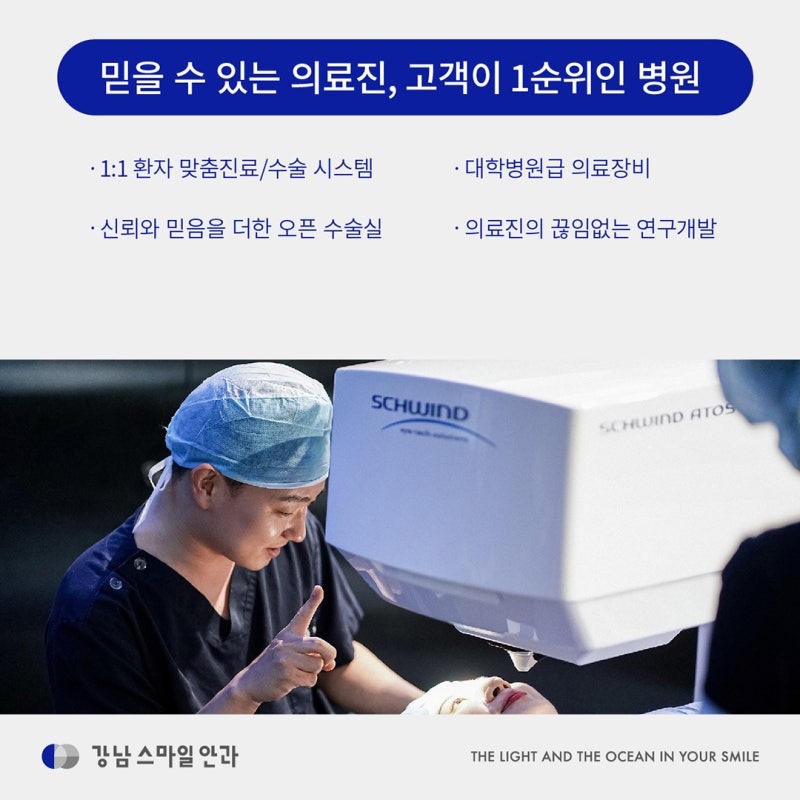
At Gangnam Smile Eye Clinic,
we do not unconditionally recommend procedures like corneal cross-linking.
Only when it is absolutely necessary,
based on the results of precise examinations using specialized equipment,
we recommend it after a 1:1 customized consultation.
If you're curious about your corneal condition,
get precise examination support at Gangnam Smile Eye Clinic, a Gangnam Station eye clinic.
We will thoroughly check the condition of your eyes.
💙 SMILE Surgery is Best at Gangnam Smile Eye Clinic 💙
💙🤍 𝖦𝖠𝖭𝖦𝖭𝖠𝖬 𝖲𝖬𝖨𝖫𝖤 𝖤𝖸𝖤 𝖢𝖫𝖨𝖭𝖨𝖢💙🤍
𝗧𝗛𝗘 𝗟𝗜𝗚𝗛𝗧 𝗔𝗡𝗗 𝗧𝗛𝗘 𝗢𝗖𝗘𝗔𝗡 𝗜𝗡 𝗬𝗢𝗨𝗥 𝗦𝗠𝗜𝗟𝗘



Frequently Asked Questions
What is corneal cross-linking?
Corneal cross-linking is a procedure that strengthens the cornea by firmly binding the collagen fibers within it using ultraviolet light and riboflavin (Vitamin B2). It helps enhance the stability of the cornea after vision correction surgery.
What are the main effects of corneal cross-linking?
The main effects include strengthening the corneal structure, preventing corneal ectasia, and improving long-term vision stability. It prevents complications such as corneal thinning or deformation after surgery and helps maintain clear vision for a long time.
Is corneal cross-linking necessary for all vision correction surgery patients?
No, it is not a procedure necessary for everyone. Its necessity varies depending on the results of a precise examination, including corneal thickness, shape, and the type of vision correction surgery. If the cornea is sufficiently thick and stable, it may not be necessary to add it.
In what cases is corneal cross-linking recommended?
It may be recommended for those with thin corneas, high myopia, severe astigmatism, or an unstable corneal topography, to ensure the long-term stability of their vision and cornea.
How long does the corneal cross-linking procedure take?
The corneal cross-linking procedure typically takes about 10 minutes. Since only low-intensity UV light is shone onto the cornea, there is little concern about side effects.
What is corneal ectasia?
Corneal ectasia is a rare complication that can occur after vision correction surgery, where the thinned cornea gradually bulges forward. Corneal cross-linking has the effect of preventing this.