2026-09-09
Can Our Eyes Truly Take In an Entire IMAX Screen? The Secret Behind Field of View
Discover how human vision encompasses over 200° through central and peripheral vision, and learn why IMAX screens create unmatched immersion by filling our field of view.


Hello, this is Gangnam Smile Eye Clinic :)
Have you ever watched a movie in an IMAX theater?
The moment that colossal screen completely fills your gaze,
you experience a level of immersion distinctly different from standard theaters.
Yet, a thought might cross your mind:
"With the screen being so massive, can our eyes actually see all of it?"
To give you the short answer,
our eyes can encompass a much wider range than you might think.
However, there is an important distinction to understand.
What we can 'perceive within our field of view' and what we can 'see sharply in clear detail'
are not the same thing.
Human vision is broader than you think.
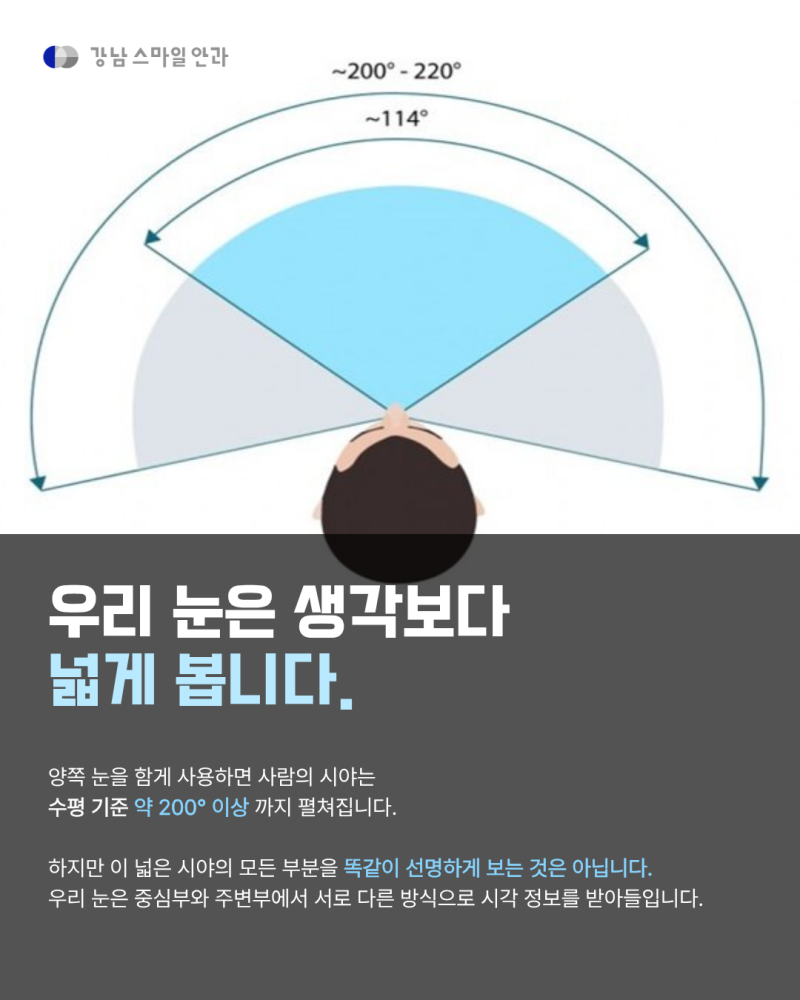
The horizontal field of view that humans can see using both eyes
extends beyond roughly 200°.
In other words, even when staring straight ahead,
our eyes are constantly receiving information from a surprisingly wide surrounding area.
However, not every part of the scene entering our field of view
is seen with equal clarity.
Our eyes process visual data differently depending on
where it falls within our vision.
The primary mechanisms behind this are central vision and peripheral vision.
The sharpest focus is at the 'center.'
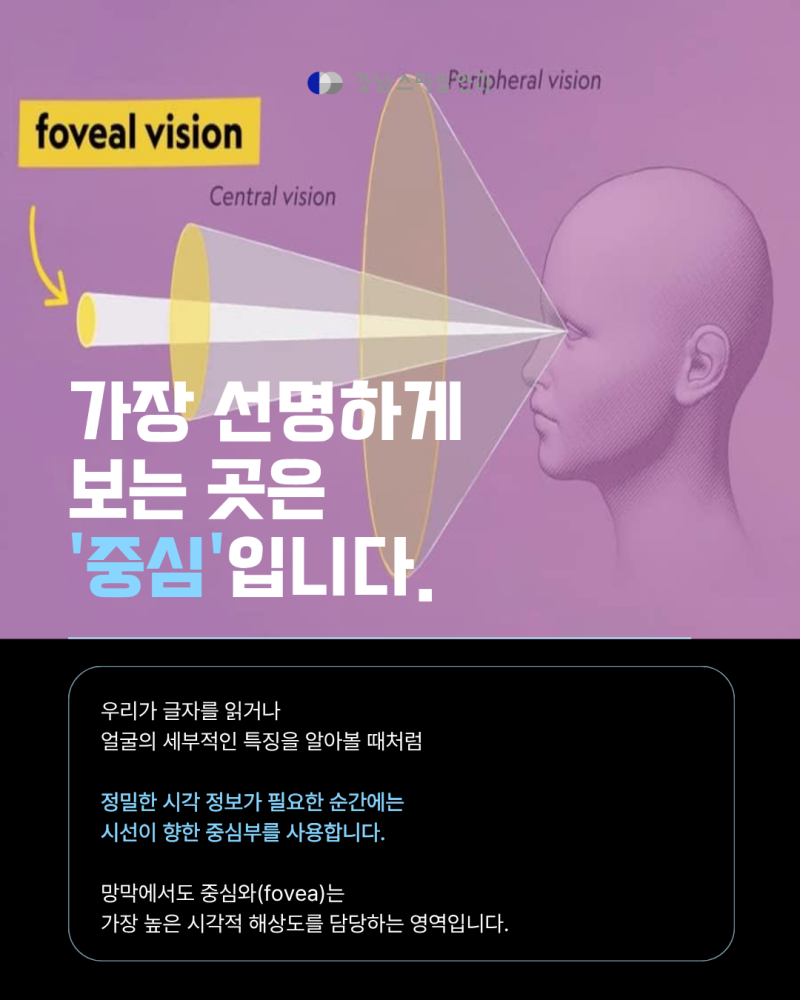
When we read fine print in a book
or observe someone's facial features closely,
we naturally direct our gaze right at the object.
What we are primarily relying on at that moment is central vision.
At the center of the retina lies an area called the fovea,
which is densely packed with photoreceptor cells
and responsible for exceptionally high visual acuity and resolution.
Therefore, when precise details are needed—
such as small lettering or intricate facial expressions—
central vision is essential.
Put simply,
Central vision = Vision for high detail.
So, is peripheral vision merely blurry and useless?

Not at all.
While peripheral vision is relatively unsuited
for resolving intricate details like central vision does,
it plays a crucial role in detecting movement, direction, and spatial shifts
across a broad vantage point.
For example, if you are looking straight ahead
and someone suddenly moves off to your side,
you notice the movement even before turning your head.
In this way, our eyes capture fine details at the center
and spatial and motion data in the periphery.
Ultimately, when viewing any scene,
we are continuously using both central and peripheral vision in harmony.
This is why 'screen size' matters in IMAX.
The intense immersion delivered by an IMAX screen
is not merely a matter of physical screen dimensions.
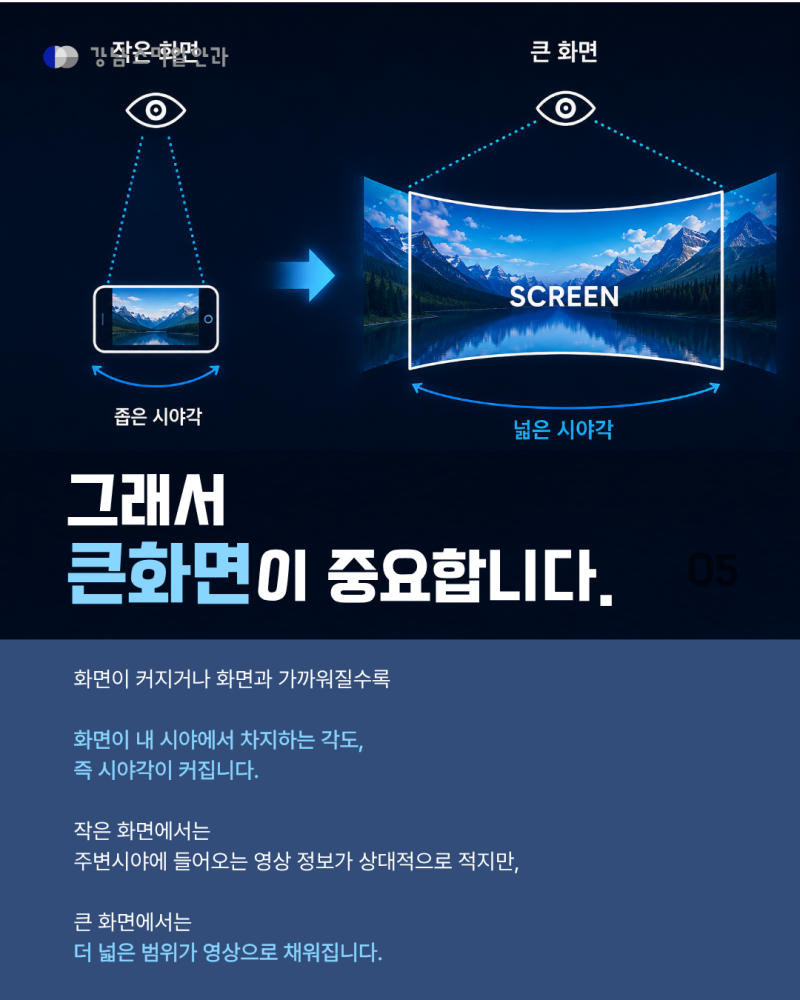
A critical factor is the field of view (FOV).
Field of view, simply put, refers to how much
of your overall sightline the screen occupies
from where you are looking.
As the screen gets larger or your viewing distance becomes closer,
the angle of vision the screen occupies before your eyes expands.
When watching a small screen from far away,
a significant amount of real-world ambient space remains around it,
whereas sitting close to an expansive screen allows the imagery itself
to encompass far more of your vision.
In other words,
it is not just about "How big is the screen?" but rather,
"How much of my entire visual field does it command?"
Why IMAX delivers unmatched immersion
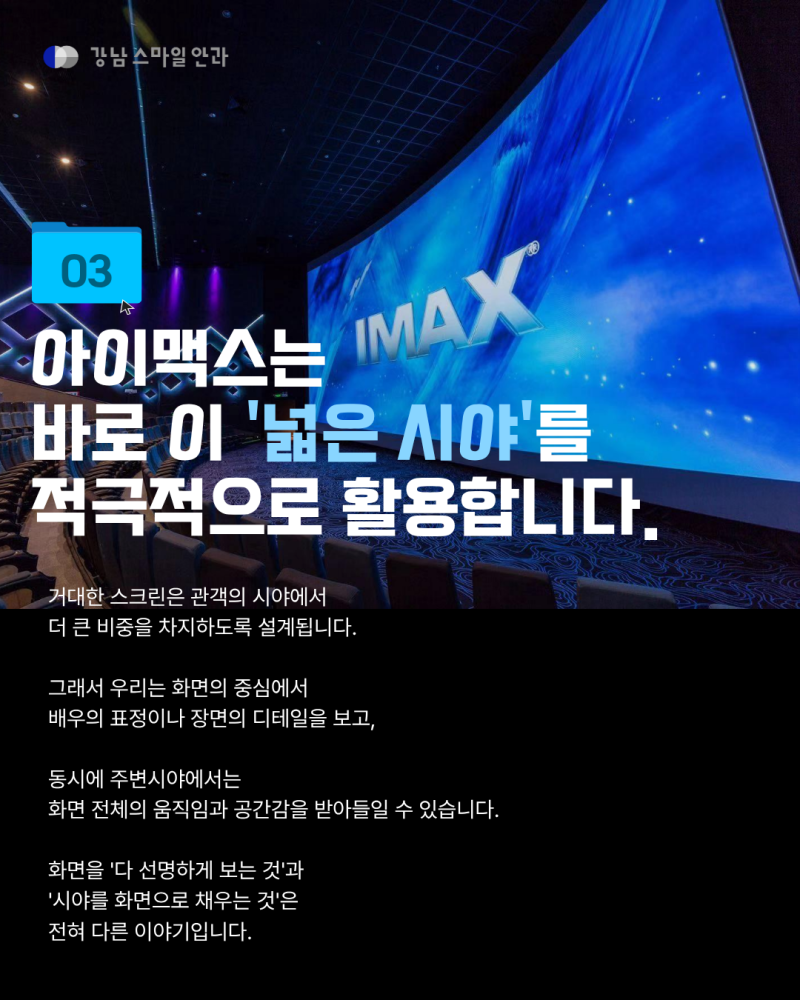
When gazing at a gargantuan screen like IMAX,
the proportion of your visual field occupied by the projection expands dramatically.
At the center of the screen, you register actors' expressions and fine object details,
while your peripheral vision simultaneously takes in the movement
and spatial context across the scene.
What we experience here is not merely watching a 'large screen.'
It is closer to the sensation that the imagery is completely enveloping our vision.
This is why you feel as if
you have stepped directly inside the world of the film.
Of course, perceived immersion is influenced not only by screen size,
but also by viewing distance, aspect ratio, content quality,
seating position, and several other factors.
'Seeing everything sharply' and
'filling the field of vision' are two different things.
Here lies an intriguing truth:
When we look at a massive IMAX screen,
we are not seeing every single corner of that screen
with equal sharpness all at the same time.
Our eyes still focus high resolution at the center,
while using the periphery to sense expansive space and motion.
However, when the screen itself blankets a far wider portion of your visual field,
these two sensory inputs work together,
allowing you to experience the entire scene far more vividly and powerfully.
Seeing a screen in total sharpness from edge to edge
and having a screen immerse your visual field are entirely different concepts.
Ultimately, our eyes never look at just 'a single point.'

The way we view the world is far more complex than it seems.
We examine fine details straight ahead,
while sensing shifts in space and motion in the periphery.
Our brain then synthesizes these diverse visual streams,
producing the cohesive perception of a single, unified scene.
That is why the experience of an IMAX screen
cannot simply be described as "seeing things bigger."
It is because the screen commands a much greater portion of our field of view,
engaging both central and peripheral vision at once.
In the end, the essence of IMAX lies
not just in 'seeing on a larger scale,'
but in 'filling a broader field of view with the screen.'
How clearly and widely we perceive our surroundings
cannot be defined by a single visual acuity number alone.
Our eyes perceive the world with far greater sophistication than we imagine!
💙 For SMILE surgery, trust Gangnam Smile Eye Clinic 💙
💙🤍 𝖦𝖠𝖭𝖦𝖭𝖠𝖬 𝖲𝖬𝖨𝖫𝖤 𝖤𝖸𝖤 𝖢𝖫𝖨𝖭𝖨𝖢💙🤍
𝗧𝗛𝗘 𝗟𝗜𝗚𝗛𝗧 𝗔𝗡𝗗 𝗧𝗛𝗘 𝗢𝗖𝗘𝗔𝗡 𝗜𝗡 𝗬𝗢𝗨𝗥 𝗦𝗠𝗜𝗟𝗘












Frequently Asked Questions
What is the typical human field of view?
Using both eyes, the human horizontal field of view spans roughly 200° or more. Even while staring forward, we constantly take in surrounding visual data across that broad span.
What is the difference between central and peripheral vision?
Central vision provides sharp, detailed focus, whereas peripheral vision detects motion and spatial orientation across a wide field. The retina's fovea resolves fine details like text and faces, while the periphery excels at picking up movement.
Can we see the entire IMAX screen with complete clarity at the same time?
No, our eyes cannot view every single part of the screen with identical sharpness simultaneously. We only resolve high detail where our central vision is focused, while our peripheral vision perceives the remaining screen as motion and spatial context.
Why is an IMAX theater so much more immersive than a conventional theater?
IMAX screens occupy a significantly greater portion of your field of view. By engaging both central and peripheral vision at the same time, the brain receives visual input that mimics being physically situated inside the movie's environment.