2026-07-20
A Doctor with 99% Target Vision Explains How to Achieve Good Corrected Vision with SMILE LASIK | Gangnam Station Eye Clinic Recommendation
Learn about target vision in refractive surgery, why 1.0 isn't always the goal, and how precise pre-operative exams, consistent post-operative care, and advanced equipment like ATOS SMILE contribute to excellent corrected vision.


Hello, this is Gangnam SMILE Eye Clinic 😊💙
During consultations, when we tell some patients, ‘You achieved 1.0 vision!’, they sometimes react with surprise, asking, ‘What? Is that all I got?’
So, today, I’d like to post about something many of you are curious about regarding vision correction surgery: ‘target vision’.
Gangnam Station Eye Clinic Recommendation: What is Corrected Vision?
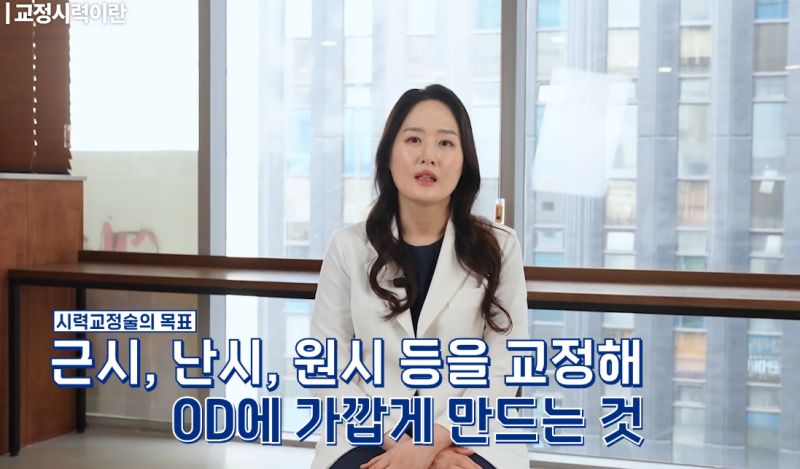
In fact, the goal of surgeries like SMILE LASIK, LASIK, or LASEK is not to achieve a specific vision value like 1.0, 1.2, or 1.5.
The goal of vision correction surgery is to correct the patient’s myopia, astigmatism, hyperopia, etc., to bring it as close to 0D as possible – in other words, to achieve an ‘emmetropic’ state.
The vision achieved when corrected to an emmetropic state is considered your eye’s maximum corrected vision, which becomes your target vision after surgery.

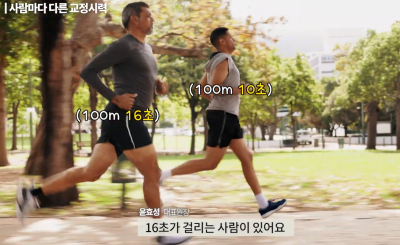


For example, if a patient has -4D of myopia, the surgery aims to reduce that 4D to 0D. When the refractive power is close to 0D after surgery, most people achieve around 1.0 vision.
However, depending on individual differences in natural eye strength or structure, some may see better than 1.0, and some may see less. It’s not a concept where removing more tissue or correcting more leads to better vision.
In fact, removing too much tissue can lead to ‘overcorrection’.
Therefore, what’s important in vision correction is to correct appropriately, without overdoing it.
Gangnam Station Eye Clinic Recommendation: How to Achieve Good Corrected Vision

Our clinic’s ATOS SMILE, or Smart LASIK, consistently achieves its target corrected vision 99.9% of the time each year.
It’s actually uncommon for all surgeries at a hospital like ours to achieve target corrected vision without error.
So, how have we been able to achieve such excellent results?

For perfect correction, accurate pre-operative examination is extremely important.
First, it’s crucial to accurately check the corneal thickness and eye condition before surgery.
Since each person’s eye conditions differ, precisely examining the thickness and shape and performing surgery tailored to each eye’s unique shape is one of the factors for successful surgery.


Among the numerous pre-operative tests, the most important is the vision test.
Because this process confirms the exact diopter of your myopia, astigmatism, or hyperopia, at a non-factory-style eye clinic like ours, which prioritizes meticulousness (a Gangnam Station eye clinic recommendation), this vision test is performed only by a few experienced optometrists.

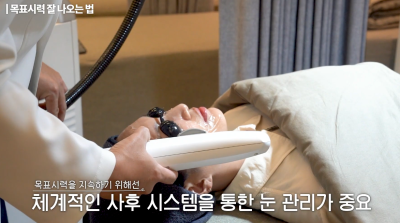
Second is consistent post-operative care and regular check-ups.
Having surgery doesn’t mean it’s all over. Managing your eyes through the hospital’s systematic post-operative care system (a Gangnam Station eye clinic recommendation) is also a very important point for maintaining your target vision.
Our Gangnam SMILE Eye Clinic has an Eye Care Center dedicated to post-operative care.
Also, after surgery, be sure to use eye drops at the prescribed times, avoid rubbing your eyes, and regularly check your eye condition. Don’t forget to manage dry eyes, inflammation, and UV protection!
Finally, the most important thing is the accuracy and safety of the surgical equipment.
Gangnam Station Eye Clinic Recommendation: Advantages of Smart LASIK
ATOS (the Smart LASIK machine) uses a 7-dimensional eye tracking device to track the eye in real-time, accurately detecting the pupil’s center. Then, its rotational axis compensation function precisely corrects the laser’s angle according to the rotation, minimizing errors in vision correction.
In contrast, with general SMILE or SMILE Pro, the surgeon must semi-automatically operate the surgical screen to compensate for rotation, making it difficult to expect the same precise correction effect as ATOS, especially for high astigmatism.
*Side cut (handle for removing surgical fragments during surgery)
Furthermore, ATOS SMILE does not have a separate ‘side cut’, resulting in a higher amount of residual cornea after surgery.
Conversely, with SMILE and SMILE Pro, which create a side cut, unnecessary corneal tissue is ablated to the extent of the side cut, leading to less residual cornea after surgery.
Residual cornea is the most important factor affecting long-term safety after surgery, so it can actually be said to be the most crucial part of the surgery.
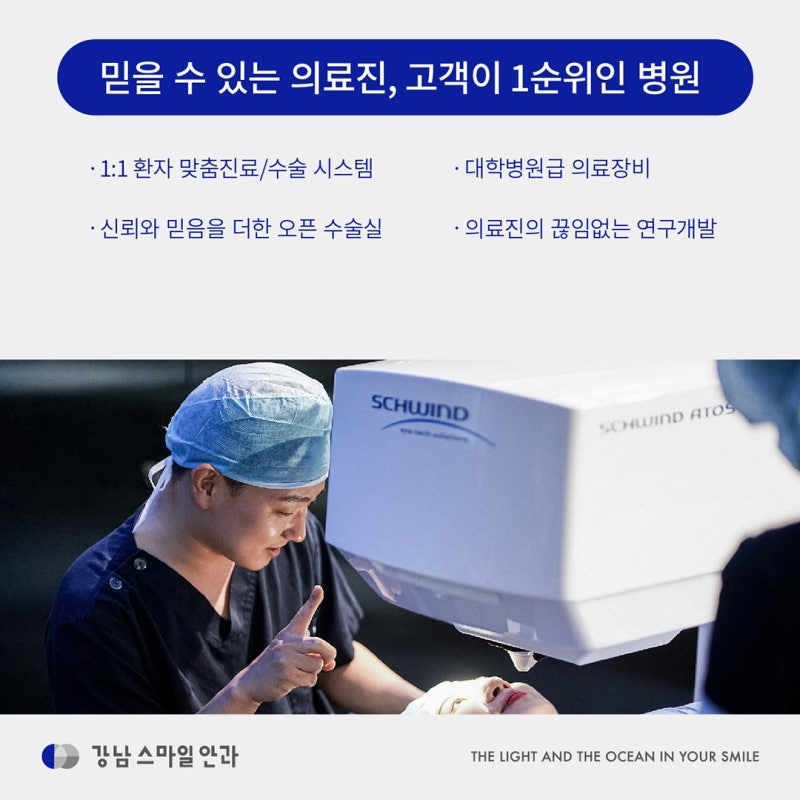
Gangnam SMILE Eye Clinic, a recommended eye clinic at Gangnam Station, accurately assesses eye conditions through various precise pre-operative examinations and guides patients to the most suitable surgical method.
We are also equipped with the latest equipment and a systematic system, providing sincere consultations and surgeries with a 1:1 customized approach for each individual.
We always prioritize the patient, with transparency and safety as our top concerns.
If you have any other questions, please feel free to contact the eye clinic at any time.
💙🤍 𝖦𝖠𝖭𝖦𝖭𝖠𝖬 𝖲𝖬𝖨𝖫𝖤 𝖤𝖤𝖸𝖤 𝖢𝖫𝖨𝖭𝖨𝖢💙🤍
𝗧𝗛𝗘 𝗟𝗜𝗚𝗛𝗧 𝗔𝗡𝗗 𝗧𝗛𝗘 𝗢𝗖𝗘𝗔𝗡 𝗜𝗡 𝗬𝗢𝗨𝗥 𝗦𝗠𝗜𝗟𝗘
Gangnam Station SMILE Surgery Gangnam Station Eye Clinic Recommendation Gangnam Station SMILE Surgery Gangnam Station Eye Clinic Recommendation Gangnam Station SMILE Surgery Gangnam Station Eye Clinic Recommendation


Gangnam Station Eye Clinic Gangnam Lens Implantation Gangnam Station Lens Implantation Gangnam Station Eye Clinic Gangnam Lens Implantation Gangnam Station Lens Implantation Gangnam Station Eye Clinic Gangnam Lens Implantation Gangnam Station Lens Implantation











Gangnam Station Eye Clinic Recommendation Gangnam Station Eye Clinic Recommendation Gangnam Station Eye Clinic Recommendation Gangnam Station Eye Clinic Recommendation Gangnam Station Eye Clinic Recommendation Gangnam Station Eye Clinic Recommendation Gangnam Station Eye Clinic Recommendation Gangnam Station Eye Clinic Recommendation Gangnam Station Eye Clinic Recommendation Gangnam Station Eye Clinic Recommendation Gangnam Station Eye Clinic Recommendation Gangnam Station Eye Clinic Recommendation Gangnam Station Eye Clinic Recommendation Gangnam Station Eye Clinic Recommendation Gangnam Station Eye Clinic Recommendation Gangnam Station Eye Clinic Recommendation Gangnam Station Eye Clinic Recommendation Gangnam Station Eye Clinic Recommendation Gangnam Station Eye Clinic Recommendation Gangnam Station Eye Clinic Recommendation Gangnam Station Eye Clinic Recommendation Gangnam Station Eye Clinic Recommendation
Frequently Asked Questions
Is the target vision for refractive surgery 1.0?
No. The goal of refractive surgery is to correct myopia, astigmatism, hyperopia, etc., to bring the eye to an ‘emmetropic’ state (close to 0D). Achieving 1.0 or higher vision is not the primary goal.
How can I achieve good corrected vision after SMILE LASIK?
There are three main factors. First, accurate pre-operative examination, including precise checks of corneal thickness and eye condition, is crucial, and a vision test by an experienced optometrist is essential. Second, consistent post-operative care and regular check-ups are necessary. Third, the use of accurate and safe surgical equipment, such as ATOS (Smart LASIK), is important.
What is overcorrection and why should it be avoided?
Overcorrection refers to a state where too much corneal tissue is ablated beyond the necessary diopter, resulting in excessive vision correction. This can be detrimental to the eyes, so appropriate correction is important in vision surgery.
What are the advantages of the ATOS (Smart LASIK) equipment?
ATOS (Smart LASIK) uses a 7-dimensional eye tracking device to accurately detect the pupil’s center and compensate for the rotational axis, minimizing errors in vision correction. Additionally, it has no separate side cut, leaving more residual corneal tissue after surgery, which is beneficial for long-term safety.
How should I manage post-operative care?
After surgery, it is crucial to use eye drops at the prescribed times and avoid rubbing your eyes. Regular eye check-ups and management of dry eyes, inflammation, and UV protection are also very important for maintaining your target vision.