2026-07-20
A Comprehensive Guide to Vision Correction Surgeries at Gangnam Station Eye Clinic!
Confused about which vision correction surgery is right for you? This guide from Gangnam Smile Eye Clinic compares LASIK, LASEK, SMILE, and ICL, helping you understand which procedure best suits your eyes and lifestyle.

Are you considering vision correction surgery due to poor eyesight,
but unsure which procedure is right for you?
Gangnam Smile Eye Clinic provides accurate diagnoses and guidance on various types of vision correction surgeries.
However, choosing vision correction surgery is not simply a matter of
‘LASIK, LASEK, or SMILE.’
The most suitable surgical method can vary completely depending on corneal thickness, tear volume, lifestyle, and occupational characteristics.
In this article, we compare and summarize the main types of vision correction surgeries performed at Gangnam Station Eye Clinic,
to help you understand which surgery is best for whom,
and assist you in making an informed decision about your surgery.
What is Vision Correction Surgery?
Vision correction surgery is a surgical treatment that helps you live
without glasses or contact lenses.
It corrects existing myopia, astigmatism, and hyperopia to achieve ‘emmetropic’ vision.
Representative Types of Vision Correction Surgery *Final table summary attached at the bottom of the post
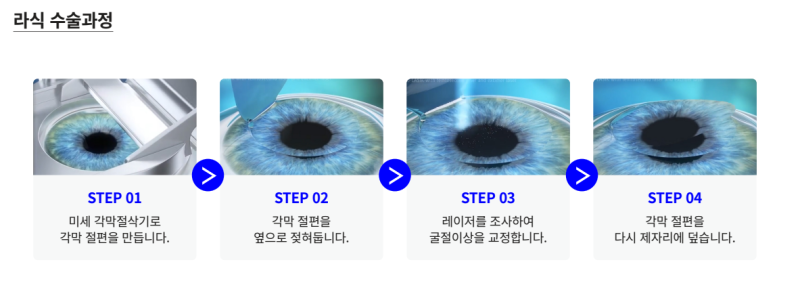
1. LASIK
This method involves creating a thin flap on the cornea, lifting it, and then using a laser to reshape the underlying tissue to correct refractive errors.
Advantages
- Almost no pain after surgery.
- Fast recovery.
- Quick return to daily life activities such as driving and work (possible the next day).
Disadvantages
- Not possible if the cornea is thin or asymmetrical.
- *Among LASIK, LASEK, and SMILE, it has the strictest conditions.
- The corneal flap created is relatively vulnerable to external impact.
👤Recommended for these individuals:
- Patients with typical myopia and astigmatism who have thick corneas.
- Office workers who do not engage in much physical activity and desire a quick recovery.
- Those for whom returning to daily life without glasses as soon as possible is important.
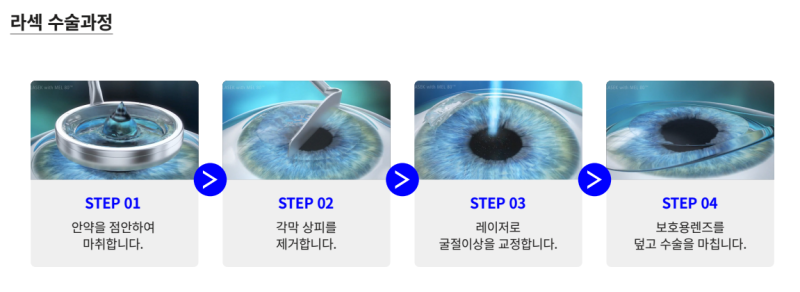
2. LASEK
This method involves removing only the epithelial layer without creating a corneal flap, and then applying a laser.
Advantages
- Possible even with thin corneas.
- Strong against external impact, offering high stability.
- Surgery is possible even if the corneal shape is irregular.
Disadvantages
- Pain after surgery (4-5 days)
- *In the case of Today LASEK, 2-3 days.
- Recovery and post-operative care are important.
👤Recommended for these individuals:
- Patients with thin corneas or high myopia.
- Those with highly active occupations such as martial arts or swimming.
- Those diagnosed as unsuitable for LASIK.
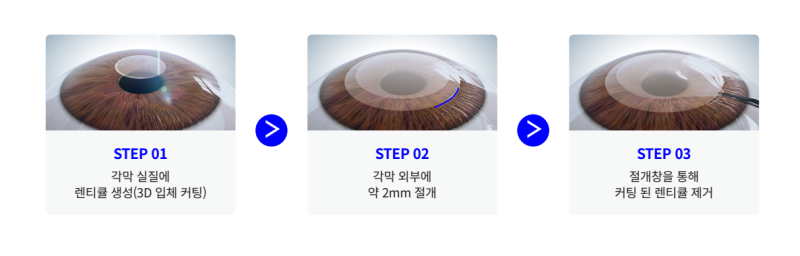
3. SMILE LASIK
An advanced technique compared to traditional LASIK and LASEK, this surgical method removes a lenticule through a minimal incision without cutting the cornea.
It is a minimally invasive (endoscopic) method, resulting in fewer side effects and faster recovery.
Advantages
- Less damage to corneal nerve plexus, leading to less dry eye syndrome.
- Fast recovery and almost no pain (daily life possible the next day).
- Small incision area makes it strong against external impact.
Disadvantages
- Limitations for high myopia/astigmatism.
- Limited correction range for hyperopia/astigmatism.
- Relatively high cost.
👤Recommended for these individuals:
- Office workers and students concerned about dry eye syndrome.
- Those who engage in many outdoor activities and desire a quick recovery, e.g., military personnel.
- Those who feel uneasy about traditional surgical methods.
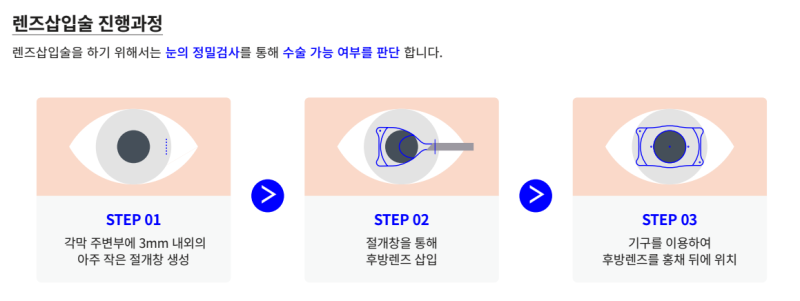
4. Lens Implantation (ICL)
Instead of reshaping the cornea, this method involves implanting a lens behind the iris and in front of the natural lens.
It is the concept of inserting a permanent ‘micro-spectacle lens’ into the eye, rather than correcting with a laser.
Advantages
- Correction is possible for high myopia and ultra-high astigmatism.
- Suitable for patients with eye diseases such as Avellino corneal dystrophy.
- No corneal damage.
- Lens removal is possible if needed (reversible surgery).
Disadvantages
- Higher cost than laser vision correction (LASIK, LASEK, SMILE LASIK).
- Rare but possible risks of endophthalmitis and cataracts.
- Requires regular monitoring.
👤Recommended for these individuals:
- Patients with ultra-high astigmatism or ultra-high myopia.
- Those whose corneas are too thin for laser surgery.
- Those who have less aversion to surgical incisions and have financial flexibility.
Differentiated Vision Correction Surgery at Gangnam Smile Eye Clinic
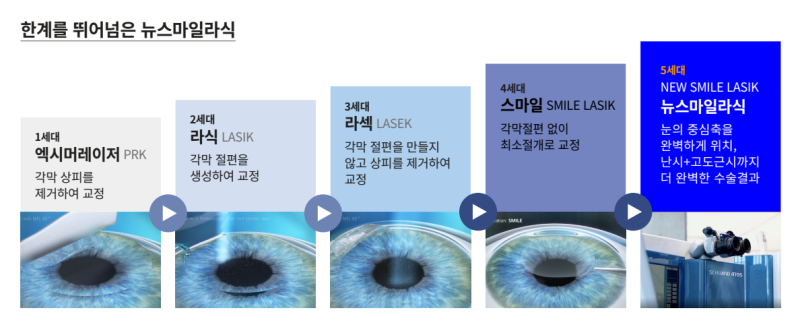
No more old SMILE LASIK!
Gangnam Smile Eye Clinic at Gangnam Station Eye Clinic
introduces 5th generation SMILE, Smart LASIK, which is a step advanced from existing SMILE,
providing more precise and safer vision correction.
It uses the same surgical method as the existing SMILE LASIK,
maintaining the stability of the existing technology while offering the advanced advantages unique to Smart LASIK.
How is ATOS different from existing SMILE?
- ✅Minimizes corneal damage by further reducing the incision area.
- ✅Applicable to highly challenging cases (thin corneas, high myopia, high astigmatism).
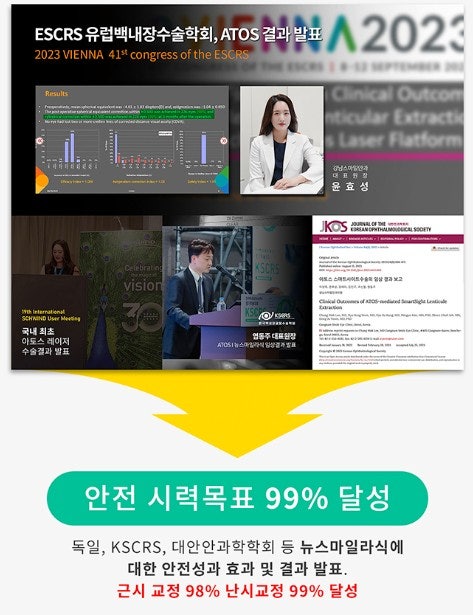
- ✅Optimized for individuals with astigmatism (accurate axis correction_achieving 99% target corrected vision).
- ✅Lower incidence of dry eye syndrome.
- ✅Precise surgery possible based on personalized data.
Surgery Name | Flap Presence | Recovery Speed | Pain | Dry Eye Syndrome | High Myopia Possible | Suitable Candidates |
LASIK | o | Fast | Almost None | Present | Not Possible | General Myopia Patients |
LASEK | x | Slow | Present | Normal | Possible | Thin Cornea, Active Individuals |
SMILE LASIK (4th Gen) | x | Fast | None | Low | Not Possible | Those Concerned About Dry Eye |
Smart LASIK (5th Gen) | x | Fast | None | Very Low | Possible (Limited) | Those Concerned About Dry Eye, High Astigmatism Patients |
ICL | x | Fast | None | Very Low | Possible | Ultra-High Myopia, Unsuitable for LASIK/LASEK/SMILE |
How to Find the Right Surgery for Your Eyes at Gangnam Station Eye Clinic
The core of vision correction surgery is not ‘which surgery is best,’
but ‘which surgery is most suitable for my eyes.’
At Gangnam Smile Eye Clinic, Gangnam Station Eye Clinic,
- ✅Corneal thickness
- ✅Corneal curvature
- ✅Tear secretion volume
- ✅Degree of refractive error
- ✅Check for intraocular diseases such as retinal conditions
are assessed in various ways,
to propose the most suitable type of vision correction surgery for each individual patient.
Get a free examination/consultation for the vision correction surgery that's right for your eyes now.
Are you looking for the right vision correction surgery for your eyes in Gangnam Station?
At Gangnam Station Eye Clinic,
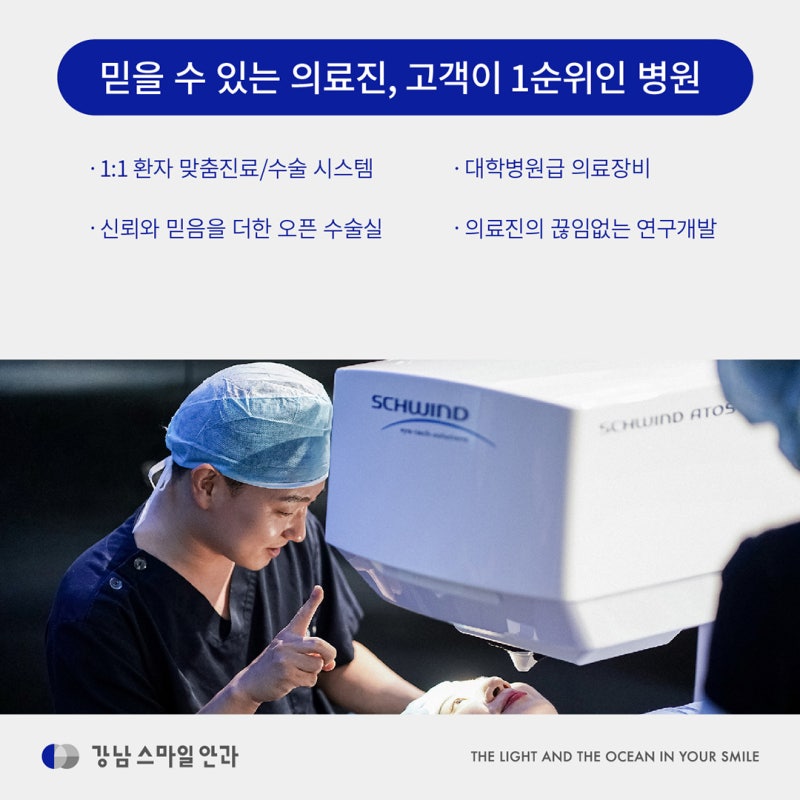
we provide a one-stop service from university hospital-level precise examination → customized patient diagnosis → 1:1 customized surgery → post-operative aftercare.
Although located in Gangnam,
we are a non-factory-type eye clinic that always prioritizes the patient,
and we place transparency and safety first.
💙🤍 𝖦𝖠𝖭𝖦𝖭𝖠𝖬 𝖲𝖬𝖨𝖫𝖤 𝖤𝖸𝖤 𝖢𝖫𝖨𝖭𝖨𝖢💙🤍
𝗧𝗛𝗘 𝗟𝗜𝗚𝗛𝗧 𝗔𝗡𝗗 𝗧𝗛𝗘 𝗢𝗖𝗘𝗔𝗡 𝗜𝗡 𝗬𝗢𝗨𝗥 𝗦𝗠𝗜𝗟𝗘












Frequently Asked Questions
What are the main differences between LASIK and LASEK?
LASIK involves creating a thin flap in the cornea, lifting it, and then using a laser to correct vision, offering fast recovery, but it's not suitable for thin or asymmetrical corneas. LASEK only removes the corneal epithelium before laser treatment, making it suitable for thin or irregular corneas, but post-operative pain can last for about 4-5 days.
What are the advantages of SMILE LASIK?
SMILE LASIK involves a smaller corneal incision, resulting in less damage to the corneal nerve plexus and a lower incidence of dry eye syndrome. Additionally, it offers fast recovery, minimal pain, and strong resistance to external impact.
Who is recommended for implantable collamer lens (ICL) surgery?
Implantable collamer lens (ICL) surgery is recommended for patients with extremely high myopia or astigmatism, or those with corneas too thin for laser surgery. It allows for vision correction without corneal damage, and the lens can be removed if necessary.
What is the difference between 4th generation SMILE LASIK and 5th generation SMART LASIK?
5th generation SMART LASIK (ATOS) further reduces the incision size compared to traditional SMILE LASIK, minimizing corneal damage. It is applicable to challenging cases (thin corneas, high myopia, high astigmatism), optimized for astigmatism correction, and has an even lower incidence of dry eye syndrome.
How do I choose the right vision correction surgery for me?
The key to choosing the right vision correction surgery is not 'which surgery is best,' but 'which surgery is most suitable for my eyes.' The optimal surgery for an individual should be determined by checking corneal thickness, corneal curvature, tear secretion, degree of refractive error, and intraocular diseases such as the retina.
Is it possible to get a vision correction surgery examination and consultation at Gangnam Smile Eye Clinic?
Yes, it is possible. Gangnam Smile Eye Clinic provides a one-stop service from university hospital-level precise examinations to personalized diagnoses, 1:1 customized surgeries, and post-operative care. You can receive a free examination and consultation about the vision correction surgery that suits your eye condition.