2026-09-03
60s Facelift Review: How to Improve Nasolabial Folds, Jowls, and Double Chin
A 60-year-old patient's journey to improve jowls, deep nasolabial folds, and a double chin through a deep plane facelift and liposuction, resulting in a smoother jawline and rejuvenated appearance.
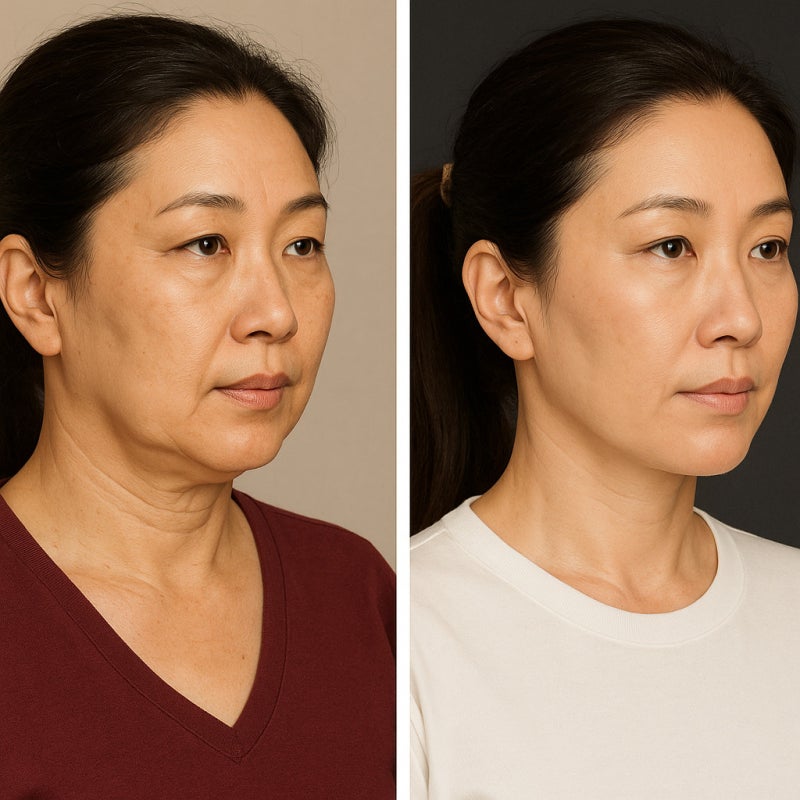
Body
Case Study: Facelift for a 60-Year-Old Female Patient
A 60-year-old woman visited our clinic for a facelift.
The patient was concerned about sagging jowls, a compromised jawline, deep nasolabial folds, and a dull-looking neck line due to a double chin.
Diagnosis: Jowls, Nasolabial Folds, and Neck Wrinkles
Upon examination:
Uneven jawline and sagging jowl area
Prominent marionette lines and a wider-looking face
Collapsed mid-face leading to deep nasolabial folds
Uneven neck wrinkles and double chin line
To address these complex issues, we decided to combine a facelift with liposuction.
Deep Plane Facelift
Improve sagging jawline, nasolabial folds, and neck sagging
This is a simulation image for illustrative purposes to help understand the actual surgery.
Surgical Method: Deep Plane Facelift
The facelift incision extends from within the scalp in the temple area → in front of the ear → earlobe → to the hairline behind the ear. While this is the longest incision among lifting surgeries, the scars are well concealed.
The surgical process is as follows:
Skin dissection followed by SMAS muscle layer surgery
SMAS incision, lifting, and pulling
Separation of retaining ligaments → key for nasolabial fold correction
Delicate dissection while protecting facial nerves
Liposuction combined for areas with excess facial fat and double chin
Specifically, manipulating the SMAS muscle layer is crucial for correcting nasolabial folds. The deep plane facelift, as it is known today, is also based on this principle.
Surgical Results and Recovery
The surgery was successfully completed without complications such as bleeding, hematoma, or skin necrosis. Facial nerve paralysis also did not occur.
Although swelling remains at present,
The uneven jawline has been smoothly improved
Deep nasolabial folds have been alleviated
Double chin and neck line have been refined
As recovery progresses further, a more natural and youthful face can be expected.
Conclusion
For patients in their 60s, complex improvements are often needed for jowls, nasolabial folds, double chin, and neck line. In such cases, a deep plane facelift, which precisely addresses the SMAS muscle layer rather than just skin lifting, is effective.
If performed safely, natural anti-aging effects can be achieved without complications.
Frequently Asked Questions
What is a deep plane facelift?
A deep plane facelift is a lifting surgery that delicately manipulates the SMAS muscle layer. After skin dissection, the SMAS muscle layer is incised, lifted, and pulled, and the separation of retaining ligaments plays a key role in correcting nasolabial folds.
What problems can a 60s facelift improve?
A facelift for individuals in their 60s can improve complex aging issues such as sagging jowls, deep nasolabial folds, an uneven jawline, double chin, and neck wrinkles. Specifically, by correcting the SMAS muscle layer, it smooths the mid-face and jawline.
Where are the facelift incisions made?
Facelift incisions start within the scalp in the temple area, extend in front of the ear, pass the earlobe, and continue to the hairline behind the ear. While this is the longest incision among lifting surgeries, it is designed to conceal scars effectively.
Is liposuction sometimes combined with a facelift?
Yes, it is possible. For individuals concerned about excess facial fat or a double chin, combining liposuction with a facelift can more effectively refine the jawline and neck line, creating a smoother facial contour.
Were there any complications after the facelift?
In this particular case, there were no complications such as bleeding, hematoma, skin necrosis, or facial nerve paralysis. Although swelling remained after the surgery, the uneven jawline and deep nasolabial folds were improved.