2025-12-13
#25 Eyebrow Lift, Epicanthoplasty, Lower Blepharoplasty, and Midface Lift: A Complex Surgery Case Analysis for a 50s Female
This article analyzes a 51-year-old female's complex eye surgery, addressing eyelid sagging, covered double eyelids, and undereye fat imbalance. It explains why an eyebrow lift, epicanthoplasty, lower blepharoplasty, and midface lift were chosen over traditional incisional double eyelid surgery.
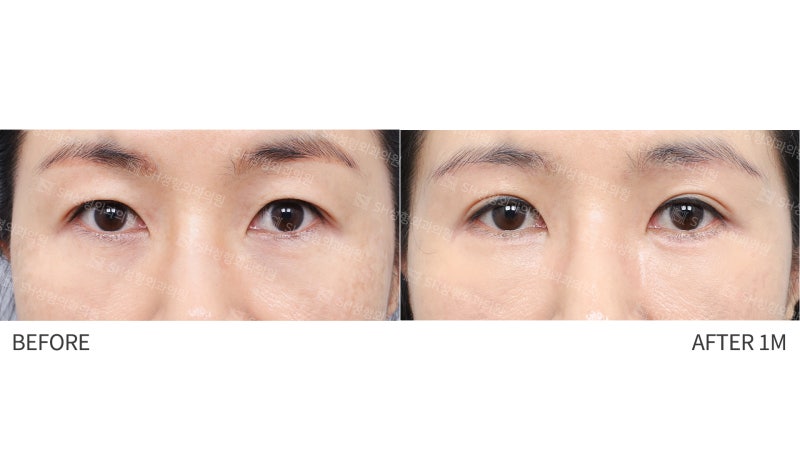
For eye surgery in your 50s, simply creating a larger double eyelid line isn't enough. This is because, after buried double eyelid surgery, it's common for eyelid sagging, covered double eyelid lines, and an imbalance of undereye fat with midface sagging to appear simultaneously over time. Dr. Kim Sung-hoon of SH Plastic Surgery explains a complex surgical strategy through the real case of a 51-year-old female patient. Instead of incisional double eyelid surgery, he corrected the upper face with an eyebrow lift and epicanthoplasty, and naturally improved the undereyes and nasolabial folds by combining lower blepharoplasty with a midface lift. The article details the eyebrow lift vs. upper blepharoplasty, the limitations of undereye fat repositioning, and the necessity of lower blepharoplasty + midface lift, along with anatomical evidence. —Dr. Kim Sung-hoon, Face Designer at SH Plastic Surgery
‘Doctor, my double eyelids used to be clear, but now the line is completely covered, and my eyes look so stuffy.’
Hello.
I am Dr. Kim Sung-hoon, a board-certified plastic surgeon and face designer.
Spending my days in the consultation room,
I hear these comments quite often.
‘Doctor, my eyes used to be fine,
but nowadays, whenever I take a photo, my eyes look hidden.’
‘I have double eyelids, but they feel like they’re disappearing.’
Especially women around their 50s
tend to express these concerns cautiously.
This is because the buried double eyelid surgery they had when they were younger,
instead of making their eyes look clear, now makes them appear covered by the eyelids.
In fact, such changes are less about a specific problem
and more about the natural passage of time.
The skin gradually sags,
the strength to open the eyes isn’t what it used to be,
and the undereyes and cheeks also begin to sag.
At this point, many people ask:
‘So, should I just make my double eyelids bigger again?’
‘Do I need to have incisional surgery again?’
However, I always begin the conversation
in a slightly different direction.
What I want to talk about today
is not ‘surgery to recreate double eyelids,’
but ‘how to understand and reorganize the structures around the eyes.’
Today’s topic is
a real case of a 50s patient with sagging eyes, who chose
an eyebrow lift, epicanthoplasty, lower blepharoplasty, and midface lift instead of incisional double eyelid surgery.
I will explain why I didn't recommend incisional double eyelid surgery,
what criteria I used to plan the eyebrow lift and lower blepharoplasty together,
and how this choice changed the overall impression. ^^
If your eyes in the mirror
‘look a little different from before,’
I hope today’s story
helps you understand the reasons for that change.
The patient was a 51-year-old female, born in 1975.
She had buried double eyelid surgery in her mid-30s, about 15 years ago, and was highly satisfied at the time.
However, over time, her eyelid skin sagged, and the original buried line became covered from above, almost invisible.
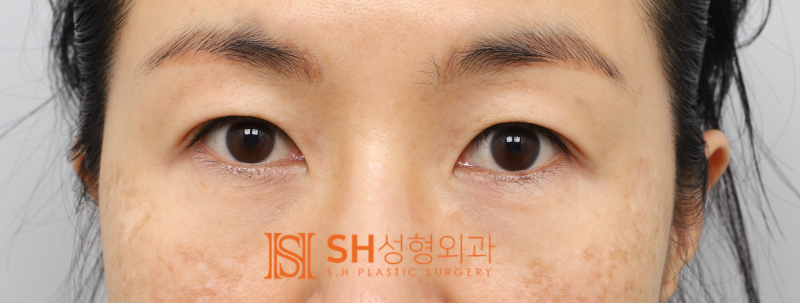
Additionally, one side of her undereyes was bulging, while the other appeared hollow,
and her biggest concern was an overall dull impression.
CASE
The core problem for this patient was not ‘double eyelids’
When I first saw this case, I assessed it this way:
‘This is not a problem of recreating double eyelids. The structures above and below the eyes have collapsed simultaneously.’
Summary of main problems
Covered double eyelid line → Eyelid skin sagging
Thick upper eyelid → Risk of looking heavier with incisional double eyelid surgery
Undereye bulging + hollowness → Midface sagging, not just a fat issue
Aged appearance extending to the nasolabial folds
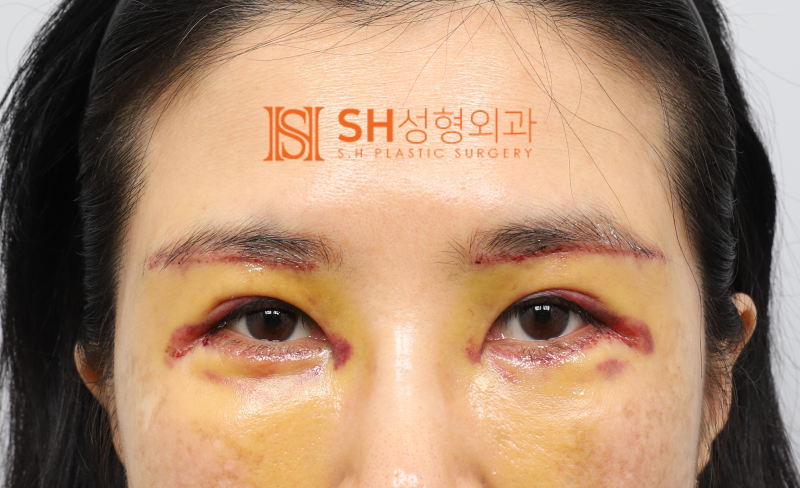
<Before Surgery>
Therefore, for this patient,
incisional double eyelid surgery was actually not recommended.
Final Surgical Plan: ‘Eyebrow Lift’ + ‘Epicanthoplasty’ + ‘Lower Blepharoplasty & Midface Lift’ — Reasons for Choice
1. Eyebrow Lift
(Eyebrow lift · Correction of sagging eyelids · Covered double eyelids)
The fundamental cause of the buried line appearing covered is eyelid sagging.
Risk of emphasizing a thick impression with upper blepharoplasty incision.
Direct removal of only the loose skin below the eyebrow → Natural restoration of the upper face.
If scarring is a concern, endoscopic forehead lift could also be considered in this case, but considering eyebrow position and skin laxity, an eyebrow lift was deemed more suitable.
2. Epicanthoplasty
(Improvement of Mongolian folds · Alternative to medial epicanthoplasty · Upper face expansion)
The effect of medial epicanthoplasty is limited in cases with heavy upper eyelids.
Epicanthoplasty secures only the inner space of the upper face.
Achieves an open, refreshed eye appearance without overcorrection.
An approach that ‘removes stuffiness’ rather than ‘enlarging’ the eyes.
3. Lower Blepharoplasty + Midface Lift
(Choice to overcome the limitations of undereye fat repositioning)
This surgery was the core of this case.
Simple undereye fat repositioning
✔ Addresses bulging but
✔ Leaves midface sagging unaddressed.
Potential for the area to appear more hollow over time.
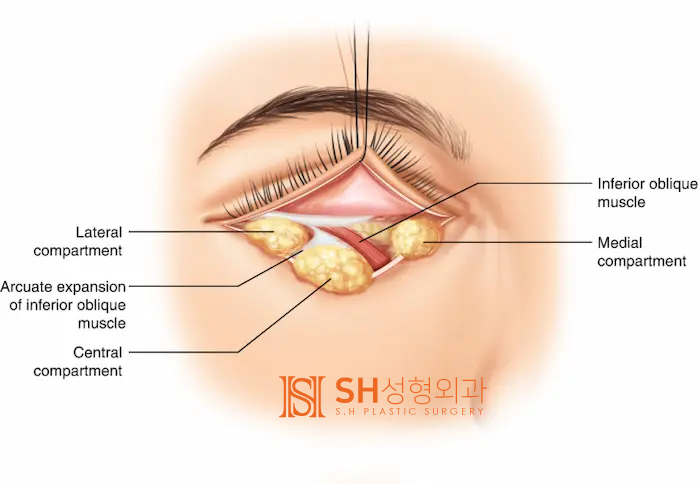
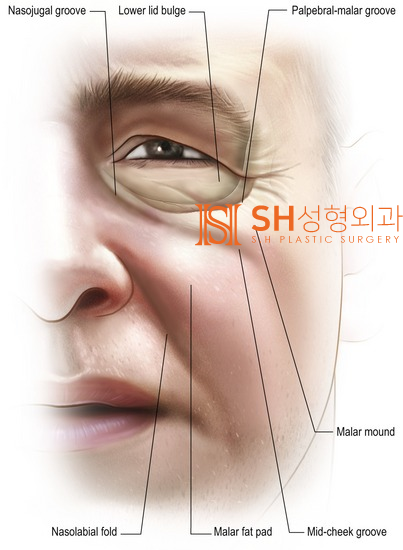
By combining lower blepharoplasty + midface lift:
Undereye bulging is resolved.
Midface cheek sagging is lifted.
Lifting effect naturally extends to the nasolabial fold area.
After Surgery
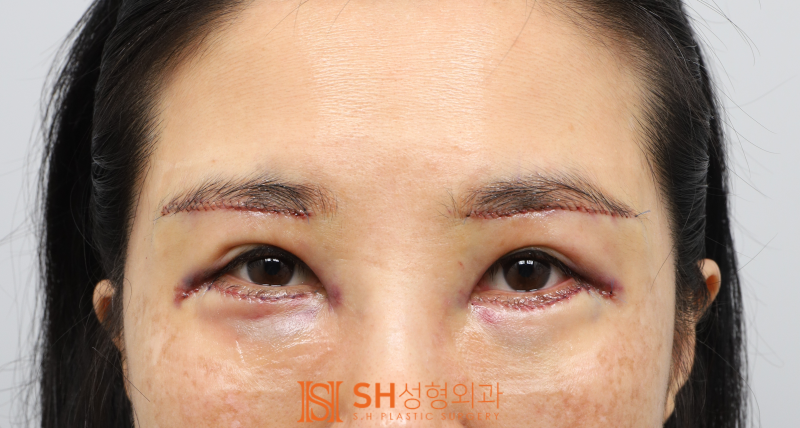
1. Eyebrow Lift
(Eyebrow lift · Correction of sagging eyelids · Covered double eyelids)
2. Epicanthoplasty
(Improvement of Mongolian folds · Alternative to medial epicanthoplasty · Upper face expansion)
3. Lower Blepharoplasty + Midface Lift
(Choice to overcome the limitations of undereye fat repositioning)
The common core message from international facial aging research is one:
‘Eye aging after 50 is not just an eyelid problem, but a problem of midface descent.’
The midface fat pad
is a continuous structure from the undereye – cheekbone – to the nasolabial fold.
If the midface is not lifted together during lower blepharoplasty,
the step-off between the undereye and cheek becomes more prominent.
Therefore, for this patient,
lower blepharoplasty alone would have been an incomplete solution.
<1 Month After>
Dr. Kim Sung-hoon’s Reflection, Face Designer
‘The goal of eye surgery in your 50s
is not to ‘look younger’ but
to achieve a **‘naturally refined impression.’**
The ‘large double eyelid line’ this patient desired
could actually have been the most risky choice in terms of outcome.
I always assess it this way:
Is the double eyelid the problem,
or have the structures above and below it collapsed?
This surgery
was not about enlarging the eyes,
but about reorganizing the structures around the eyes.
Therefore, even with time,
it won’t be excessive or collapse.’

FAQ
Q1. Is it common for people in their 50s not to have incisional double eyelid surgery?
Yes. It is often not recommended depending on skin thickness and the degree of sagging.
Q2. What is the biggest difference between an eyebrow lift and upper blepharoplasty?
Upper blepharoplasty is a surgery to create a double eyelid line,
an eyebrow lift is a surgery to tidy up sagging skin.
Q3. Can’t I just have undereye fat repositioning?
When midface sagging is also present, its limitations are clear.
Q4. Isn’t lower blepharoplasty + midface lift too major a surgery?
The more structural the cause of aging, the more fundamental this choice becomes.
Q5. How long is the recovery period?
Return to daily life is 2-3 weeks, and natural stabilization is around 3 months.
Q6. Is this complex surgery necessary for everyone?
No. It must be decided after a thorough anatomical diagnosis.
Consultation Inquiry
KakaoTalk Channel - SH Plastic Surgery Clinic