2025-11-21
#19 Revision Rhinoplasty Side Effects and Cases: When is it Possible and How Can it Change?
Revision rhinoplasty is a complex procedure to correct issues from a previous surgery. This article covers timing, methods, materials, and challenging cases like short nose, contracture, and cartilage depletion, offering realistic, evidence-based information for patients.
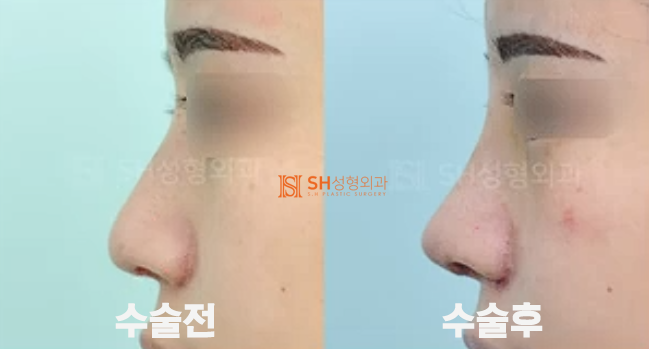
Revision rhinoplasty is a highly complex surgery that aims to correct problems not resolved by a single initial procedure. Shortened nose, lowered nasal tip, contracted nose that has pulled upwards, cartilage absorption, implant visibility, inflammation, and increased scar tissue are common changes that gradually appear over time after the primary surgery. Revision rhinoplasty is not simply ‘a surgery to replace an implant,’ but rather a process of reconstructing damaged structures. Numerous conditions must be considered, including the feasible timing for revision, methods, material selection, tissue condition, and skin laxity. Dr. Kim Sung-hoon of SH Plastic Surgery defines revision rhinoplasty as ‘a surgery to redesign’ and ‘a process to restore the internal laxity of the nose,’ explaining stable revision strategies based on human-derived tissues (autologous costal cartilage, donated costal cartilage, dermis, temporalis fascia, etc.). Today, we will cover everything from the possible timing for revision, limitations of repeated surgeries, difficulty of revision, and even highly challenging cases encountered in clinical practice, such as contracted nose, scar tissue, and cartilage depletion, to provide the most realistic and evidence-based information to patients considering revision rhinoplasty. Dr. Kim Sung-hoon, Facial Designer.
‘Doctor… my first surgery was fine, but over time, my nose shape has gradually changed. It's shorter than before, and my nasal tip pulls up when I smile.’
This was shared by a female patient in her 30s.
The problems that appeared over time after her primary surgery were as follows:
- Absorption of nasal tip cartilage
- Implant displacement
- Increased scar tissue
- Upturned nasal tip
- Hardness of the nasal bridge (initial signs of contracture)
What was more uncomfortable than her appearance was the ‘awkwardness of her face.’
She said the most stressful part was that her nose didn't move with her expressions, and her skin felt tight when she smiled.
What she wanted was not a higher or more glamorous nose, but normal movement and naturalness that suited her face.
Therefore, revision rhinoplasty becomes an option for ‘recovery’ and ‘restoration,’ not for cosmetic ambition.
When is revision rhinoplasty possible?
Many patients ask:
‘Is revision surgery possible after just 6 months?’
The answer is:
‘After 6 months, it merely means it ‘might be possible,’ not that it’s unconditionally possible.’
This is because revision surgery is determined by the tissue condition, not by time.
Conditions for possible revision rhinoplasty:
- The nasal skin should move softly.
- Scar tissue at the nasal tip/columella should have softened.
- The internal tissues should move relatively freely.
- The boundaries of the implant, cartilage, and scar tissue should be palpable.
Cases where revision surgery is ‘impossible’ even after 6 months:
- The inside of the nose is hard and immobile.
- Scar tissue is firmly attached.
- The skin is thinned and lacks elasticity.
- Signs of contracture are progressing.
In such cases, forcibly performing revision surgery carries a risk of skin necrosis, implant visibility, and worsening contracture.
Exception! Cases requiring immediate revision surgery even before 6 months:
- Occurrence of inflammation
- Implant protrusion
- Sudden upturning of the nasal tip
- Redness or warmth in the nose
In these situations, the nose should not be reconstructed immediately.
Only the removal of the cause (implant removal, drainage of inflammation) should be performed first.
How many times can revision rhinoplasty be performed?
To put it simply:
If the skin and cartilage can withstand it, it's possible three or even four times.
However, there are conditions:
- There must be sufficient skin remaining.
- Blood supply must be well maintained.
- Internal tissues must have enough laxity to withstand revision surgery.
In other words, the ‘condition of the tissue,’ not the ‘number of times,’ determines the limitation.
Dr. Kim Sung-hoon always explains to patients:
‘This surgery must be the last. Revision surgery is a process of making it ‘never collapse again,’ not ‘prettier.’’
The biggest difference between revision rhinoplasty and primary surgery
1) How much skin and cartilage are ‘preserved’
The most important aspect of revision surgery is not technique, but tissue preservation.
- Minimizing skin thinning
- Preventing further cartilage atrophy
- Minimizing blood flow damage
- Avoiding unnecessary creation of more scar tissue
Especially with repeated surgeries, the skin undergoes **atrophy (scar contraction)**, becoming thinner and harder.
Therefore, in revision surgery, simply suturing is not enough.
First securing skin laxity is an essential process.
2) Dermis, fascia, and autologous tissue augmentation are key
If the skin is thinned, posing a risk of implant visibility, or if signs of contracture are observed,
- Autologous dermis
- Buttock dermis
- Donated dermis (ADM)
- Temporalis fascia
- Autologous fat
are needed to augment and restore skin thickness and flexibility.
Without this augmentation, revision surgery will lead to a vicious cycle of ‘thinning → visibility → contracture’ again.
Material Selection: Autologous Cartilage vs. Donated Cartilage
- Autologous costal cartilage → Most preferred
- High strength
- Less deformation
- Stable engraftment rate
- Optimal for nasal tip support reconstruction
- Donated costal cartilage → When autologous harvesting is burdensome
- Low risk of infection
- Moderate absorption rate
- Provides structural support
- Ear cartilage · Septal cartilage
- Auxiliary role
- For fine-tuning the nasal tip
- Limited cartilage volume, often insufficient for standalone revision surgery
Common problems requiring revision rhinoplasty
1) Short Nose
Causes:
- Excessive upward rotation of the nasal tip into a 'ski-slope' or 'semi-ski-slope' shape
- Insufficient cartilage support
- Early progression of contracture
- Deformation or absorption of nasal tip cartilage
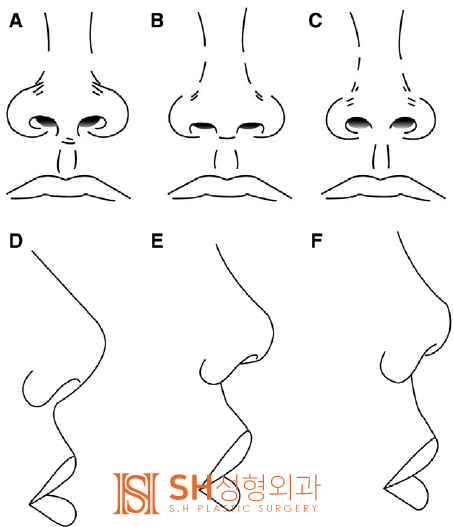
Three Classifications of Short Nose — Based on Frontal and Lateral Views
These are the three classifications of short nose as seen in frontal (A–C) and lateral (D–F) photographs.
A and D: Marginal-type short nose — A type where the nasal tip is short, accompanied by an upturned nostril (alar retraction).
B and E: Basal-type short nose — A type where the nasal tip is short, with columellar retraction (columella pulled back and upward).
C and F: Severe short nose — A severe short nose type where the nasal tip is short, and both columellar retraction and alar retraction are present.
Solution:
- Columellar extension
- Reconstruction of nasal tip support structure
- Costal cartilage-based redesign
- Readjustment of nasal tip angle (internal rotation → neutral)
A shortened nose is not simply ‘a surgery to lower it,’ but a reconstructive surgery to redesign its length.
2) Lowered Nasal Tip
Causes:
- Cartilage warping
- Partial cartilage absorption
- Cartilage displacement
- Weakening of support structure
Solution:
- Reconstruction of nasal tip support structure
- Correction of cartilage direction
- Cartilage augmentation (donated costal cartilage/ear cartilage)
- Reformation of stable nasal tip angle
3) Inflammation → Contracted Nose
Characteristics:
- Nasal bridge is firm and hard
- Nose is pulled upwards
- Implant visibility
- Scar tissue palpable as a lump
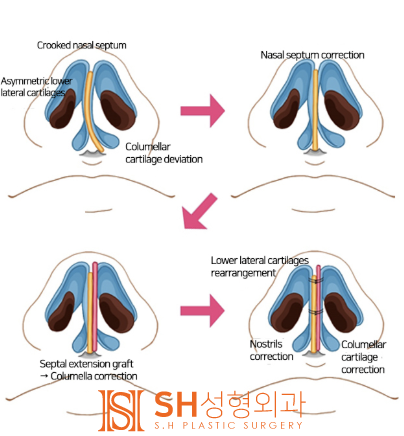
Solution:
- Complete dissection of scar tissue and capsule
- Nasal tip and columellar extension
- Dermis/fascia augmentation if skin is thinned
- Removal of existing implant
- Costal cartilage-based structural reconstruction
Contracture is not a ‘cosmetic surgery’ but falls closest to the realm of reconstructive surgery.
Revision Surgery Case Summary
Case 1. High nasal tip, only low nasal bridge
- Implant insertion only in the nasal bridge
- Sufficient septal cartilage to maintain the nasal tip with patient's own cartilage
- Ear cartilage used to refine the tip line
Case 2. Dissatisfaction with both nasal bridge and nasal tip
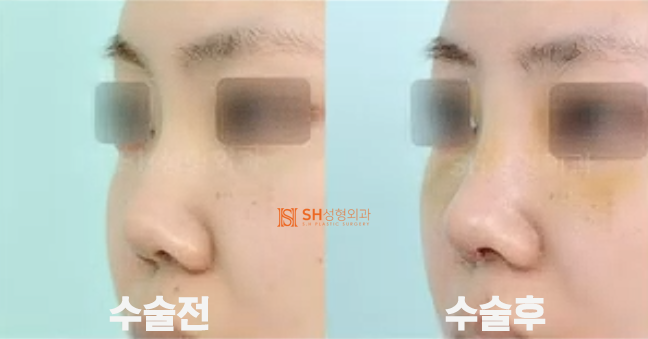
- Nasal bridge redesigned to a more stable height
- Nasal tip reconstructed with donated costal cartilage due to insufficient previous septum
- Finished with ear cartilage
Case 3. Difficulty breathing due to increased scar tissue inside the nose
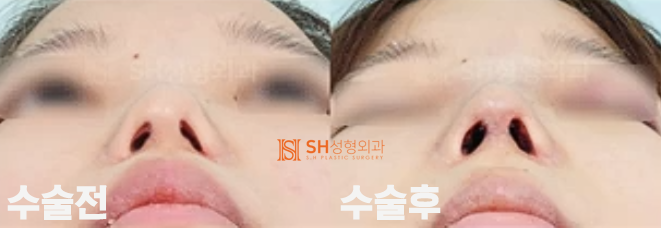
- Scar tissue removal
- V-Y plasty to compensate for skin deficiency
- Nostril expansion → securing airway
Case 4. Severe contracted nose
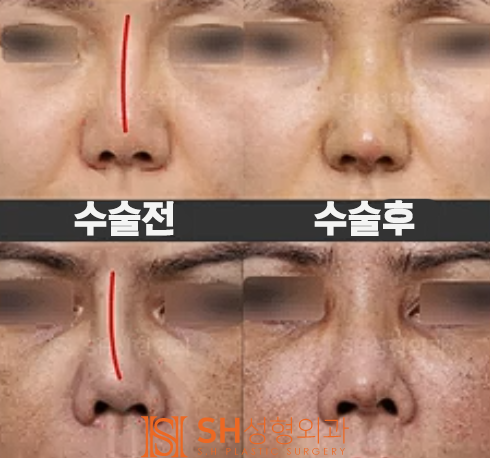
- Implant removal
- Complete removal of scar tissue and capsule
- Skin augmentation with temporalis fascia/autologous dermis/donated dermis
- Nasal tip reconstructed with donated costal cartilage
Dr. Kim Sung-hoon, Facial Designer's Reflection
‘The most important thing in revision rhinoplasty is not how high it is built,
but how safely and durably it can withstand over time.
Revision surgery is not simply a task of correcting shape,
but a process of restoring once-damaged tissue.
Skin laxity, cartilage strength, extent of scar tissue, blood flow status…
All of these must be considered to create a ‘nose that never collapses again.’
Patients considering revision surgery have already experienced trauma once.
Therefore, I prioritize safety over beauty, structure over speed, and long-term stability over temporary satisfaction.’
FAQ
Q1. Is revision surgery always possible after 6 months?
No. It is determined by the tissue condition and the flexibility of the scar tissue.
Q2. How many times can revision surgery be performed?
If the tissue can withstand it, there is no limit to the number of times.
However, it should be planned with the mindset that ‘this will be the last time.’
Q3. Can a contracted nose be fully restored?
Yes, but it is highly challenging.
Scar tissue removal + skin augmentation + cartilage reconstruction are all necessary.
Q4. Is revision rhinoplasty possible without an implant?
Only human-derived materials are recommended for the nasal tip.
For the nasal bridge, it varies depending on the case.
Q5. What is the recovery period?
Swelling takes 2–3 weeks, structural stability takes 3–6 months, and the final line takes 6–12 months.
Q6. Can only the nasal tip or only the nostrils be operated on separately?
Yes. Since the nasal tip/nostrils are independent structures,
standalone surgery is possible regardless of the timing of revision surgery.
#Why is revision rhinoplasty needed? Are there precautions? Everything about revision rhinoplasty! [feat. Dr. Kim Sung-hoon of SH Plastic Surgery]