2025-11-15
#18 Nose Revision Surgery Review: How Much Can It Change?
Nose revision surgery is not just about reshaping; it's a complex procedure to restore collapsed structures and address issues like contracture, short nose, tip show, and implant side effects. Dr. Kim Sung-hoon of Facial Designer Plastic Surgery defines it as 'redesigning, not just rebuilding.' This article uses real cases to explain the changes, limitations, and realistic expectations of nose revision surgery, offering evidence-based answers for those considering revision, contracture nose revi
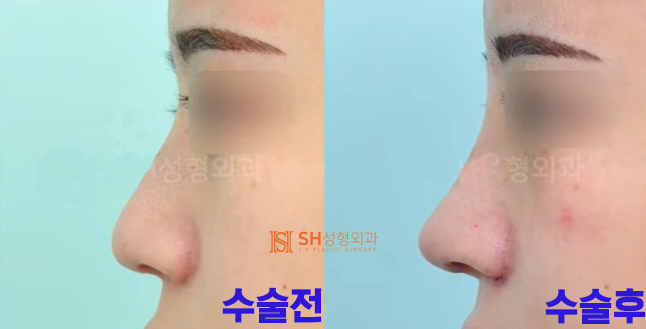
Nose revision surgery is not simply ‘a surgery to reshape.’ It is a highly complex procedure that anatomically analyzes intricate problems such as contracture, a shortened nose, tip show, and side effects from artificial materials due to previous surgeries, and restores collapsed structures. Dr. Kim Sung-hoon of Facial Designer Plastic Surgery defines nose revision surgery as ‘a surgery to redesign, not just rebuild.’ He presents an approach that prioritizes structural stability and long-term harmony, focusing on human-derived materials. This content explains the changes, limitations, and realistic expectations of nose revision surgery based on actual cases. It provides evidence-based answers for those considering nose revision surgery, contracture nose revision, tip reconstruction, or human tissue-based revision. Dr. Kim Sung-hoon, Facial Designer Plastic Surgery
‘It was fine at first, but over time, my nose became shorter.’
‘Doctor, my nose is gradually turning up. It feels so awkward because my nasal tip curls upwards every time I smile.’
This was the story a 35-year-old female patient cautiously shared.
Four years prior, she had undergone rhinoplasty at another hospital, a case where both silicone implants and artificial materials were used.
At the time, she was satisfied with the height, and the reactions from those around her were positive.
However, as time passed, her nasal tip gradually turned up,
and she began to feel an unstable sensation where her nasal tip moved when she smiled.
Her skin became thinner, and she was bothered by a visible white silhouette.
For this patient, nose revision surgery was not chosen ‘to become prettier’ but
‘to return to a comfortable face.’
Ultimately, the essence of nose revision surgery is not aesthetics but restoration and recovery.
It is about rebuilding collapsed structures and stabilizing an unstable state.
That is why I call nose revision surgery ‘a process of redesigning, not just rebuilding.’
Nose revision surgery is not a matter of ‘height.’
Many people say this when consulting for nose revision surgery:
‘Doctor, the height is the same, but my nose looks strangely upturned.’
‘My nasal tip seems shorter than before.’
In fact, this problem stems not from ‘height’ but from structural fatigue and deformation.
Typical problems that appear after the first surgery are as follows:
Nose Revision Cases
Shortening of the nose (Short Nose)
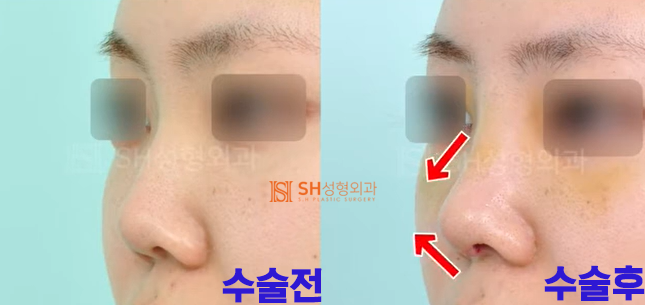
There are two reasons why a nose might shorten:
One is complications during the surgical process,
the other is changes resulting from design choices.
Especially if the nose shape in the first surgery was created in a ‘semi-up-turned’ or ‘straight-up-turned’ style,
instead of the nasal tip lengthening, an upward force is created, which can lead to the nose appearing ‘shorter’ over time.
In nose revision surgery,
by rebuilding (extending) the length of the columella,
stabilizing the angle of the nasal tip, and
restoring a strong support structure for the nasal tip,
a shortened nose can be restored to a natural and refined shape.
Solving a shortened nose is not about ‘lowering the nasal tip’ but about ‘designing its length and rebuilding it.’
Lowering of the nasal tip
There are various reasons why the nasal tip might lower over time after surgery:
The cartilage supporting the nasal tip may bend over time.
The cartilage used may be partially absorbed.
The position of the cartilage may shift or collapse.
All three of these stem from insufficient support.
In revision surgery,
by rebuilding the support for the nasal tip and
securing a stable angle and height,
a lowered nasal tip can also be reconstructed into a natural and harmonious form.
For the nasal tip, ‘making it withstand’ is more important than ‘making it higher.’
Contracted nose due to inflammation
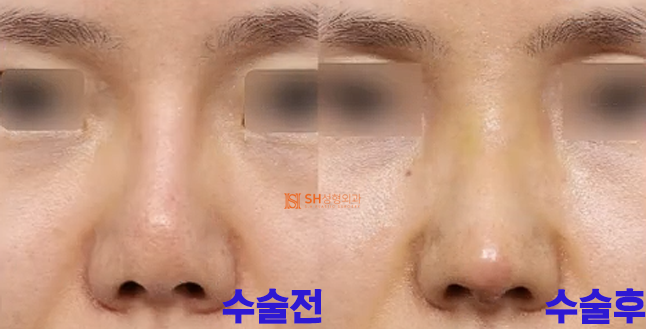
A severely contracted nose is the most challenging case among revision patients.
When inflammation occurs, a hard scar capsule forms around the nasal bridge,
and this scar pulls the nasal tip upwards, causing the nose to curl up.
Its characteristics are as follows:
The nasal bridge becomes hard and stiff.
The skin appears sunken and depressed inwards.
The nasal tip curls upwards, becoming short and blunt.
In such cases, revision surgery must
accurately dissect and remove the existing capsule and scar tissue,
sufficiently extend the length of the nasal tip and columella, and then
redesign the curved line extending from the nasal tip to the nasal bridge.
Contracture cannot be solved by simply ‘raising the nose.’ Accurately clearing the scars and capsule is essential.
Dr. Kim Sung-hoon’s Approach to Nose Revision Surgery
‘Revision surgery is not about creating a beautiful nose again,
but about restoring collapsed structures to regain a nose that harmonizes with the face.’
1. Anatomical Analysis of Failure Causes
Type and position of the implant used
Degree of adhesion and contracture
Skin thickness, elasticity, and blood flow status
Extent of damage to the nasal septum and cartilage support structure
Accurately identifying the anatomical cause determines the direction of revision surgery.
2. Reconstruction centered on human-derived materials
Material selection determines the success or failure of revision surgery.
Autologous costal cartilage: High strength and engraftment rate, most stable for nasal tip reconstruction.
Donated costal cartilage: No burden of autologous harvesting, low risk of infection.
Septal cartilage: Key material for reconstructing the central support pillar of the nose.
While artificial materials are convenient for creating a short-term shape,
they pose risks of inflammation, visibility, and deformation in the long term.
Therefore, I insist on using only human-derived materials for the nasal tip.
3. Redesigning Nose Balance and Angle
Restoration of columella length
Adjustment of the nasal bridge–tip connection line
Adjustment of nasal tip projection and curve
Confirmation of natural movement when smiling
True revision surgery is completed only when all these elements achieve ‘harmony.’
After nose revision surgery, how much can it change?
Looking at the changes in actual patients,
‘a more comfortable facial impression’ is noticed before ‘a changed height.’
Restoration of nose length
Stabilization of nasal tip angle
Natural connection line between nasal bridge and tip
Resolution of skin visibility and contracture
Smooth movement of the nasal tip during expression
However, not all revision surgeries guarantee the same results.
The condition of already damaged tissue, skin thickness, past surgical methods, blood flow status, etc.,
various factors determine the speed of recovery and the extent of the outcome.
That is why I always explain to patients:
‘This surgery should be judged not by ‘how much it can change’ but by
‘how safely it can be maintained.’’
Dr. Kim Sung-hoon of Facial Designer’s Reflection
‘The nose is the center of the face.
But it is not just a simple centerline;
it is a structure that coordinates breathing, expression, and the entire impression.
Considering revision surgery means you have already experienced a wound and anxiety.
Therefore, I approach it with stability first, rather than beauty,
and with a focus on long-term maintenance rather than quick results.
Even after 10 years, even when smiling,
if the feeling of ‘it feels like my own face’ remains, then the surgery is a success.
Revision surgery is not about impatience but requires structural understanding and the aesthetics of waiting.’
FAQ
Q1. How many times can nose revision surgery be performed?
It depends on the extent of tissue damage,
but usually, repeated surgeries more than 2-3 times place a significant burden on skin elasticity and blood flow.
Q2. Can a contracted nose also recover?
Yes. However, depending on the extent of skin and cartilage damage, highly complex structural reconstruction may be necessary.
Q3. Will there be scars after revision surgery?
If columellar incision is required, a subtle scar may remain,
but it is hidden in natural crease lines and fades almost completely over time.
Q4. Is there no possibility of the nasal tip turning up again?
By building sufficient support with human-derived materials and
establishing the correct fixation direction, the possibility of recurrence can be minimized.
Q5. How long is the recovery period?
Swelling and sensation stabilize in about 3 months,
and the final line is completed approximately 6 months later.
Q6. Is the use of artificial materials absolutely not allowed?
It is not recommended for the nasal tip.
However, for the nasal bridge, it can be applied restrictively
depending on the patient’s skin condition and structure.
(128) #When can nose revision surgery be done? Let’s check out #alar reduction for a perfect nose! - YouTube
SH Plastic Surgery Clinic