2026-05-25
Why Donated or Autologous Costal Cartilage is Used in Rhinoplasty!
Learn why costal (rib) cartilage is used in rhinoplasty, the differences between autologous and donated options, and how to balance aesthetics with functional breathing.

Hello.
This is VIBE Plastic Surgery.
Recently, due to psychological anxiety and potential side effects regarding nasal implants,
many people have been curious about methods that allow for surgery without them,
specifically using autologous or donated costal cartilage.
We would like to inform you about everything you might be curious about,
including where costal cartilage is located and the reasons for using it.

Costal cartilage refers to the cartilage of the ribs.
In our bodies, rib cartilage is located in the chest area
to protect vital structures such as the lungs and heart.
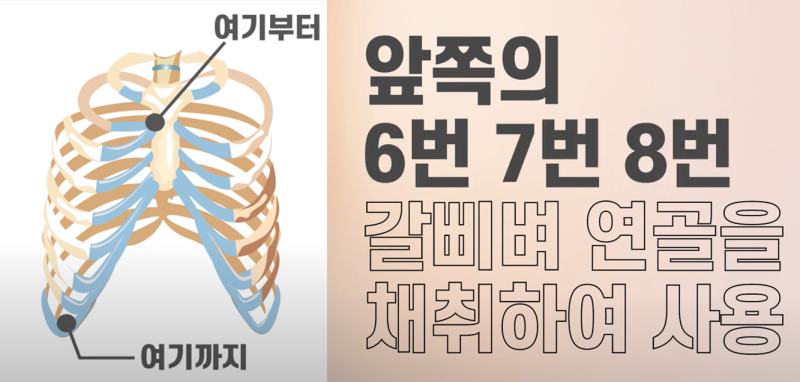
As shown in the diagram, the center and bottom parts consist of costal cartilage,
while the outer parts are composed of bone.
Therefore, in rhinoplasty, cartilage is typically harvested from the 6th, 7th, or 8th ribs at the front.

However, some may be afraid of using their own autologous costal cartilage,
or may feel burdened by the small scar (about 2.5cm to 3cm) it leaves behind.
In such cases, donated costal cartilage—which is harvested from a donor and has undergone full immunological processing—is used as a material.

The characteristics of costal cartilage are that it is large, hard, and strong.
Because of this, using costal cartilage in rhinoplasty is the best way
to achieve a sharp, straight, and well-defined nasal shape.

The first preference is usually septal and ear cartilage.
This is because harvesting cartilage within the surgical field is much more comfortable for the patient,
involves less pain, and allows for a faster recovery in daily life.
However, there are cases where costal cartilage is truly necessary.
If the septal and ear cartilage are too thin and weak, or if they have already been used in previous surgeries,
we believe that costal cartilage should naturally be the choice.

Many patients have a small, blunt, or weak nose but desire a slightly high, sharp ‘straight-semi-basal’ line.
In these cases, using costal cartilage is necessary to expect high satisfaction.

Costal cartilage has a curved rather than a straight shape.
Consequently, the smaller it is cut, the more likely a ‘warping phenomenon’—where the cartilage itself bends slightly—may occur.
Even if it looks quite straight during surgery, if it warps over time,
it can lead to the side effect of the nose leaning to one side.
Additionally, because costal cartilage is harder than other types of cartilage,
it can be disadvantageous in terms of tactile feel.
While these reasons cause concern, we do not believe it is a material that should never be used.

The most important thing not to overlook in rhinoplasty is the functional aspect.
Since the nose is ultimately a structure for breathing,
even if the shape is beautiful, if breathing becomes uncomfortable or difficult,
that method should be avoided.
Therefore, do not only focus on the shape of the nose during rhinoplasty;
you must choose the appropriate type of cartilage while considering functional aspects as well.

It is difficult to definitively say whether costal cartilage is ‘good’ or ‘bad’.
It can be an excellent choice if used correctly according to the patient’s needs.
If you are having difficulty choosing materials for your rhinoplasty,
please visit VIBE Plastic Surgery for a precise diagnosis via 3D-CT
to improve both functional and aesthetic aspects together.




