2026-07-27
Forehead Reduction Surgery Textbook Content Revealed - Key Anatomical Techniques to Lower Side Effects and Enhance Forehead Reduction Perfection
Dr. Woo-Hyun Tak, a professor at Yonsei University College of Medicine and head of Tailor Plastic Surgery, shares excerpts from his textbook on forehead reduction surgery. This article details the procedure's indications, process, and complications, emphasizing anatomical precision to minimize side effects and achieve natural-looking results.
Hello, I am Dr. Woo-Hyun Tak, a professor at Yonsei University College of Medicine, Department of Plastic Surgery, and the director of Tailor Plastic Surgery.
This article explains the core indications, surgical process, and complications of forehead reduction surgery based on university textbook standards.
While lecturing as a professor at Yonsei University, I also participated in writing a textbook on hair science. Today, I would like to introduce a part of the forehead reduction chapter that I personally authored.
Textbooks are literature for medical professionals and are not easily accessible to the general public. However, I hope that explaining some of the content will be of practical help to those considering forehead reduction surgery.
Forehead reduction surgery is often mistakenly thought of as simply lowering the hairline. However, it is a very delicate anatomical technique that requires complex consideration of scalp blood flow, laxity, future hair loss potential, and individual hairline shape. Below, I will summarize the key points to reduce side effects based on the textbook content.
1. Introduction to Forehead Reduction Surgery and Basic Anatomical Concepts
Forehead reduction surgery is a cosmetic plastic surgery procedure that reduces the vertical length of the forehead by advancing the hair-bearing scalp forward to improve a wide forehead or high hairline. Academically, it is also known as hairline lowering surgery or reduction foreheadplasty. Beyond simply reducing the external appearance, its ultimate goal is to improve the proportions of the upper, middle, and lower face and create a youthful and balanced impression.
This procedure was independently reported to the academic community in 1999 by Marten and Guyuron, respectively, and evolved from the brow lift technique originally used to shorten large foreheads. Currently, the combination of trichophytic incision and posterior scalp advancement has become the global standard procedure.
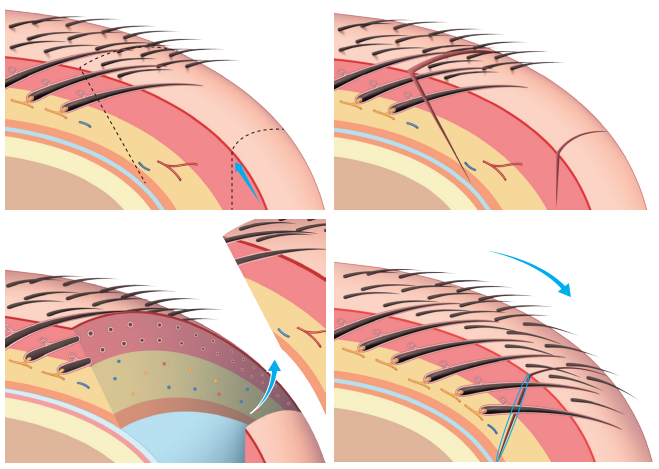
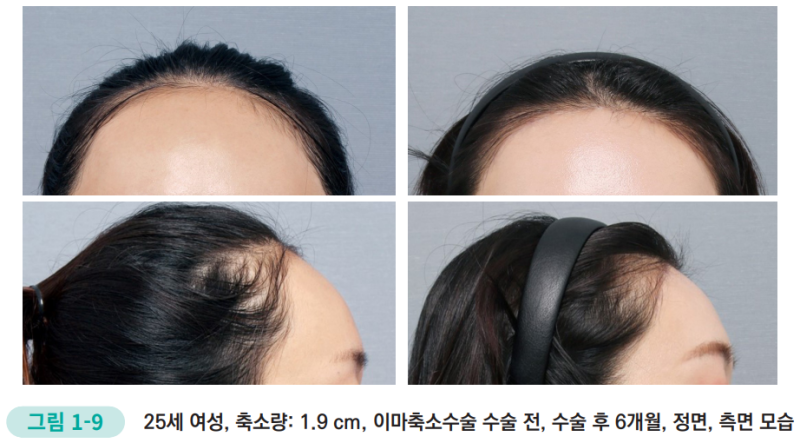
The most important factor when planning forehead reduction surgery is the patient's individual scalp condition. Patients with sufficient scalp laxity and hair density are ideal surgical candidates. It is primarily requested by female patients with congenitally wide foreheads and can also be applied to men without a risk of hair loss or patients undergoing gender-affirming surgery.
The average advancement amount reported in academic papers, primarily focusing on Caucasians, is known to be about 2cm. However, a recent systematic review and meta-analysis of over 800 patients reported an actual average reduction of 1.6cm (95% confidence interval 1.4-1.8). This result is slightly less than the commonly known 2cm and may be due to differences in surgical techniques or the scalp laxity characteristics of Asian patients, thus requiring precise expectation management with the patient before surgery. If an excessive reduction of more than 3cm is required, the use of a tissue expander must be considered.
2. Nine Essential Indications to Check Before Surgery
These are the nine pre-considerations established in the textbook for safe results.
① Hair Density and Thickness
Since the principle involves stretching and lowering the scalp flap, the hair density from the hairline to the crown will anatomically decrease. The average reduction rate is expected to be about 5-10%. While individuals with normal hair density may not perceive this change significantly, it can be quite noticeable for patients with congenitally extremely fine or low-density hair, requiring careful diagnosis beforehand.
② Hair Direction at the Hairline
This is the most precise area to examine to prevent hair loss and scar exposure at the hairline after surgery. Sometimes, ‘cow-lick hair’, which lies completely flat backward, is present at the hairline.
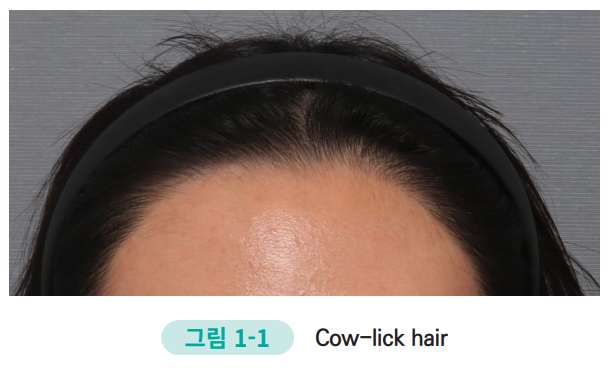
In this case, it is important to recognize that the hair roots (follicles) are located further forward than their visible position. Therefore, the design must be moved further back, and the incision should begin at least from the area where the hair stands straight vertically, to enable a trichophytic incision that preserves the hair follicles. If the hair direction is ignored during design, permanent hair loss will occur behind the scar after surgery, leading to the scar being fully exposed as a side effect.
To aid understanding, typical ‘forehead reduction surgery’ is like an extended form of ‘subbrow lift’, but if applied excessively to individuals with cow-lick hair, it can result in visible scars accompanied by hair loss, similar to a ‘suprabrow lift’.
③ Scalp Laxity and Gliding Test
In actual clinical practice, individual scalp elasticity varies greatly, from 0.5cm to 3cm. The ‘gliding test’, which involves grasping the scalp near the hairline and moving it vigorously back and forth, is used to predict this before surgery. In my clinical experience, the results of this test almost accurately match the findings observed during actual surgery.
Adding multiple galeotomies can achieve an additional advancement of about 2-3mm, but it does not change the overall picture. Accurate prediction requires skilled experience, and the more accurate the prediction, the less likely one is to be flustered in the operating room. For less experienced surgeons, it is recommended to prepare multiple design stages safely or to perform tissue resection as the final step.
④ Family History of Hair Loss (Especially Male Patients)
A family history of hair loss in men strongly tends to follow the genetic patterns of the father, brothers, and maternal grandfather. Therefore, for male patients with a clear family history, there is a risk that hidden scars may become externally exposed as hairline hair loss progresses later. For this reason, Tailor Plastic Surgery generally does not recommend surgery for such cases.
⑤ Skin and Scalp Color Difference
No matter how precise the incision, a white line of scar will remain after healing. If the patient's skin and scalp color are generally oily and reddish-brown, this white scar line will stand out due to the strong contrast. This also aligns with the principle of brow lift surgery, where scar prognosis varies depending on the surrounding skin color.
⑥ Surgical Suitability Based on Hairline Shape
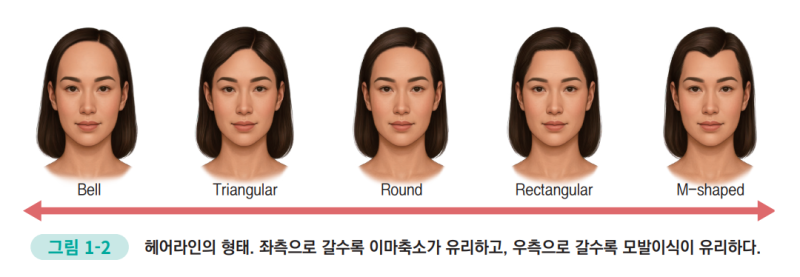
The procedure maintains the existing hairline shape while lowering it in parallel. Therefore, a ‘bell-shaped’ hairline that curves upward is most suitable for surgery. Conversely, patients with an M-shaped or square forehead are at a disadvantage because forehead reduction alone will emphasize the square appearance. In these cases, hair transplantation alone or in combination is much more aesthetically advantageous.
⑦ Simultaneous Forehead Lift and Reduction
If the forehead is very wide and there is severe eyebrow ptosis requiring a simultaneous forehead lift, both surgeries can be performed together through a pretrichial incision. An advantage of this is that the amount of forehead reduction that can be achieved is additionally secured by the amount the eyebrows are lifted (approximately 3-5mm) through the forehead lift.
⑧ Indications for Revision Surgery
Patients who have already undergone a primary surgery but desire further reduction may also be candidates for revision surgery. However, the amount that can be reduced in revision surgery is limited to about half (1/2) compared to the first surgery. It is generally recommended to perform revision surgery after a sufficient interval of at least one year to allow for scalp tissue stress and optimal adjustment of posterior scalp blood flow.
⑨ Absolute and Relative Contraindications
Absolute Contraindication: A history of surgery involving a bicoronal incision. Severe ischemia can occur in the scalp tissue between the reduction incision and the existing bicoronal incision, leading to extensive hair loss or skin necrosis.
Relative Contraindication: Recent hair transplantation via the follicular unit transplantation (FUT) method. Since scalp blood flow in the crown and occipital areas is reduced, I personally recommend waiting at least one year for recovery before surgery.
3. Design
Traditional literature describes a design that aggressively removes villous hair (shaggy hair) and deeply penetrates into the temporal recession to hide the scar within the hair.
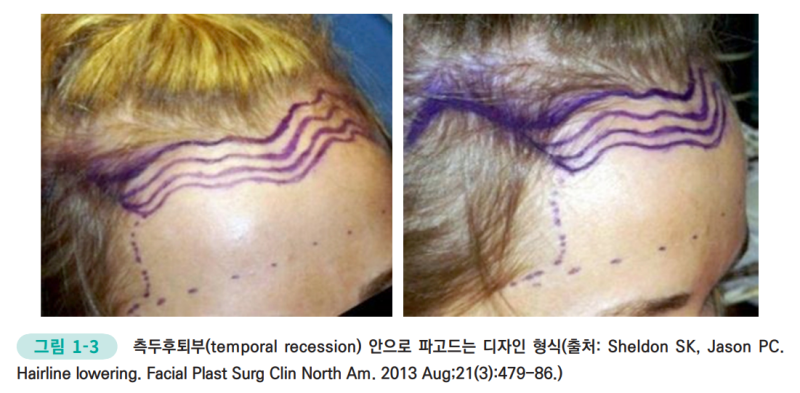
However, for female patients, applying this method often leads to cosmetic dissatisfaction, as the hairline can become excessively angular and square after surgery.
Therefore, in my practice, for female patients, I design a gentle curve while preserving the natural fine hairs of the forehead as much as possible. Even if the incision line is somewhat exposed outside the temporal region, by meticulously performing subcutaneous layer suturing and completely eliminating tension on the incision line, the original rounded hairline can be maintained with almost invisible scars after recovery.
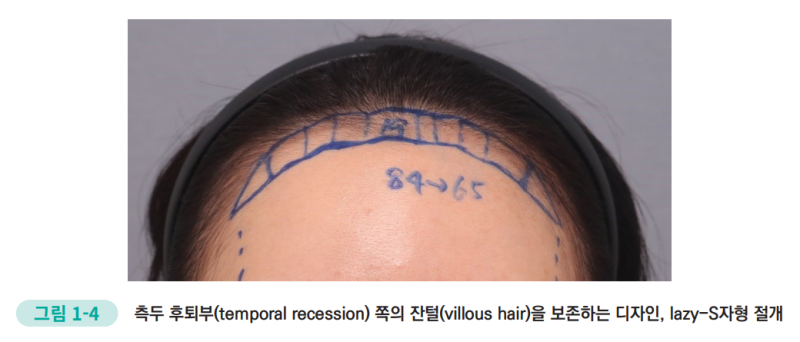
4. Step-by-Step Forehead Reduction Surgery Process to Minimize Side Effects
This section of the textbook covers the entire surgical process from anesthesia to suturing in a step-by-step educational manner, but due to confidentiality, it will be omitted. I will briefly describe only the fixation aspect, which patients are most curious about.
Progressive Tension Suture Fixation: Two-Row Tunneling Fixation
When advancing the scalp flap and fixing it to the bone, academic studies have shown no significant differences in complications or reduction amount between using absorbable implants (Endotine, FixTine) and cortical tunneling fixation. Implants are a simple method for novice surgeons with insufficient technical skills, but they have disadvantages such as material cost burden and long-term foreign body sensation for the patient. Cortical tunneling requires separate tunneling equipment and a learning curve to master the technique, but it has the advantages of relatively lower material costs and, most importantly, no foreign body sensation for the patient.
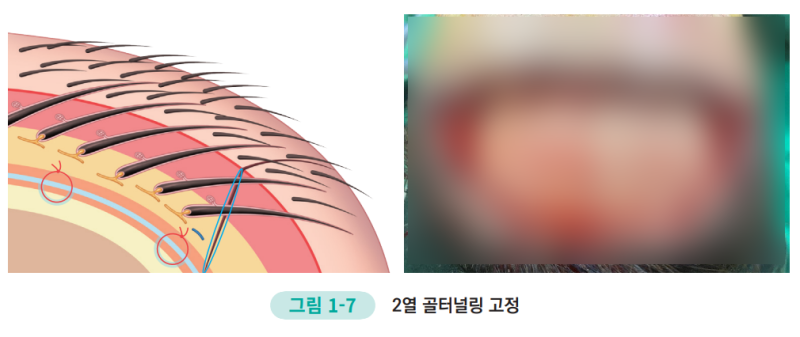
I apply a fixation method that increases the number of fixation points and gathers the scalp medially to create a rounded hairline. More specifically, I use a ‘two-row fixation method’ that applies the progressive tension suture fixation commonly used in abdominoplasty to the scalp, performing 2-3 additional cortical tunnel fixations in an area 2-3cm posterior to the main hairline incision. This significantly reduces the tension on the skin incision site, allowing the scar to heal beautifully without widening and contributing to hematoma prevention.
When performing cortical tunneling, it is better to use a burr instead of a drill. Most surgeons use a 1.4mm microburr, but I use a 1.2mm microburr, which allows a PDS 0 suture to pass through while creating the smallest possible hole. With a 1.2mm burr, if it penetrates beyond a certain depth (about 3mm), the depth is automatically controlled due to the head thickness structure, ensuring safety. The suture is passed through this micro-hole for fixation.
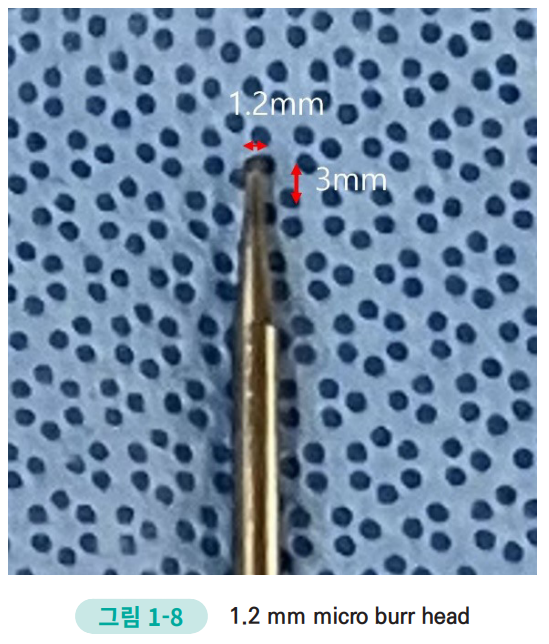
5. Systematic Post-Operative Management Protocol
Dressing: If the surgery was performed within the predictable range of fluidity without excessive tension, the dead space for internal hematoma accumulation is completely blocked. Therefore, strong elastic bandage compression dressings, which can be uncomfortable for the patient, are not necessary at our clinic.
Pain Control: Patients may complain of pain if excessive galeotomy and high scalp tension are required, so appropriate advancement planning is crucial.
Return to Daily Life: Sutures are removed 7-10 days after surgery, and excessive exercise that raises scalp blood pressure is restricted for one month.
Inclusion Cyst Management: When hair grows out from the trichophytic incision site, weak hairs may fail to penetrate the skin, causing ingrown hair-like cysts. This is a normal part of the healing process that often occurs within 6 months after surgery and improves within a week after micro-drainage, removal of ingrown hair, and a small injection of triamcinolone solution diluted 1:10 with saline.
Scars and Laser: Patients are encouraged to consistently apply silicone scar ointment for 6 months. Fraxel laser may be helpful for stitch marks or subtly uneven scars, but it must be applied very restrictively and precisely due to the risk of damaging surrounding hair follicles.
6. Clinical Surgical Cases
Case 1 (Female Patient)
Case 2 (Male Patient)
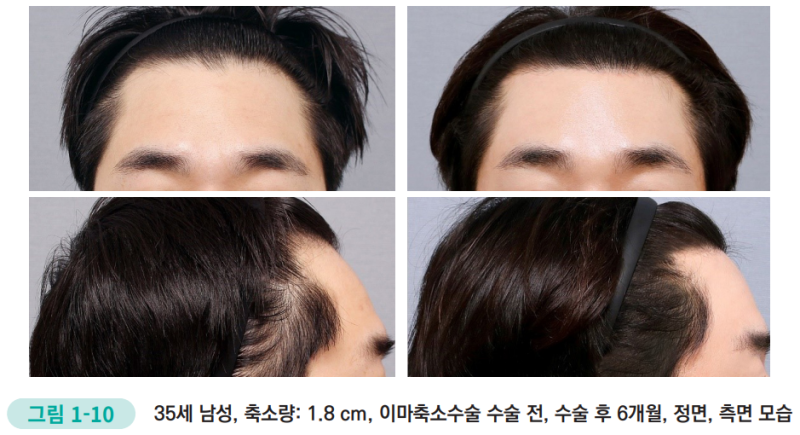
Case 3 (Patient with Combined Forehead Lift)
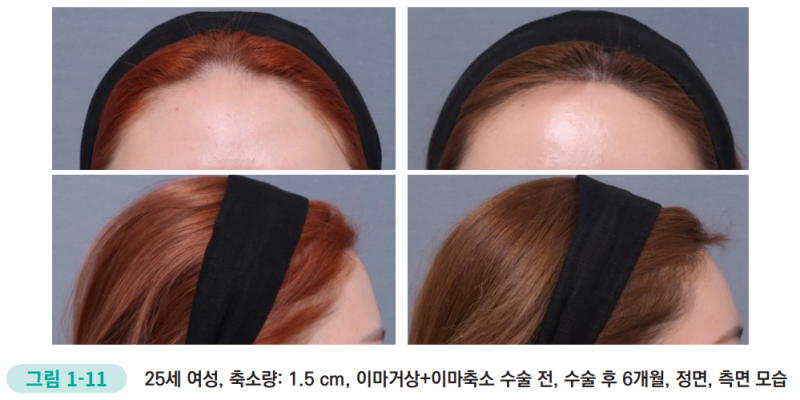
7. Academic Data-Based Complications and Side Effects
According to large-scale meta-analysis results, the incidence of major complications was all less than 1% when standard techniques were followed.
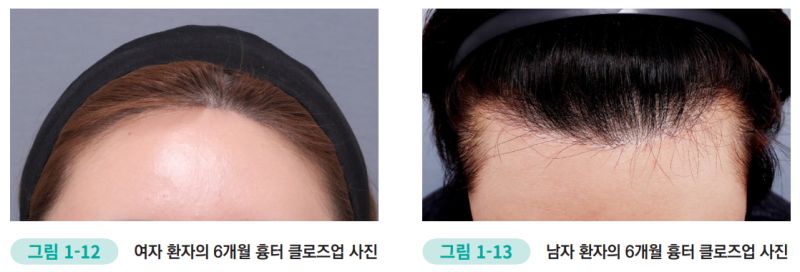
Poor Scarring: This is the biggest concern for patients in clinical practice. However, by selecting appropriate indications, using a two-row fixation method to reduce incision line tension, and applying multi-layer suturing that does not damage hair follicles, the frequency of dissatisfaction with scars is low. For patients with an extremely low psychological threshold for scars, it is safer to thoroughly discuss the possibility of micro hair transplantation around the scar line beforehand.
Hair Loss: This is not a common side effect if excessive galeotomy is avoided and tension is distributed. If the direction of ‘cow-lick hair’ is perfectly understood and designed as mentioned earlier, the risk of permanent hair loss is almost nil. However, patients must understand that due to the surgical mechanism, the scalp near the crown is pushed down, so a 5-10% reduction in hair density in that area is an anatomical mechanism, not a side effect. Occasionally, minor temporary telogen effluvium near the incision line usually recovers within 2-3 months with diluted triamcinolone injections.
Persistent Sensory Abnormalities: The incidence of sensory nerve damage is extremely low compared to full forehead lift surgery. The majority of patients recover normal sensation within 1-2 months, and no cases of discomfort lasting beyond 6 months have been reported. Sensory abnormalities in the forehead and crown occur due to damage or stretching of major nerve branches around the eyebrows, which is largely unrelated to forehead reduction. Precise dissection techniques that accurately identify the main nerve pathways must be supported.
Forehead reduction surgery is not simply about reducing the forehead by a large numerical amount. A natural hairline without scar concerns can only be achieved by clearly understanding the limitations of the patient's scalp, calculating the angle of hair follicles, and employing an anatomical approach that distributes tension. We promise to continue providing safer and more precise medical services by linking academic research with clinical practice.
자주 묻는 질문
이마축소술은 어떤 수술인가요?
이마축소술은 넓은 이마나 높은 헤어라인을 개선하기 위해 모발이 있는 두피를 전방으로 당겨 이마의 수직 길이를 줄이는 미용 성형외과 수술입니다. 얼굴 전체의 비율을 개선하고 젊고 균형 잡힌 인상을 만드는 데 궁극적인 목적이 있습니다.
이마축소술의 이상적인 수술 후보자는 누구인가요?
이마축소술의 이상적인 후보자는 충분한 두피 이완도와 모발 밀도를 가진 환자입니다. 주로 선천적으로 넓은 이마를 가진 여성 환자들이 많이 요청하며, 탈모의 위험이 없는 남성이나 젠더 확정 술을 받는 환자들에게도 적용될 수 있습니다.
이마축소술 후 회복 기간은 얼마나 되나요?
이마축소술 후 실밥 제거는 수술 후 7~10일 사이에 시행됩니다. 두피 혈압을 올리는 과도한 운동은 한 달간 제한하는 것이 좋습니다.
이마축소술 후 흉터 관리는 어떻게 해야 하나요?
이마축소술 후 흉터 관리를 위해 실리콘 흉터 연고를 6개월간 꾸준히 도포하도록 권장됩니다. 봉합 실밥 자국이나 미세하게 울퉁불퉁한 반흔에는 프락셀 레이저가 도움이 될 수 있습니다.
M자 이마도 이마축소술이 가능한가요?
M자 형태나 사각형 이마를 가진 환자는 이마축소술만 진행하면 사각 느낌이 더 강조될 수 있어 불리합니다. 이 경우에는 모발이식을 단독으로 하거나 병합하는 것이 훨씬 심미적으로 유리합니다.
이마축소술 시 평균적으로 얼마나 줄일 수 있나요?
학술 논문에 보고된 평균 축소량은 약 1.6cm(95% 신뢰구간 1.4-1.8)입니다. 만약 3cm 이상의 무리한 축소가 필요한 경우에는 조직 팽창기 사용을 필수적으로 고려해야 합니다.
Frequently Asked Questions
What kind of surgery is forehead reduction?
Forehead reduction surgery is a cosmetic plastic surgery that reduces the vertical length of the forehead by pulling the hair-bearing scalp forward to improve a wide forehead or a high hairline. Its ultimate purpose is to improve overall facial proportions and create a younger, more balanced impression.
Who is an ideal candidate for forehead reduction surgery?
Ideal candidates for forehead reduction surgery are patients with sufficient scalp laxity and hair density. It is primarily requested by female patients with naturally wide foreheads, but it can also be applied to men without the risk of hair loss or patients undergoing gender-affirming surgery.
What is the recovery period after forehead reduction surgery?
Stitches are removed 7 to 10 days after forehead reduction surgery. It is recommended to avoid strenuous exercise that increases scalp blood pressure for one month.
How should I manage scars after forehead reduction surgery?
For scar management after forehead reduction surgery, it is recommended to consistently apply silicone scar ointment for six months. Fraxel laser can be helpful for suture marks or slightly uneven scars.
Is forehead reduction surgery possible for an M-shaped forehead?
Patients with an M-shaped or square forehead may find that forehead reduction surgery alone can emphasize the square appearance, which is disadvantageous. In these cases, hair transplantation alone or in combination is much more aesthetically beneficial.
On average, how much can be reduced during forehead reduction surgery?
The average reduction reported in academic papers is approximately 1.6 cm (95% confidence interval 1.4-1.8). If an excessive reduction of more than 3 cm is required, the use of a tissue expander must be considered.