2026-09-07
Yaksu Station Dental Clinic: How Many Implants Are Needed for Full Mouth Implants?
Learn how many implants are typically needed for full mouth restoration, considering factors like bone density, bite, and final prosthesis design.
Hello.
This is Dr. Kim Tae-young, chief director of Barunyoung Dental Clinic at Yaksu Station.^^
When consulting for full mouth implants, there's a question patients ask most frequently:
‘Doctor, how many implants do I need?’
‘If all my teeth are gone, do I need to implant as many implants as there were teeth?’
This is a common question for anyone considering full mouth implants.
To get straight to the point, full mouth implant treatment does not involve placing one implant for each missing tooth.
The number of implants to be placed is determined by comprehensively considering factors such as the amount and condition of the jawbone, the implant placement site, the occlusion of the upper and lower teeth, biting force, habits like teeth grinding or clenching, and the form of the final prosthesis.
Today, we will explore the differences in the number of implants when planning full mouth implants at Yaksu Station, and what aspects are checked when deciding the number of implants.
Full mouth implants are not a treatment where you implant as many as you have teeth.
If a single tooth is missing, typically one implant is placed to replace it.
However, the situation changes when multiple teeth are missing or all teeth have been lost.
Instead of placing an implant in every tooth position, multiple implants can be placed in appropriate locations, and then a full prosthesis can be fabricated by connecting these implants.
Therefore, if 14 teeth are missing, it does not mean that 14 implants must be placed.
What's important is not just how many implants are placed, but where they are placed, where they receive force, and how the final prosthesis is designed.
How many implants are usually placed for full mouth implants?
For full mouth implants, various methods of implant placement are possible, such as 4, 6, 8, or more implants, depending on the patient's oral condition and the final prosthetic plan.
Number of Implants | Generally Considered Cases |
4 or more | Considered under limited conditions, such as when there is insufficient bone for a sufficient number of implants, difficult placement, or weak opposing occlusal force. |
6 or more | Considered as a benchmark when planning a fixed full prosthesis that does not restore the rearmost molars. |
8 or more | Considered when restoring a wider range of teeth under sufficient jawbone and stable occlusal conditions. |
However, 4 is not necessarily insufficient, and 8 is not always superior.
The appropriate number of implants can vary depending on the patient's jawbone condition, occlusion, biting force, the range of teeth to be restored, and the form of the final prosthesis.
Is it okay to place only 4 implants?
During full mouth implant consultations,
There are cases where surgery is difficult due to insufficient bone to place a sufficient number of implants. In such cases, there is a method called ‘all-on-X’ where 4-5 implants are placed, followed by prosthetics, but this is not generally recommended.
Especially when there is insufficient jawbone making implant placement difficult, or when the rearmost molars are not being restored, a method of supporting the prosthesis with 4-5 implants can be considered.
Furthermore, it can be included in the treatment plan if the opposing arch uses dentures or if the occlusal force with natural teeth is not strong.
However, the important thing is not simply reducing the number of implants.
It is necessary to confirm whether the 4 implants can achieve sufficient initial stability, whether the placement positions and spacing are appropriate, and whether they can stably distribute the forces applied to the final prosthesis.
Therefore, rather than uniformly deciding that ‘4 implants are sufficient,’ it is about making the best diagnosis for the current situation. However, if there is sufficient bone, placing only 4 implants is not recommended for distributing occlusal forces.
In what cases are 6 or more implants considered?
In full mouth implants, placing 6 or more implants can be considered to support a relatively wide range of fixed prostheses.
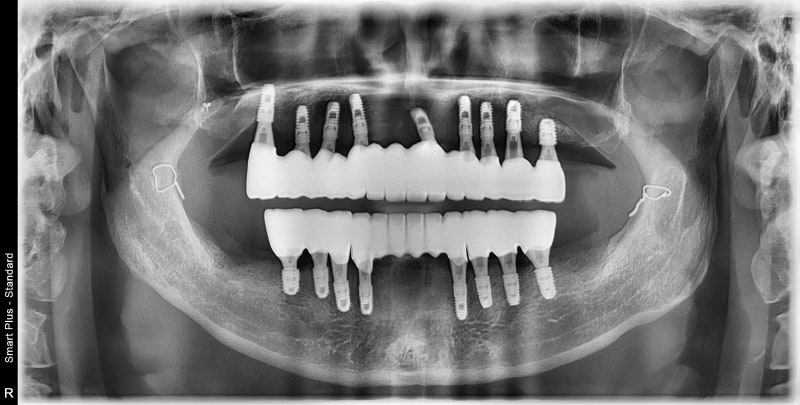
Especially when the rearmost molars do not necessarily need to be restored, 6 implants can be considered as a benchmark for supporting a complete fixed prosthesis.
If the patient's bone condition and occlusal conditions are appropriate, about 6 implants may be planned to restore functionally necessary teeth, excluding the rearmost molars.
However, this does not apply uniformly to all patients.
The number and position of implants required can vary depending on whether the rearmost teeth need to be restored, how strong the biting force is, and whether there are habits like teeth grinding or clenching.
In such cases, for molars, it may be necessary to place an implant for each tooth.
Ultimately, what's important is not the number 6 itself, but where the implants are placed and how the final prosthesis is designed.
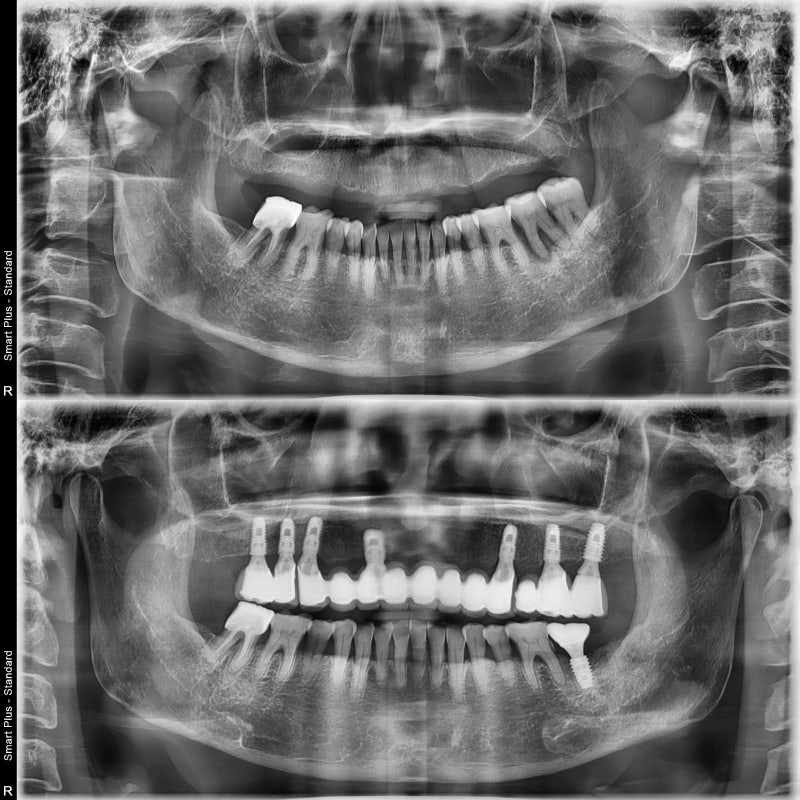
In actual patients, even when the rearmost molars were treated, if there was insufficient bone in the anterior region, the procedure might be carried out by maximizing the implant angle and distributing occlusal forces in this manner.
In what cases are 8 or more implants considered?
If there is sufficient jawbone, good conditions for implant placement, and stable occlusion, a method of placing 8 or more implants to plan a full prosthesis can also be considered.
Increasing the number of implants provides more support points for the prosthesis and can help distribute biting forces across multiple implants.
Especially if sufficient jawbone is secured and a wider range of teeth, including the rearmost molars, needs to be restored, placing 8 or more implants can be considered.
It is important to have sufficient bone, be able to place each implant in the appropriate position, and construct a structure that is easy for the patient to manage the implants and prostheses long-term.
Ultimately, it is important to place the appropriate number of implants in the necessary positions and create a prosthesis that can be used stably for a long time.
For this patient, the rearmost molars were excluded from the diagnosis because the bone condition was not good at the time of surgery. However, since he is male and has a developed jaw, implants were placed at each tooth position in the molar area.
Thus, because each person's oral cavity, habits, and other conditions differ, the diagnosis will also differ accordingly.
How is the number of implants determined?
When determining the number of implants for full mouth implants, the following factors are comprehensively checked:
1. Amount and condition of jawbone
Bone is needed to stably support the implants.
The height, width, and quality of the bone are checked, and the implant placement site is determined.
If necessary, bone grafting may be performed first or simultaneously with implant placement.
2. Implant placement site
Not only the number of implants but also where they are placed is important.
Implant positions are planned considering the final tooth position and size, and the direction of biting force.
3. Occlusion of upper and lower teeth
Full mouth implant treatment can involve treating only the upper or lower arch, but also treating both upper and lower teeth together.
The number and position of implants, and the form of the final prosthesis, can vary depending on how the upper and lower teeth meet.
4. Biting force and teeth grinding habits
If a person habitually clenches their teeth strongly or grinds their teeth severely during sleep, greater force can be transmitted to the implants and prostheses.
In such cases, the occlusion must be designed more meticulously, and the number and position of implants must also be considered.
5. Form of the final prosthesis
The number of implants is also closely related to what kind of prosthesis will be fabricated ultimately.
The necessary number of implants and placement sites can vary depending on whether the rearmost molars will be restored and to what extent fixed teeth will be created.
The number of implants can differ between the maxilla and mandible.
The upper and lower jaws have different bone structures, bone quality, and anatomical characteristics.
Generally, the upper jaw has a wider arch and weaker bone, requiring a similar or greater number of implants than the lower jaw.
Especially in the maxilla, anatomical structures like the maxillary sinus exist, making the process of checking the amount of bone available for implant placement crucial.
Conversely, in the mandible, the position of the inferior alveolar nerve canal must be considered.
Therefore, even for the same patient, the number of implants required for the maxilla and mandible can be planned differently.
For example, there are cases where 6 implants are planned for the upper jaw and 4 or 6 for the lower jaw, which varies depending on the patient's bone condition, occlusion, and final prosthetic plan.
Isn't it better to place more implants?
This question is also frequently asked in the clinic.
If the number of implants increases as long as the bone allows, it can help distribute occlusal forces, but in actual clinical practice, various situations must be considered.
The diagnosis is made considering various situations such as narrow spacing between teeth, cases where occlusal force is not strong enough to allow for spaced placement, and economic reasons.
Rather than simply placing as many as possible or the absolute minimum, we focus on how well the patient can maintain and use them for a long time.
Therefore, for full mouth implants, it is important to consider not only the number of implants but also how comfortably the patient can manage them long-term.
When consulting for full mouth implants, I believe it's important to consider not just ‘how many implants to place,’ but also ‘how the patient can use them comfortably for a long time.’
Why 3D CT scans are important before full mouth implant surgery
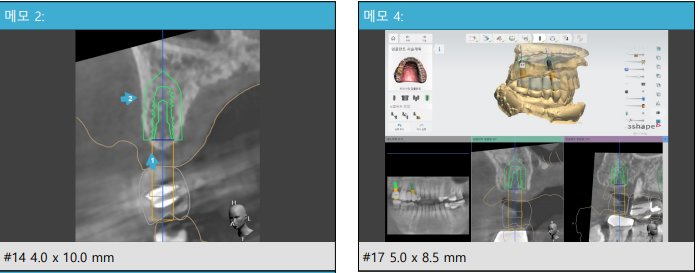
Since full mouth implants require the placement of multiple implants, accurate diagnosis before surgery is crucial.
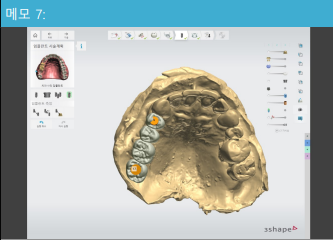
Using 3D CT, it is possible to three-dimensionally check the height and width of the jawbone, bone quality, and anatomical structures such as nerve canals or the maxillary sinus, which are difficult to confirm with conventional X-rays.
Additionally, it can be usefully employed in the production of guided implants.
It also helps plan where to place implants, considering the position of the final prosthesis to be fabricated.
Therefore, for full mouth implants, it is important to first establish an overall treatment plan, including the current jawbone, occlusion, biting force, and final prosthesis, rather than starting with the question ‘how many implants should I place?’
More important than the number of implants is the ‘overall treatment plan’.
It is natural for those considering full mouth implants to be interested in the number of implants.
However, there is no single answer of 4, 6, or 8 that is correct for all patients.
If bone is insufficient and occlusal force is not strong, 4 implants can be considered. If it's a fixed full prosthesis that doesn't restore the rearmost molars, 6 implants can be considered as a benchmark.
Conversely, if there is sufficient jawbone and stable occlusal conditions, and a wider range of teeth needs to be restored, placing 8 or more implants can be considered.
Ultimately, what's important is not placing many implants, but determining the appropriate number and position that suits the patient's oral condition.
To summarize today's content:
✔ Full mouth implants are not a treatment where you implant as many implants as there are teeth.
✔ Various treatment plans are possible, including 4, 6, 8, or more implants.
✔ 4 implants can be considered under limited conditions, such as when there is insufficient bone in the molar area or occlusal force is not strong.
✔ 6 implants can be considered as a benchmark when planning a fixed full prosthesis that does not restore the rearmost molars.
✔ Placing 8 or more implants can be considered with sufficient bone and stable occlusal conditions.
✔ More implants are not necessarily better.
✔ The amount and position of jawbone, occlusion, biting force, and teeth grinding habits must be comprehensively considered.
✔ The form of the final prosthesis and the possibility of long-term management are also important criteria.
✔ It is important to determine the appropriate number of implants for each individual based on precise diagnosis using 3D CT, etc.
In conclusion,
If you've been wondering ‘how many implants do I need?’ while planning full mouth implants, it's better to check not just the number of implants, but also where and how they will be placed given your jawbone condition, and what kind of final prosthesis will be made.
At Barunyoung Dental Clinic at Yaksu Station, we establish a treatment plan after comprehensively checking the patient's oral condition, occlusion, and jawbone state based on precise examinations, including 3D CT.
If you need full mouth implants and are curious about how many implants to place, we recommend accurately checking your current oral condition first.
Which treatment, 4, 6, or 8 implants, is suitable can vary depending on the patient's bone condition, occlusion, and final prosthetic plan. Please confirm the exact number of implants and treatment method through a precise diagnosis.
This was Barunyoung Dental Clinic at Yaksu Station.^^
We believe that proper treatment yields proper results.
We will always do our best to ensure that all who visit can leave with a more comfortable feeling.
Barunyoung Dental Clinic
This post was written in compliance with Article 56, Paragraph 1 of the Medical Service Act for the purpose of providing medical information. All treatments may vary in applicability and treatment process depending on the individual's oral condition, and a treatment plan will be decided after sufficient diagnosis and consultation.
Frequently Asked Questions
Are full mouth implants placed one for each missing tooth?
No. Full mouth implants are not a treatment where one implant is placed for each missing tooth. Multiple implants can be placed in appropriate locations and connected to create a full prosthesis.
How many implants are usually placed for full mouth implants?
The number can vary, such as 4, 6, 8, or more, depending on the patient's oral condition and the final prosthetic plan. It is determined by comprehensively considering factors like jawbone volume, occlusal force, and the extent of restoration.
Is it okay to place only 4 implants?
It can be considered in certain cases. If there is insufficient jawbone, the rearmost molars are not being restored, or the opposing occlusal force is not strong, a method of supporting the prosthesis with 4-5 implants can be considered. However, if there is sufficient bone, placing only 4 implants is not recommended.
How is the number of implants determined?
The number of implants is determined by comprehensively considering the amount and condition of the jawbone, the placement site, the occlusion of the upper and lower teeth, biting force, teeth grinding habits, and the form of the final prosthesis.
Is it better to place more implants?
Placing more implants is not necessarily better. While a greater number can help distribute occlusal forces if bone allows, the optimal number is determined by comprehensively considering the patient's oral condition, economic reasons, and ease of long-term management.
Why is a 3D CT scan important?
A 3D CT is essential for accurately diagnosing and planning implant placement by three-dimensionally checking the height and width of the jawbone, bone quality, and anatomical structures such as nerve canals and the maxillary sinus. It also aids in the fabrication of the final prosthesis.