2026-09-07
Extraction and Implant Placement after Implant Inflammation in Yaksu-dong (Sinus Lift)
This article explains the causes of tooth sensitivity, focusing on severe periodontal disease. It details a case where a patient's tooth required extraction due to inflammation, followed by a sinus lift and implant placement, emphasizing the importance of careful planning and patience for successful outcomes.
Hello,
I am Dr. Kim Tae-young, the head director of Bareunyoung Dental Clinic in Yaksu-dong, and I personally explain the cases we treat.
My teeth are extremely sensitive when I drink water.
Sometimes, when you drink cold water or cold air enters your mouth,
you might often experience tooth sensitivity.
For those who haven't experienced such symptoms in the past,
this sudden discomfort can be a source of great concern.
‘Could I have a cavity in my tooth?’
‘Is this a serious problem that requires treatment?’
You might worry like this.
Tooth sensitivity can occur due to various reasons.
1. Due to tooth abrasion 2. Due to cavities 3. Due to severe periodontal disease
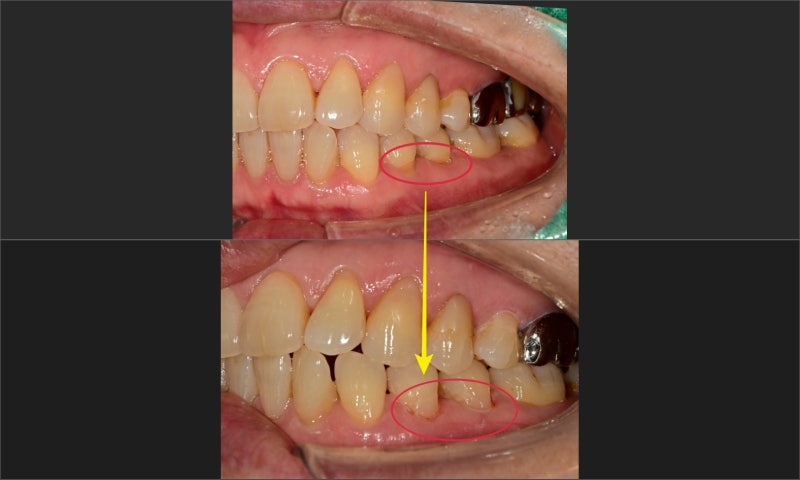
Generally, at the boundary between the gums and the tooth,
the cervical part of the tooth, also known as the neck of the tooth, can fracture due to strong occlusal forces.
When this happens, the pathway to the nerve is exposed to the outside, leading to sensitivity due to irritation.
In such cases, as shown in the picture below, simply covering that part blocks the transmission of stimuli to the nerve,
and the sensitivity immediately disappears.
Symptoms caused by cavities
can naturally be expected to resolve with cavity treatment.
The last cause, and the one we will introduce today, is
when moderate periodontal disease has progressed and the bone surrounding the tooth root has been absorbed due to inflammation.
If the root is exposed to external stimuli, it can be accompanied by severe pain.
In cases where the tooth root is exposed due to periodontal disease, even with gum treatment,
the dissolved bone does not regenerate. Therefore, while treatment to alleviate symptoms is possible,
the prognosis is often poor, and extraction is usually required.
It was a bad tooth in the past, and now it's sensitive when I drink water.
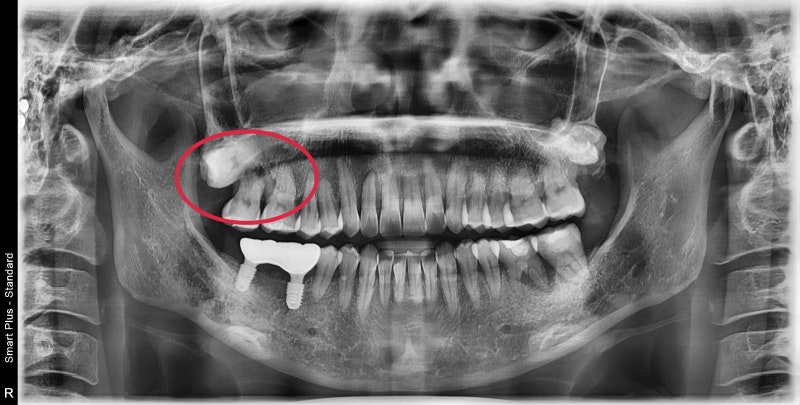
This patient regularly visited our clinic.
Although there was periodontal disease around some roots, there were no major symptoms,
so we were only monitoring the symptoms with gum treatment and regular check-ups.
One day, the patient mentioned that the upper right side, indicated in the picture, was very sensitive to cold water.
Since the X-ray showed signs of inflammation around the root, to confirm it definitively,
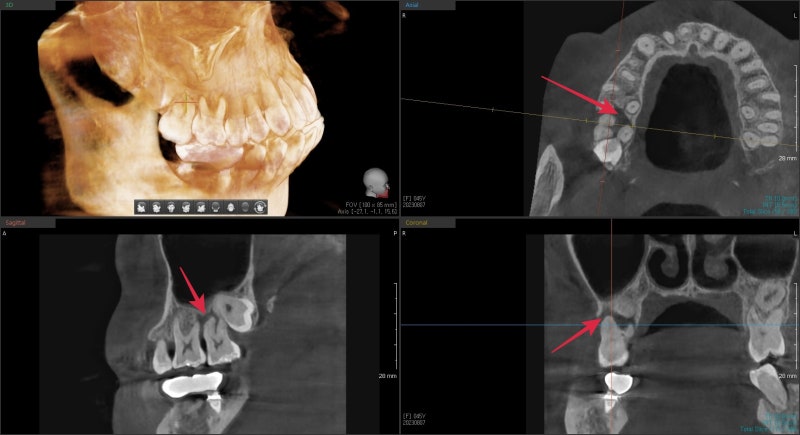
we performed a 3D CT scan and explained the findings.

This is a 3D CT scan showing various cross-sections of the affected area.
The area indicated by the arrow, which should have been filled with white bone,
had completely dissolved around the root due to inflammation, leaving the root directly exposed to external stimuli.
Since the root had already dissolved down to its base, extraction of this tooth and the adjacent wisdom tooth seemed necessary.
Furthermore, the adjacent tooth also had inflammation spreading, leading to periodontal disease and exposure of half of its root.
This tooth also had a high potential for long-term problems, but we first checked the symptoms after extraction
and observed it, informing the patient of the possibility of extraction if the surrounding area did not regenerate over time.
Waiting for natural healing of surrounding tissue after extraction
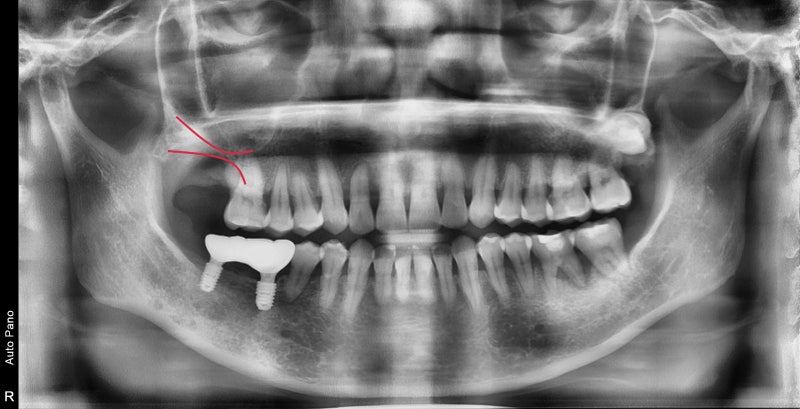
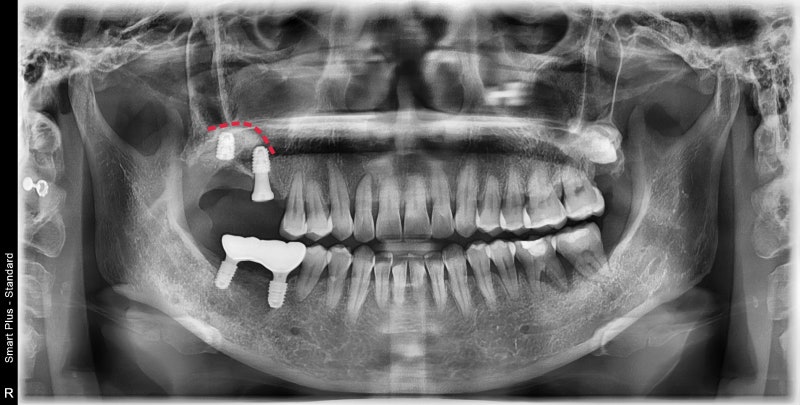
This picture was taken after about 3 months post-extraction, once the remodeling of the surrounding bone was complete.
As expected, half of the root of the rearmost tooth, which should have been covered by bone, had not regenerated and remained exposed.
In such cases, over time, the sensitivity of the exposed root would become the same as before,
and from the perspective of implant maintenance, it was more important to perform surgery simultaneously to secure stability.
(Since the remaining bone indicated by the line is very insufficient, if only one implant at the very end were surgically placed simultaneously with a bone graft called a sinus lift,
the implant's stability would be significantly reduced.)
After thoroughly explaining the treatment plan and my opinion to the patient, the patient understood and, for a better treatment method,
trusted and followed my advice.
As much as the patient trusted and followed, I performed the surgery with my utmost effort to achieve good results.
Implant placement was performed simultaneously with a sinus lift, a surgery that increases the volume of insufficient bone.
As expected, the very end part had very soft bone quality, so we decided to wait a sufficient amount of time after the surgery.
Generally, in the case of the upper jawbone, implant stability is achieved in 3 months,
but in this case, due to the very soft bone quality after extraction, it took more than 6 months.
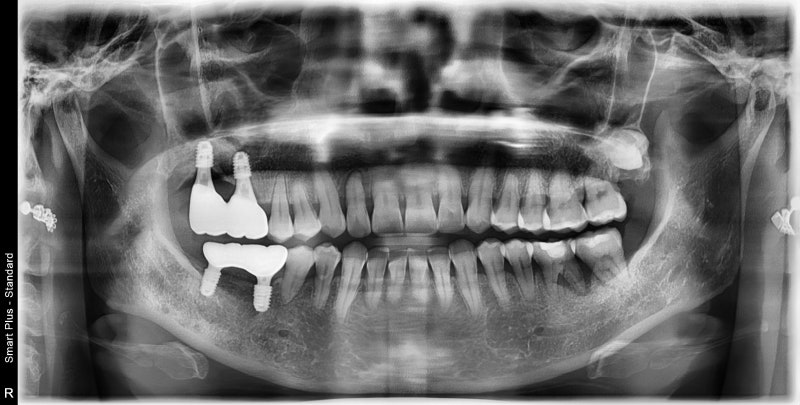
From extraction to surgery, waiting, temporary crown use, and final prosthetic stage,
I would like to express my gratitude to the patient who patiently waited for over half a year, despite the long and possibly tedious process.
Thanks to their cooperation and patience, the initial predicted bone formation and bone graft material were well maintained.
In cases of extraction due to periodontal disease, immediate implant surgery is often difficult.
In such situations, proceeding slowly and taking time for treatment is also a good approach.
Today, we looked at implant placement after extraction due to periodontal disease,
simultaneously with alveolar bone grafting, also known as a sinus lift.
Among those who have similar symptoms,
even if the location and symptoms are the same, the treatment may not be identical,
so we recommend visiting us for an examination and explanation.
I hope that some of your questions have been resolved,
and I will return with another case next time.
Thank you^^
▼ Related cases you might find helpful
We believe that proper treatment leads to proper results. My goal is to create a trustworthy dental clinic where all patients who visit us with worries can leave feeling reassured. – Bareunyoung Dental Clinic –
Directions: JYJ Building, 2nd floor, 179 Dongho-ro, Jung-gu. Right in front of Exit 6 of Yaksu Station, towards Yaksu Market. Use Village Bus No. 5 (Yaksu Station), Village Bus No. 12 (Namsan Town, Yaksu Police Station). Bus stops (Yaksu Heights, Sindang Social Welfare Center, Gaondo Hall, Geumho Tunnel Entrance). From Yuyu Pharmaceutical towards Geumho Station.
This post was written directly by Bareunyoung Dental Clinic for the purpose of providing medical information and hospital advertising (in compliance with Article 56, Paragraph 1 of the Medical Service Act).
Frequently Asked Questions
What causes tooth sensitivity?
Tooth sensitivity has various causes. Yes, it can be caused by several factors, including tooth abrasion, cavities, and severe periodontal disease. Sensitivity is particularly common when there is tooth fracture at the gum-tooth boundary or nerve exposure.
Is immediate implant placement possible after extraction due to severe periodontal disease?
No, it is often difficult. In cases of extraction due to periodontal disease, the bone often dissolves due to inflammation, making immediate implant surgery difficult. In such situations, it is advisable to take sufficient time and wait for the bone to regenerate before proceeding with treatment.
In what cases is a sinus lift necessary?
A sinus lift is needed when there is insufficient bone volume. Yes, it is a bone grafting procedure performed to increase the volume of insufficient bone, especially when implants need to be placed in the upper jawbone but there is not enough bone due to periodontal disease or other reasons, making it difficult to secure implant stability.
How long does it take from extraction due to periodontal disease to implant placement?
It can typically take 6 months or more. After extraction, it takes about 3 months for the surrounding bone to remodel. If the bone quality is weak, a sinus lift may be performed along with implant placement, and it can take more than 6 months for the bone to harden.
Why is 3D CT scanning necessary before implant treatment?
3D CT scanning is necessary for accurate diagnosis. Yes, it allows for precise identification of inflammation around the root or bone conditions that are difficult to confirm with X-rays alone, by capturing multiple cross-sections. This helps in establishing an accurate treatment plan and ensuring safe implant placement.