2026-07-20
[Smile Eye Clinic Broadcast Appearance] Protect Your Eye Blood Vessels! What is Diabetic Retinopathy?!
Due to increased indoor living and screen time, eye diseases like diabetic retinopathy are on the rise. Smile Eye Clinic's Director Yeom Dong-ju explains this condition, which is the leading cause of blindness and often goes unnoticed in its early stages. Regular eye exams are crucial, especially for diabetics and those over 40.
![[Smile Eye Clinic Broadcast Appearance] Protect Your Eye Blood Vessels! What is Diabetic Retinopathy?!](/uploads/smileeye2019/222010944460/2a73d80d6520c7dd.jpg)

As people maintain social distancing due to the novel coronavirus and spend more time indoors,
the consumption of delivery food and the use of electronic devices are increasing.
Furthermore, as this virus prolongs, the increased numbers
show no signs of abating,
leading to the bitter reality of a rise in eye diseases.
With more people spending time alone, engaging in ‘honsul’ (drinking alone) and ‘honbap’ (eating alone),
the aging of the eyes is accelerating due to these factors.
It is said that various eye diseases are appearing, threatening not only the lens of the eye but also the optic nerve and retina.

Today, Director Yeom Dong-ju of Smile Eye Clinic
appeared on a broadcast titled ‘Protect Your Eye Blood Vessels!’
and explained diabetic retinopathy,
one of the retinal diseases.
Many people are familiar with presbyopia, cataracts, and glaucoma,
but diabetic retinopathy seems unfamiliar to some.
Before we delve into diabetic retinopathy,
let's first understand where the retina is located in our eye
and what its role is.
The retina is located at the back of our eye,
and it plays a role in transmitting visual information to the brain.
The retina performs this function by receiving necessary oxygen and nutrients
through retinal blood vessels and capillaries.
If there is an abnormality in this retinal area,
our vision will inevitably be affected, won't it?
When we are feeling down or depressed while attending university or working,
we often eat sweet desserts, saying we need a ‘sugar rush’.
Many people habitually consume sweet foods because it helps them relax
and improves their mood.
Did you know that diabetic retinopathy, ranked as the number one cause of blindness,
primarily occurs due to diabetes?
According to the Health Insurance Review and Assessment Service, diabetic retinopathy
increased by about 28% over four years from 2013 to 2017,
so it's no exaggeration to say that diabetes has also increased by a similar amount.
The frightening aspect of diabetic retinopathy is that its early symptoms are not distinct
and it's difficult for patients to recognize them themselves.
In the early stages, vision is normal, and there are no particularly noticeable symptoms,
so it's often unintentionally left untreated.
As time passes,
symptoms such as floaters, which feel like insects flying around,
and photopsia, which feels like flashes of light in the dark,
begin to appear one by one.

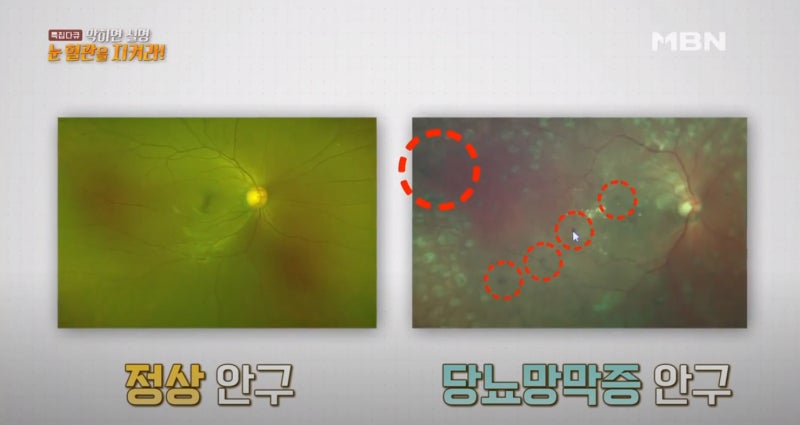
If one visits the clinic after experiencing such symptoms,
there may be cases where it's difficult to intervene,
making it a dangerous eye disease that can lead to blindness.





Our eyes are designed to be small and complex.
There are various parts such as the lens, cornea, and retina,
and the capillaries of the retina are said to be the thinnest among the many blood vessels in our body.
If these retinal capillaries are damaged,
the risk of blindness increases.
As we age, maintaining eye health becomes essential.

Director Yeom Dong-ju, who appeared on the ‘Protect Your Eye Blood Vessels!’ broadcast, stated:
According to statistics from the Ministry of Health and Welfare, approximately 130,000 people lose their sight acquiredly. While there are various reasons for acquired blindness, eye diseases are rapidly increasing due to chronic conditions such as smartphone use, diabetes, and high blood pressure. Any condition affecting the eye, not just the retina, can lead to a decrease in vision, but because humans have two eyes, it's not easy to immediately notice a decrease in vision in one eye.
It is important for individuals with diabetes
or those over 40 years old
to visit the clinic at least once a year
for a detailed eye examination.


Frequently Asked Questions
What is diabetic retinopathy?
Diabetic retinopathy is an eye disease primarily caused by damage to the capillaries of the retina due to diabetes. The retina plays a crucial role in transmitting visual information to the brain, and abnormalities in this part can lead to vision problems.
What are the early symptoms of diabetic retinopathy?
Diabetic retinopathy often does not show clear early symptoms, making it difficult for patients to notice it themselves. In many cases, vision is normal in the early stages, leading to unintentional neglect.
What happens if diabetic retinopathy is left untreated?
If diabetic retinopathy is left untreated, symptoms such as floaters (like insects flying around) or photopsia (flashing lights) may appear. In severe cases, it is a dangerous eye disease that can lead to blindness.
What role does the retina play in the eye?
The retina is located at the back of our eye and is responsible for transmitting visual information to the brain. It performs its functions by receiving oxygen and nutrients through retinal blood vessels and capillaries.
Who should get screened for diabetic retinopathy?
It is important for individuals with diabetes or those over 40 years old to visit an ophthalmologist at least once a year for a detailed eye examination.
Why is diabetic retinopathy the leading cause of blindness?
Diabetic retinopathy is considered the leading cause of blindness because its early symptoms are not distinct, making it difficult for patients to recognize, and if left untreated, it can lead to blindness. Damage to retinal capillaries increases the risk of blindness.