2026-07-20
Could I be ineligible for LASIK/LASEK? Ineligible cases and solutions
Discover why some eyes aren't suitable for LASIK/LASEK and explore alternative vision correction options like implantable lenses or advanced LASEK procedures.
Hello, this is Gangnam Smile Eye Clinic😊
Have you ever heard the saying, ‘Now you can buy eyesight with money’?
As modern medicine has developed significantly these days,
vision correction surgery has become a procedure that many people can undergo easily and quickly,
and this joke emerged as LASIK, LASEK, and SMILE surgeries became popularized.
But everyone! Did you know that there are eyes that cannot undergo LASIK, LASEK, or SMILE,
meaning laser vision correction surgery is impossible?
Today, we will look into cases where laser vision correction surgery is not possible
and alternative surgeries for them :)
First, laser vision correction surgery includes LASIK, LASEK, and SMILE procedures,
which involve ablating a part of the corneal tissue to ultimately correct myopia and astigmatism to 0D.
Therefore, there are defined correctable vision ranges and cases for ablation,
and the type and feasibility of the surgery can also depend on the condition of the eye.
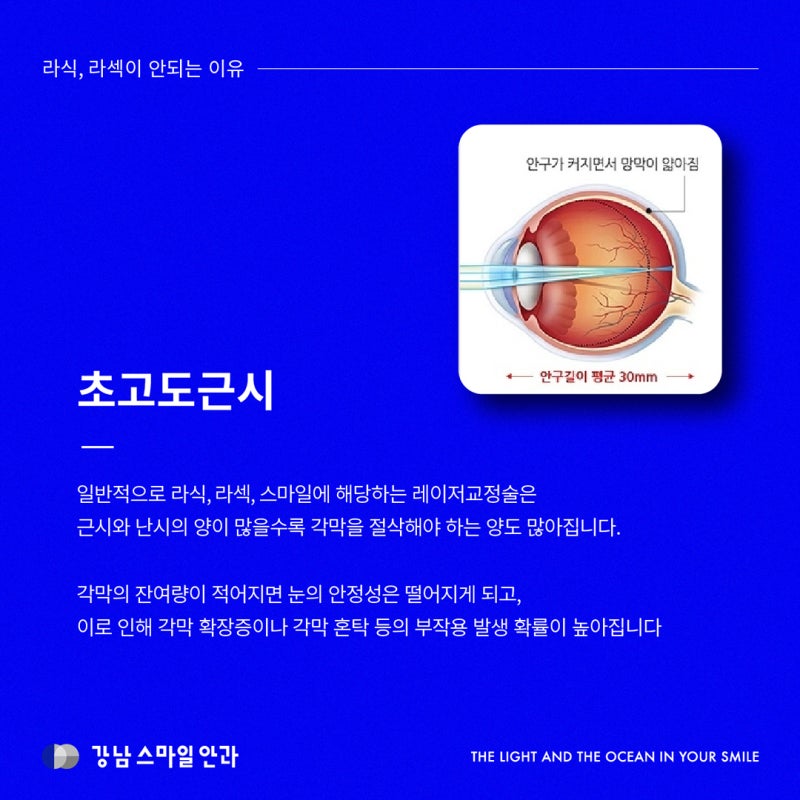
Generally, for laser correction surgeries like LASIK, LASEK, and SMILE,
the greater the amount of myopia and astigmatism, the more corneal tissue needs to be ablated.
Just as glasses get thicker with higher prescriptions,
a higher prescription requires more corneal tissue to be removed.
After surgery, if the residual corneal thickness is too low, the stability of the eye decreases,
which increases the risk of side effects such as corneal ectasia or corneal opacity.
Therefore, in such cases, rather than corneal ablation,
implantable collamer lens (ICL) surgery is recommended for correction.

Thin corneas or asymmetrically shaped corneas are in the same context as cases of extremely high myopia.
If a person has a cornea that is significantly thinner than average or severely asymmetrical,
undergoing corneal ablation surgery would reduce the stability of the eye
and increase the risk of side effects like corneal ectasia, so implantable collamer lens (ICL) surgery is recommended.
Since the thickness and shape of the cornea cannot be externally confirmed before a detailed examination,
it is necessary to visit an ophthalmologist to check your natural corneal thickness and shape.
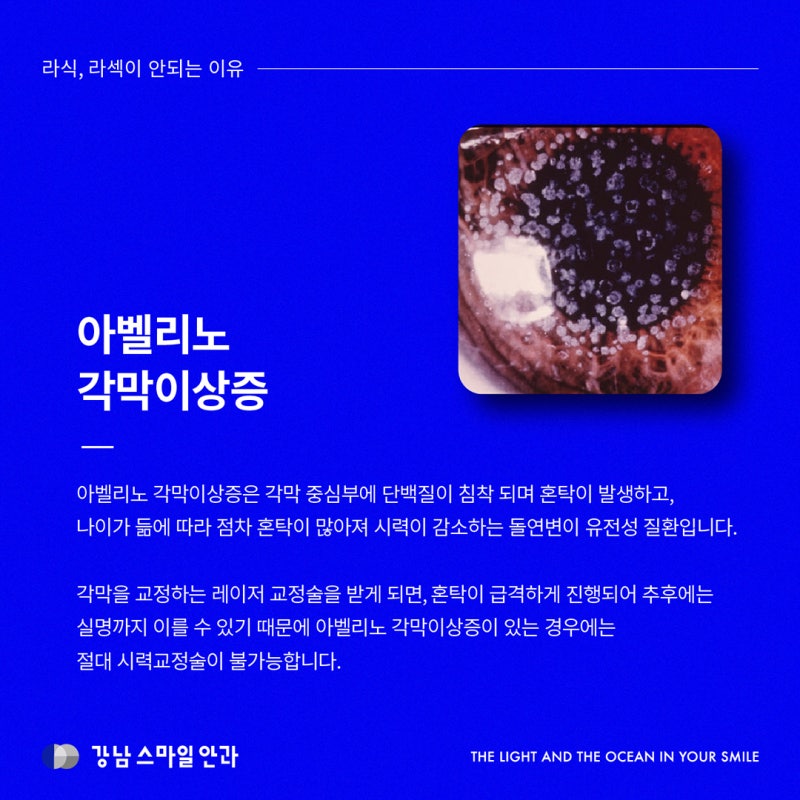
Avellino corneal dystrophy is a hereditary genetic disease where protein deposits accumulate in the central part of the cornea, causing opacity,
and vision gradually decreases as the opacity increases with age.
If a patient with this condition sustains a corneal injury,
the mutated genes produce an abnormally large amount of protein to heal the injury,
which rapidly worsens the opacity.
Therefore, if laser correction surgery is performed on the cornea,
the opacity can progress rapidly, potentially leading to blindness in the future,
making laser vision correction surgery absolutely impossible for those with Avellino corneal dystrophy.
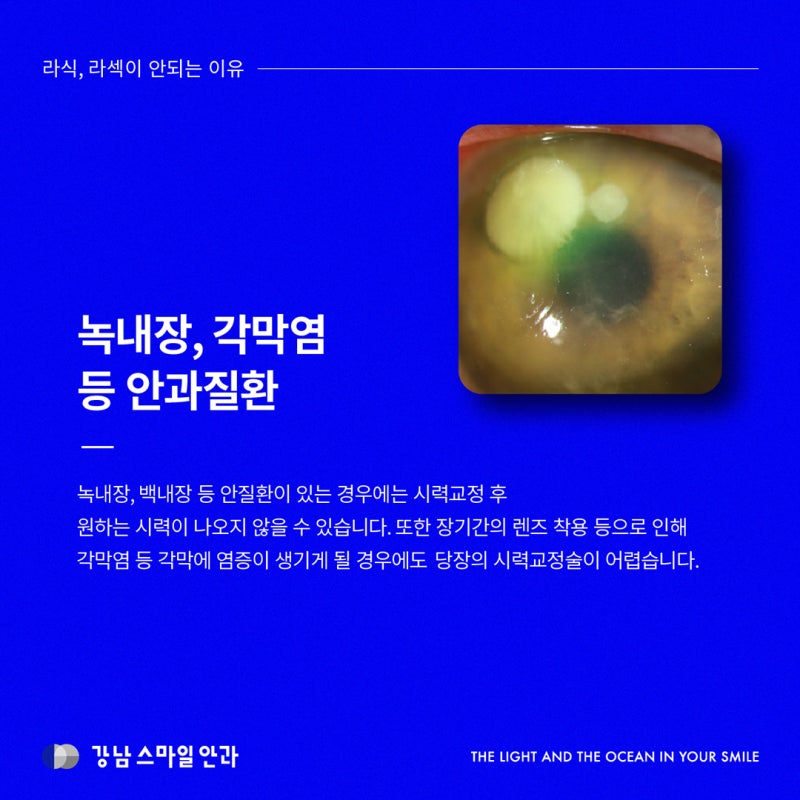
In cases of eye diseases such as glaucoma or cataracts, the desired vision may not be achieved after vision correction.
Additionally, if corneal inflammation, such as keratitis, occurs due to prolonged contact lens wear,
immediate vision correction surgery is difficult.
Therefore, before vision correction, it is essential to undergo a precise eye examination to confirm the presence of such diseases,
and then decide on the surgical method.
Similarly, if there is inflammation or disease in the cornea,
or if there are eye diseases other than the cornea that affect vision,
vision correction surgery is not possible as those conditions must be treated first.
However, even in cases of naturally thin or irregularly shaped corneas, or high prescriptions,
there is a method that allows for laser vision correction surgery.
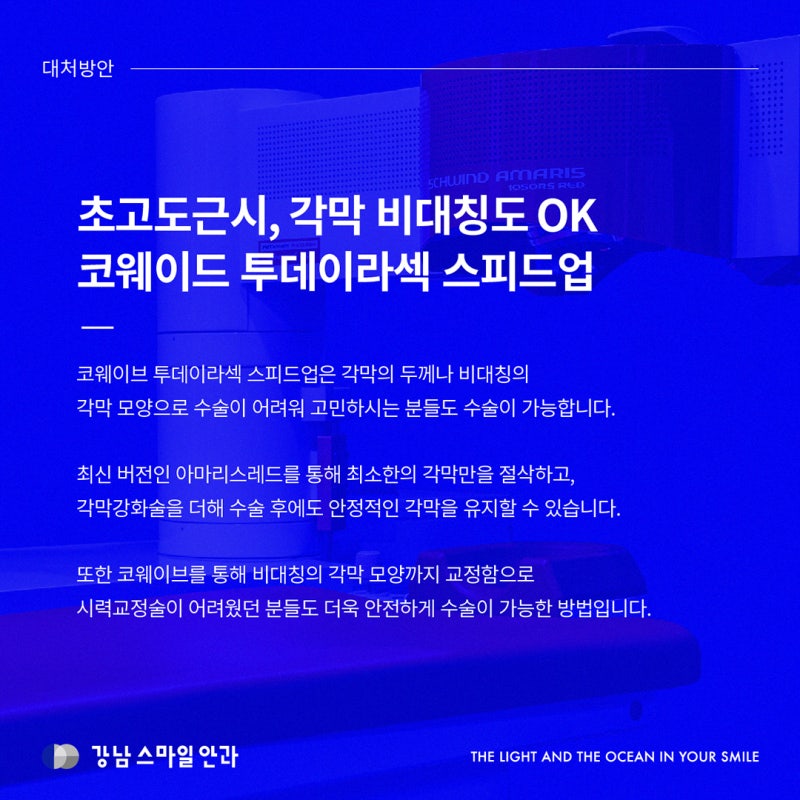
Gangnam Smile Eye Clinic's Today LASEK
uses an excimer laser called Amaris Red to ablate the cornea minimally.
Therefore, for the same prescription, compared to other surgeries,
more residual cornea remains after the surgery.
Additionally, corneal cross-linking treatment is fundamentally included,
making the cornea more than 150% stronger,
further enhancing corneal stability after surgery.
Corneal cross-linking is actually used in university hospitals
for the treatment of a condition called ‘keratoconus’, where the corneal shape is unstable,
so you can consider it a proven safe method.
Furthermore, Co-Wave is a surgical method tailored to each individual's corneal shape,
thus it has the effect of correcting corneal asymmetry.
Therefore, if you have extremely high myopia
or if your corneal shape or thickness is not suitable for other surgeries,
we highly recommend Gangnam Smile Eye Clinic's Co-Wave Today LASEK Speed-up.
Our Gangnam Smile Eye Clinic
is equipped with the latest equipment and a systematic examination system,
and we treat and operate on each individual with a 1:1 customized consultation,
with sincerity.
We also always prioritize the patient
and place transparency and safety first.
If you have any other inquiries,
please feel free to contact the eye clinic at any time.
💙🤍 𝖦𝖠𝖭𝖦𝖭𝖠𝖬 𝖲𝖬𝖨𝖫𝖤 𝖤𝖸𝖤 𝖢𝖫𝖨𝖭𝖨𝖢💙🤍
𝗧𝗛𝗘 𝗟𝗜𝗚𝗛𝗧 𝗔𝗡𝗗 𝗧𝗛𝗘 𝗢𝗖𝗘𝗔𝗡 𝗜𝗡 𝗬𝗢𝗨𝗥 𝗦𝗠𝗜𝗟𝗘
Ultra-high myopia LASIK, Ultra-high myopia LASEK

Today LASEK Smile Eye Clinic



Frequently Asked Questions
Are there eyes that cannot undergo LASIK or LASEK?
Yes, there are. Laser vision correction may be difficult for eyes with ultra-high myopia requiring significant corneal ablation, thin or asymmetrical corneas, Avellino corneal dystrophy, or eye diseases such as glaucoma. These eye conditions must be confirmed through a precise examination.
If my cornea is thin or asymmetrical, can I not get vision correction surgery?
No, it's not always impossible. While laser surgery that ablates the cornea is not recommended due to increased risk of reduced eye stability and side effects, alternatives such as implantable collamer lens surgery or Today LASEK, which minimizes corneal ablation, can be considered.
Is vision correction surgery absolutely impossible if I have Avellino corneal dystrophy?
Yes, laser vision correction surgery is absolutely impossible if you have Avellino corneal dystrophy. This is because if the cornea gets injured, the opacity can progress rapidly, leading to blindness.
Can I get vision correction surgery even if I have eye diseases like glaucoma or cataracts?
No, it is difficult to undergo vision correction surgery immediately. If you have eye diseases such as glaucoma or cataracts, you may not achieve the desired vision even after correction, and if you have inflammation like keratitis, you must treat that condition first.
What vision correction surgeries can be considered for ultra-high myopia or thin corneas?
Implantable collamer lens surgery is a common alternative, and Gangnam Smile Eye Clinic's Today LASEK can also be considered. Today LASEK minimizes corneal ablation and enhances corneal stability through corneal strengthening and Co-wave, making it applicable even for ultra-high myopia or asymmetrical corneas.
What are the effects of corneal strengthening in Today LASEK?
The corneal strengthening included in Today LASEK maintains the cornea 150% stronger after surgery, compensating for corneal stability. This method has proven safety, to the extent that it is used in university hospitals for the treatment of keratoconus.