2026-09-07
Seoul Jung-gu Dental Treatment: Is a Crown Necessary for a Root Canal-Treated Tooth?
Dr. Kim Tae-young of Bareunyoung Dental Clinic in Seoul Jung-gu explains why a crown is often necessary after root canal treatment, especially for molars, to prevent fracture and secondary decay.
Hello,
I am Dr. Kim Tae-young, the head director of Bareunyoung Dental Clinic in Seoul Jung-gu, and I am here to introduce cases directly treated by the head director.
When a tooth develops a cavity, appropriate treatment is required.
When patients come for a check-up after a long time and I explain the areas that need cavity treatment,
sometimes the cavity has progressed to the tooth's nerve,
making root canal treatment unavoidable.
Patients often wonder if a cavity can spread so extensively without any pain or noticeable symptoms.
Usually, pain from a cavity occurs when the broken outer part of the tooth is exposed to temperature stimuli or when the nerve becomes inflamed due to the cavity.
However, if a cavity develops slowly from the inside, symptoms may not appear, or they may be so subtle that patients don't notice them.
If a cavity has progressed to the nerve, root canal treatment, also known as endodontic treatment, is necessary.
After treatment, prosthetic restoration is also performed.
In the case of front teeth, depending on the situation, after root canal treatment, aesthetic finishing may be done without prosthetic restoration.
This is typically when the occlusal force is not strong or the space for a prosthesis is ambiguous.
For molars, which are primarily responsible for chewing function,
it is advisable to perform prosthetic restoration if possible, due to the strong occlusal forces.
The analogy I often use with patients is that
when root canal treatment is performed, the nerve inside the tooth is removed, and its vitality is lost.
This causes the tooth's interior to become brittle, like dead wood, making it unable to withstand external occlusal forces.
Teeth in the posterior region, where occlusal interference occurs repeatedly or occlusal forces are strong, become vulnerable to fracture.
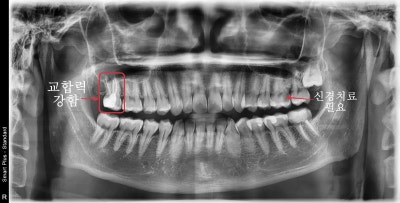
My previously root canal-treated tooth broke.
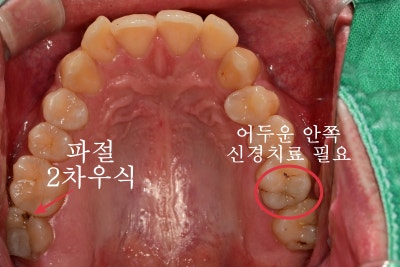
These are the initial X-ray and intraoral photos.
This is a case where root canal treatment was completed in the past and finished only with resin, without prosthetic restoration.
Over time, the tooth fractured, and secondary decay progressed around it,
and subtle crack lines were also observed inside.
Although there was no pain, to prevent further fracture, the existing material was removed and restored, and prosthetic treatment was performed.
Root canal treatment was also needed for a cavity that had progressed on the opposite side, internally.
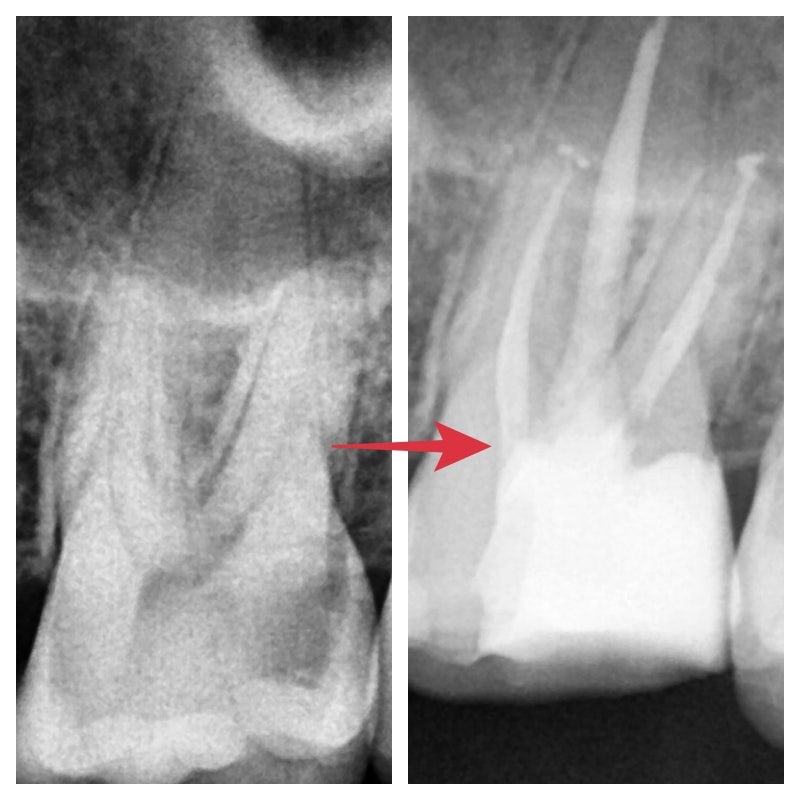
From the outside, the inside looked slightly dark,
but on the X-ray, the cavity had already progressed to the nerve.
This photo shows the root canal thoroughly cleaned and filled according to standard procedures.
There are opinions that if the occlusion is perfectly adjusted and the tooth is used well after root canal treatment, it is much better for the tooth than getting a crown.
However, to perform root canal treatment, the tooth's occlusal surface must be reduced, so without a prosthesis,
it cannot properly perform its chewing function.
Moreover, when examining teeth over a long period, the majority of them experience fracture.
If the cavity is not deep, it is best not to perform root canal treatment
and preserve the tooth.
But if root canal treatment is unavoidable, then prosthetic treatment should also be done
for a more predictable outcome.
Occlusal Adjustment After Prosthetic Treatment
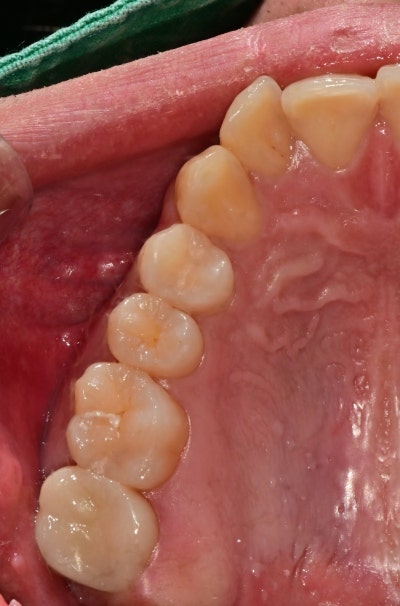
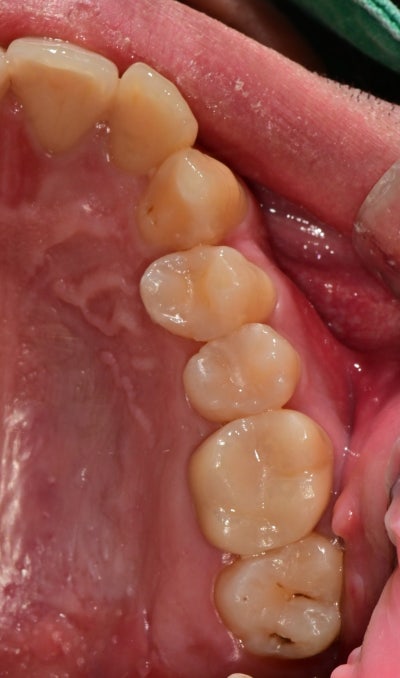
These photos show the completion of prosthetic treatment.
After all treatments were concluded,
occlusal checks were performed regularly in the initial period.
As we moved towards the posterior, the tooth space was shorter,
and the occlusion was tight, so occlusal interferences were eliminated,
and the occlusion was harmoniously adjusted with other teeth.
The fact that the original tooth fractured indicates that
there was an over-occlusion with a specific tooth.
Therefore, regular occlusal checks are expected to help maintain the teeth without fracture for a long period.
While not all fractured teeth require prosthetic treatment,
if appropriate treatment is provided for necessary areas depending on symptoms or situations,
your natural teeth can be preserved as much as possible without extraction.
#SeoulJungguDental #BareunyoungDental
If you have similar symptoms
or any questions,
we recommend visiting a nearby dental clinic for a diagnosis.
Hoping that some of your questions have been resolved,
I will return with another case next time.
Thank you.^^
▼Related cases to read
We believe that proper treatment leads to proper results.My goal is to create a trustworthy dental clinic where everyone who visits with worries can leave feeling relieved.― Bareunyoung Dental Clinic
DirectionsJYJ Building, 2nd floor, 179 Dongho-roRight in front of Exit 6 of Yaksu Station, towards Yaksu MarketVillage Bus 5 (Yaksu Station)Village Bus 12 (Namsan Town, Yaksu Police Station)Bus Stop (Yaksu Heights, Sindang Social Welfare Center, Gaon Library, Geumho Tunnel Entrance)From Yuyu Pharmaceutical towards Geumho Station
This post was written directly by Bareunyoung Dental Clinic for the purpose of providing medical information and hospital advertising (in compliance with Article 56, Paragraph 1 of the Medical Service Act).The photos are taken from individual patients, and results, side effects (prosthesis detachment, pain) may vary depending on the individual after surgery/procedure, so please consult sufficiently with the medical staff in charge before making a decision.
Frequently Asked Questions
Is a crown (prosthetic treatment) always necessary after root canal treatment?
Yes, in most cases, it is necessary. A tooth that has undergone root canal treatment loses its internal nerve vitality and becomes brittle, like dead wood, making it vulnerable to external occlusal forces. Especially for molars, which have strong chewing functions, the risk of fracture is high, so it is advisable to protect them with prosthetic treatment.
What happens if I don't get a crown after root canal treatment?
The tooth may fracture or secondary decay may occur. If a tooth is finished only with resin after root canal treatment without prosthetic restoration, over time, tooth fracture may occur, secondary decay may progress around it, or subtle crack lines may be observed.
Do front teeth also need crowns after root canal treatment?
It depends on the case. For front teeth, if the occlusal force is not strong like molars, or if the space for a prosthesis is ambiguous, aesthetic finishing may be done after root canal treatment without prosthetic restoration. However, for molars, prosthetic treatment is recommended due to their chewing function.
Why do teeth break after root canal treatment?
Because the tooth loses its vitality and becomes weakened due to root canal treatment. Additionally, to perform root canal treatment, the occlusal surface of the tooth must be reduced, so without a prosthesis, it cannot properly perform its chewing function, and fractures often occur over a long period.
Why is occlusal adjustment important after root canal treatment?
To preserve the tooth for a long time and prevent fracture. Fracture of an existing tooth means that excessive occlusal force has occurred on a specific tooth, so regular occlusal checks and adjustments are necessary to harmonize the occlusion with other teeth.