2026-05-25
How Many Times Can You Have Eyelid Surgery? Let’s Find Out!
Learn about the limits of revision eyelid surgery, common reasons for re-operation, and the importance of skin elasticity in achieving successful results.

Hello.
This is VIBE Plastic Surgery.
As eyelid surgery has become a highly popularized procedure compared to other plastic surgeries, the number of revision cases is also significant.
For those considering their first eyelid surgery or those planning a revision, we will explore one of the most common concerns: ‘How many times can revision surgery actually be performed?’

The reasons for revision surgery are truly diverse.
01. When the double eyelid line loosens after a natural adhesion or non-incisional method.
02. Simple dissatisfaction with the line shape.
03. Side effects of double eyelid surgery:
- When the double eyelid line is too high (sausage eyes)
- When the left and right eyelid sizes are asymmetrical
- When the eyelashes are upturned (ectropion)
- When ptosis (drooping eyelid) was not properly corrected

The most common reason for revision surgery is dissatisfaction with the double eyelid line.
This often happens because many people choose to undergo surgery based on current trends without carefully considering their own eye condition and various anatomical factors.
Rather than following a trending style, we recommend getting eyelid surgery in a style that harmonizes with your unique features.

Why do double eyelids loosen?
The most common cause is weak eyelid-opening muscles (levator muscles).
Since a double eyelid is created by the force of opening the eye, the line will inevitably loosen if that force is weak.
In such cases, a procedure called ptosis correction must be added to achieve a clear and satisfactory line.

If you are simply dissatisfied with the line after a natural adhesion or buried suture method, it is entirely possible to perform a non-incisional surgery again to match a new line.
However, if the double eyelid line has loosened, the surgery must proceed only after accurately identifying the reason why it failed.

If the line loosened because the skin is thick and there is a lot of fat, there is a high probability it will loosen again if performed via the non-incisional method.
Therefore, in these cases, a satisfying revision result can be achieved by using the incisional method to sufficiently remove obstructive elements and excess fat.

The number of possible revisions is not necessarily about the ‘difference in surgical methods,’ but rather a more important underlying factor.
The key is that the eyelid surgery must proceed after accurately diagnosing your current eye condition.

There is no fixed limit on the number of revision surgeries.
Incisional surgery involves cutting the eyelid and suturing it to create a line. With each subsequent revision, the skin becomes thinner and the amount of available skin decreases.
Therefore, you must proceed only after thorough consultation with a medical professional before undergoing a revision.

If there is enough excess skin, multiple revisions are possible. However, just because it is technically possible doesn’t mean you should keep doing it.
It is crucial to set a proper plan and execute the surgery correctly at once.

The timing for revision surgery is generally divided into two categories: early correction and late correction.
What is early correction?
This is when correction is needed immediately—for instance, if asymmetry is severe or if other side effects cause significant stress. In such cases, early correction can be performed within 2 weeks after consulting with a surgeon.
What is late correction?
This refers to waiting about 6 months for the surgical scars to fully heal and the tissue to soften before proceeding.
While performing the first surgery correctly is the most fundamental and important step, many people consider revision for various reasons.
Revision eyelid surgery may not be as burdensome as you fear, so we recommend having a detailed consultation with a medical professional.
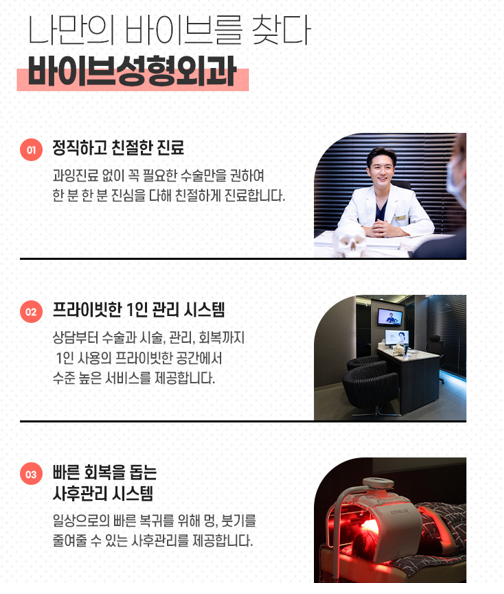
Why People Choose VIBE Plastic Surgery:
- 1:1 dedicated care by the Representative Director (Board-certified Plastic Surgeon)
- Private one-person management system
- Aftercare system to facilitate rapid recovery
- CCTV installed in operating rooms and consultation rooms for safety
- Thorough infection prevention system