2026-05-24
Rhinoplasty Revision: Do You Really Need to Tear Everything Down? | A Case Study on Preserving the Septal Pillar by Dr. Young-moon Yoo of VIBE Plastic Surgery
Learn how a rhinoplasty revision can be performed efficiently by preserving the existing septal pillar to minimize tissue damage and recovery time while improving the tip and nasolabial angle.
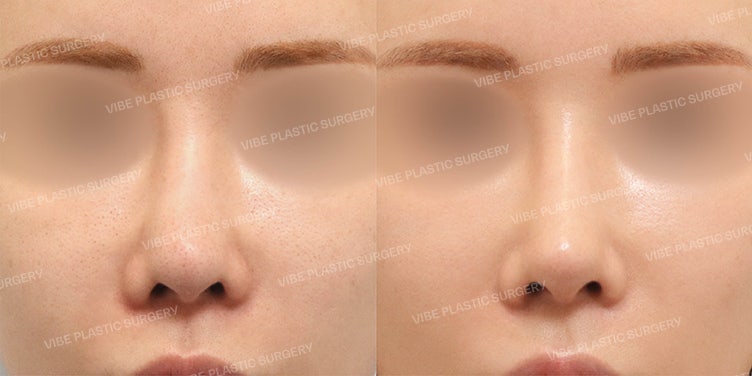
Rhinoplasty Revision Case: Preserving the Septal Pillar
Many people considering rhinoplasty revision think, ‘Revision surgery is always difficult and must be a major overhaul.’
However, in reality, the scope and difficulty of the surgery can vary greatly depending on the condition of the structure created during the previous surgery.
The case I am introducing today is a patient who underwent rhinoplasty four years ago at another clinic using septal cartilage and implants. We performed a revision that reduced the burden by utilizing the existing structure as much as possible.
Reasons for Considering Revision | Drooping Tip and Nasolabial Angle Concerns
The patient:
- Was initially satisfied immediately after the first surgery.
- Over time, the tip of the nose began to look slightly droopy.
- Felt the nasolabial angle appeared somewhat cramped from the side profile.
The overall line of the nose was not severely damaged, but there was a clear need for ‘a bit more refinement.’
Examination Points | A Sturdy Septal Pillar
The most important step in revision surgery is 👉 accurately evaluating the structure created by the previous surgery.
Upon physical examination:
- The septal pillar supporting the tip was sufficiently sturdy.
- There were no signs of wobbling or excessive weakening.
In this case:
✔ There is no reason to forcibly remove the existing septal pillar.
✔ Rather, utilizing it effectively can be a safer and more rational choice.
Surgical Strategy | ‘Distinguishing What to Remove and What to Save’
1️⃣ Maintain the existing septal pillar
- Unnecessary removal only increases tissue damage and burden.
- Maximize the use of the well-constructed existing structure.
2️⃣ Improve tip volume and shape with ear cartilage
- Naturally supplement the tip height using ear cartilage.
- Correct the blunt-looking tip into a more refined line.
3️⃣ Nasolabial angle correction using ear cartilage
- Improve the nasolabial angle, which was lacking in the side profile, for a more stable look.
- Complete a sophisticated side profile that is not overdone.
4️⃣ Implant replacement tailored to the overall balance
- Adjust the implant line to match the changes in the tip and nasolabial angle.
- Pursue a harmonious result from both the front and side.
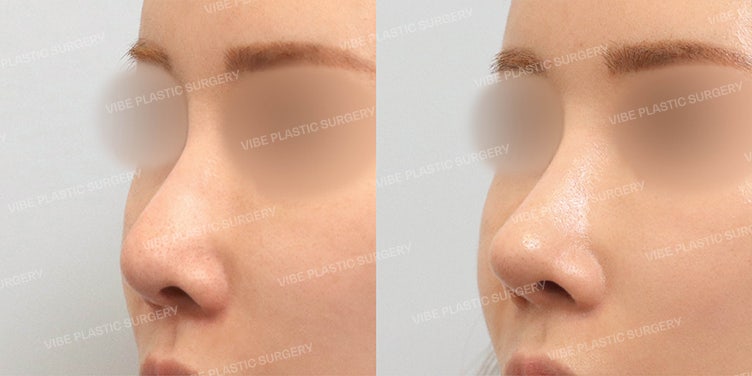
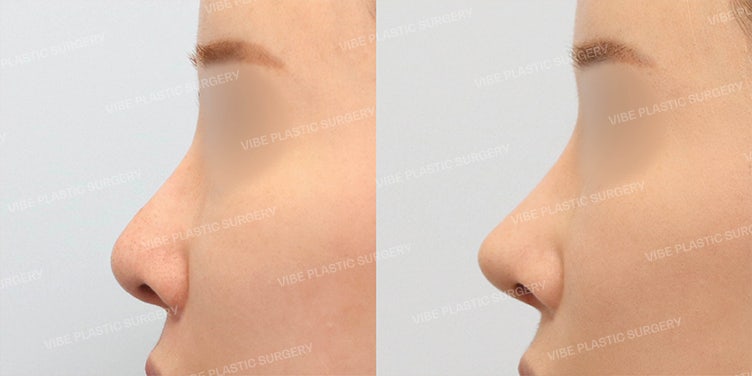
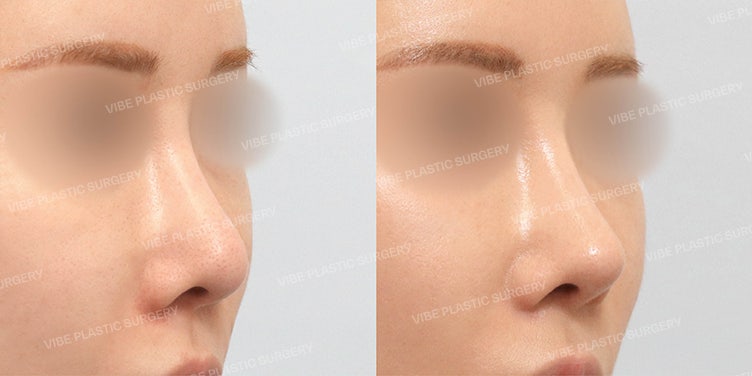
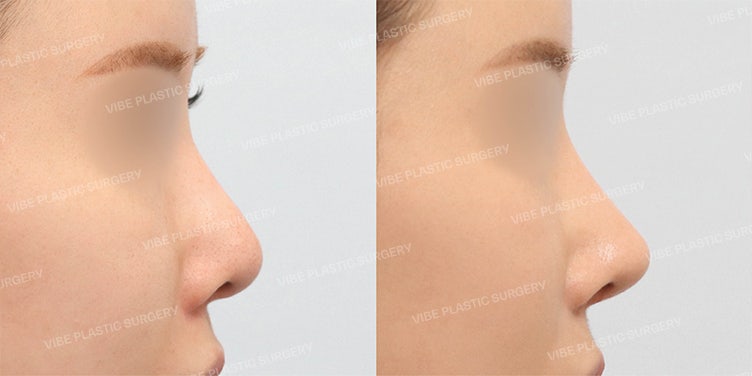
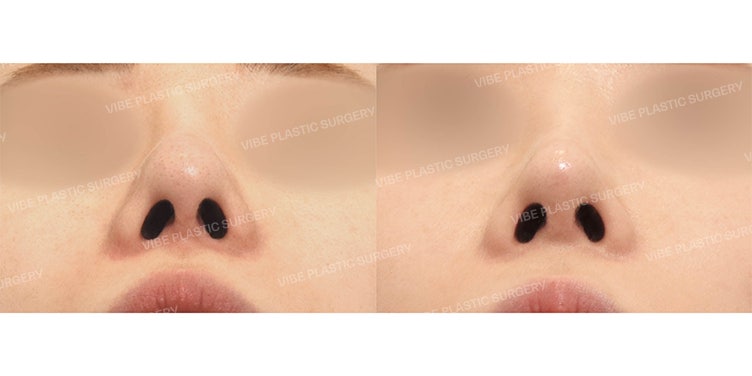
Surgical Results | Subtle but Definite Improvement
After the surgery:
- The drooping tip was corrected, creating a sharper impression.
- The nasolabial angle opened up naturally, resulting in a sophisticated side profile.
- An overall stable change that ‘does not look like revision surgery.’
Most importantly, because the surgical scope was reduced by saving the existing structure:
✔ The recovery burden was relatively low.
✔ Minimal tissue damage was a major advantage.
Not All Rhinoplasty Revisions Are ‘Major’ Surgeries
Just because it is a revision doesn’t mean:
❌ You must remove all existing structures.
❌ Rebuilding everything from scratch is the only answer.
👉 If there are no major issues with the septal pillar created in the previous surgery, utilizing it while precisely supplementing only the necessary parts is much less burdensome for the patient and can lead to more stable results.
‘Judging how far to go and where to stop’ is also a crucial skill in rhinoplasty revision.
Consider ‘Structure-Preserving Revision’ in these cases:
- When the overall nose is fine, but only the tip or nasolabial angle is unsatisfactory.
- When there is no significant deformity or contracture after the previous surgery.
- When the septal pillar is in a relatively stable condition.
- When you want natural improvement rather than an excessive revision.
Closing | The core of revision is not ‘always’ rebuilding from scratch!
The goal of rhinoplasty revision is not necessarily to create a brand-new structure,
👉 but to accurately understand the already established structure and improve it in the most rational way.
VIBE Plastic Surgery does not recommend unnecessarily large surgeries. We prioritize the method that is least burdensome and most stable for the patient.
Consultations and surgeries should be performed by a board-certified plastic surgeon!
VIBE that comes from rich experience.
Dr. Young-moon Yoo, Representative Director of VIBE Plastic Surgery
VIBE Plastic Surgery complies with medical laws. These before-and-after photos were taken under the same conditions with the patient’s consent. Complications and side effects such as bleeding, inflammation, infection, and asymmetry may occur after surgery and vary by individual; caution is advised.