2026-05-18
Does Sleeping Position Cause Facial Asymmetry? A Plastic Surgeon's Honest Answer
Cheongdam Snup Plastic Surgery examines the myth that side sleeping causes facial asymmetry from a medical perspective. Healthy adults unconsciously change positions during sleep, so asymmetry doesn't develop from sleep position alone—the actual causes are one-sided chewing habits, forward head posture, chin resting, and dental or temporomandibular joint issues. The post includes self-check methods and guidance on when to consult a specialist.

Hello.
This is Cheongdam Snup Plastic Surgery.
One of the most frequently asked questions
we receive in the clinic is:
Doctor, I always sleep on my right side, so my face looks crooked.
inquiries like this.
Today, we'll examine
the truth behind the myth of sleep position and facial asymmetry
from a scientific perspective.
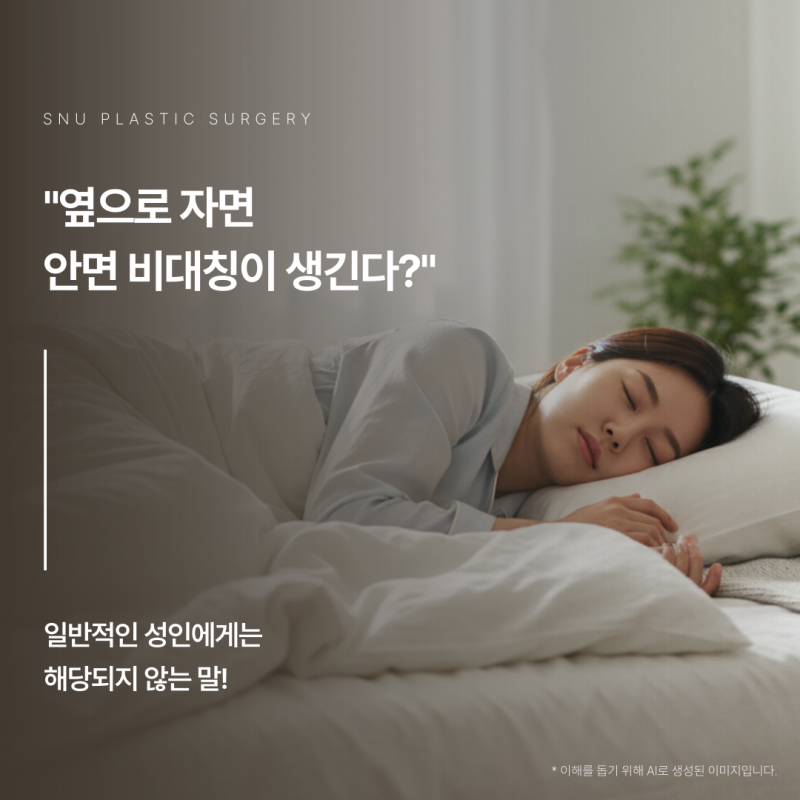
Does sleeping on your side really cause facial asymmetry?
To answer directly,
this does not apply
to most healthy adults.
The reasons are as follows:
1. Healthy people unconsciously
change their sleeping position
20–30 times during sleep.
2. Our body has a reflex
where it naturally shifts and redistributes pressure
when one side is pressed.
3. The facial skeleton is not
flexible enough to be easily deformed
by simple external pressure alone.
Of course, there are exceptions.
For people with neurological or motor disorders
that restrict movement,
one position can be held for extended periods,
so caution is warranted.
However, in these cases,
other health concerns like bed sores
take priority over facial asymmetry.
Can sleeping on the opposite side correct facial asymmetry?
Unfortunately,
simply changing which side you sleep on
does not correct existing facial asymmetry.
This is because facial asymmetry that has already developed
is a structural issue of bone and soft tissue.
However, for managing craniofacial deformities in children,
guardians can manage sleep position
and use special headgear as a treatment method.
This is a special case
that only applies to children during their growth years.
Is there an "ideal" sleep posture that's good for facial asymmetry?

There is insufficient scientific evidence
that a specific sleep position prevents facial asymmetry.
However, sleeping on your back
in a straight, upright position is generally
recommended for facial health.
Why?
✅ Pressure doesn't concentrate on one side of the face,
reducing sleep creases.
✅ It doesn't obstruct lymphatic circulation,
reducing morning facial puffiness.
✅ It helps maintain proper alignment
of the neck and spine.
Congenital vs. Acquired Facial Asymmetry
That's right.
Facial asymmetry is mostly determined by genetic factors
and the growth and development process.
However, it can also develop or worsen after birth,
and the main cause is NOT sleep position!
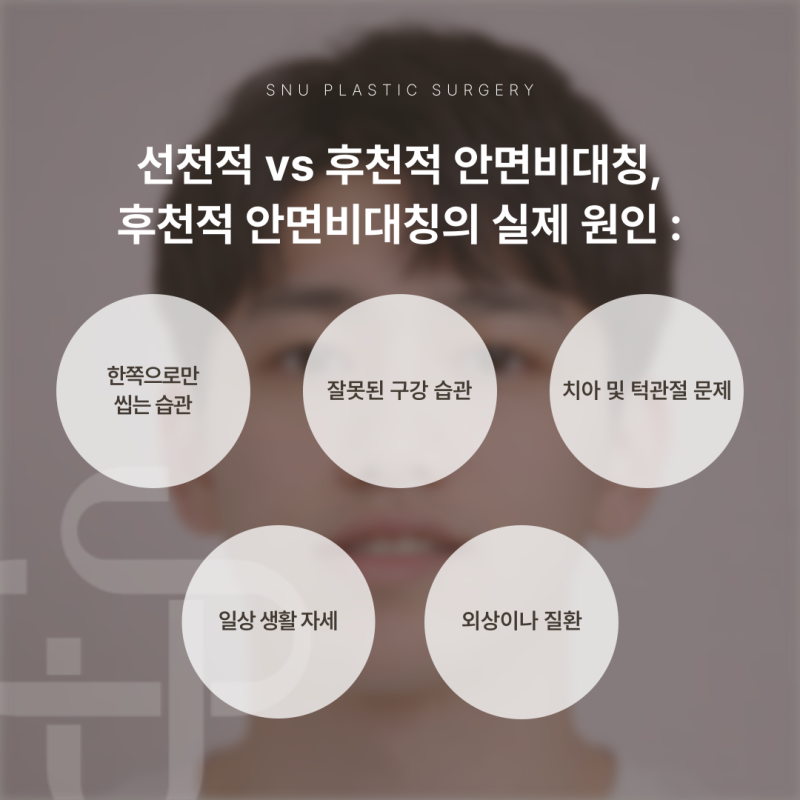
The Real Causes of Acquired Facial Asymmetry
1. One-sided chewing habit
: Unbalanced development of jaw muscles
2. Incorrect oral habits
: Mouth breathing, teeth grinding, abnormal tongue position
3. Dental and temporomandibular joint problems
: Missing teeth, unstable bite, TMJ disorder (TMD)
4. Daily life posture issues
: Forward head posture, chin resting habit
5. Trauma or disease
: Facial nerve paralysis, fracture aftermath, etc.
The Real Impact of Side Sleeping on Your Face
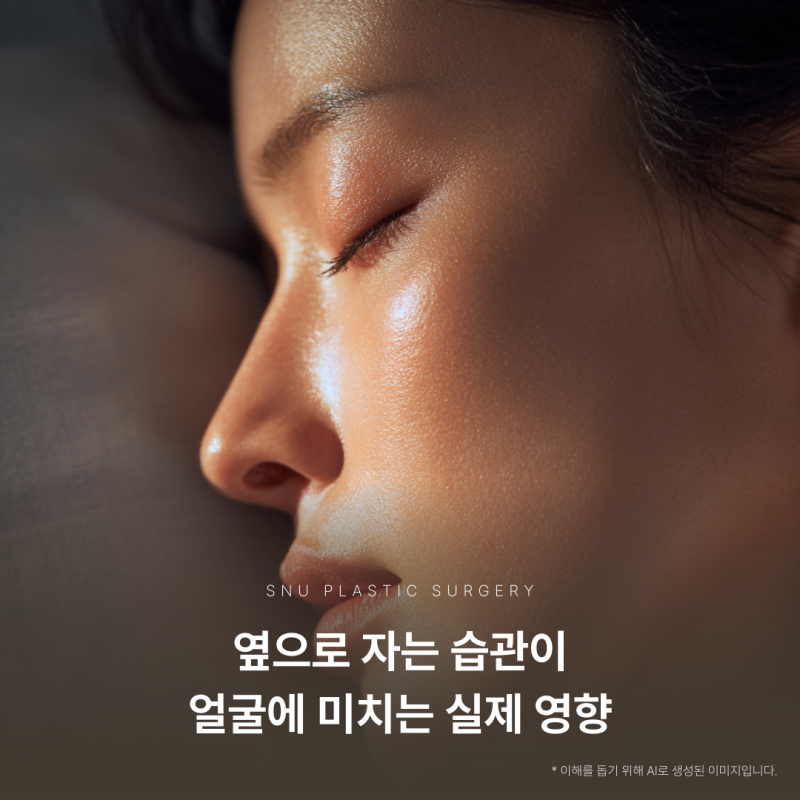
When one side of the face is continuously pressed
against the pillow during sleep,
the following temporary changes can be observed:
✅ In the morning, the pressed area may appear slightly swollen
or pillow creases may be clearly visible.
✅ Skin wrinkles may temporarily
appear more pronounced.
However, most of these phenomena
disappear within a few hours of waking.
In the long term,
side sleeping habits are less impactful than
👉🏻 sun exposure, smoking, and facial expression habits,
which have a greater impact on
skin aging and wrinkle formation.
Habits More Important Than Sleep Position
The daily habits that actually affect facial asymmetry
are as follows:
1. Imbalanced Chewing Habits
Chewing food on one side only
can excessively develop the masticatory muscles on that side,
affecting facial shape.
2. Incorrect Daily Posture
Forward head posture or "tech neck,"
where the neck extends forward when using computers or smartphones,
can cause cervical spine deformation,
which can lead to changes in lower jaw position.
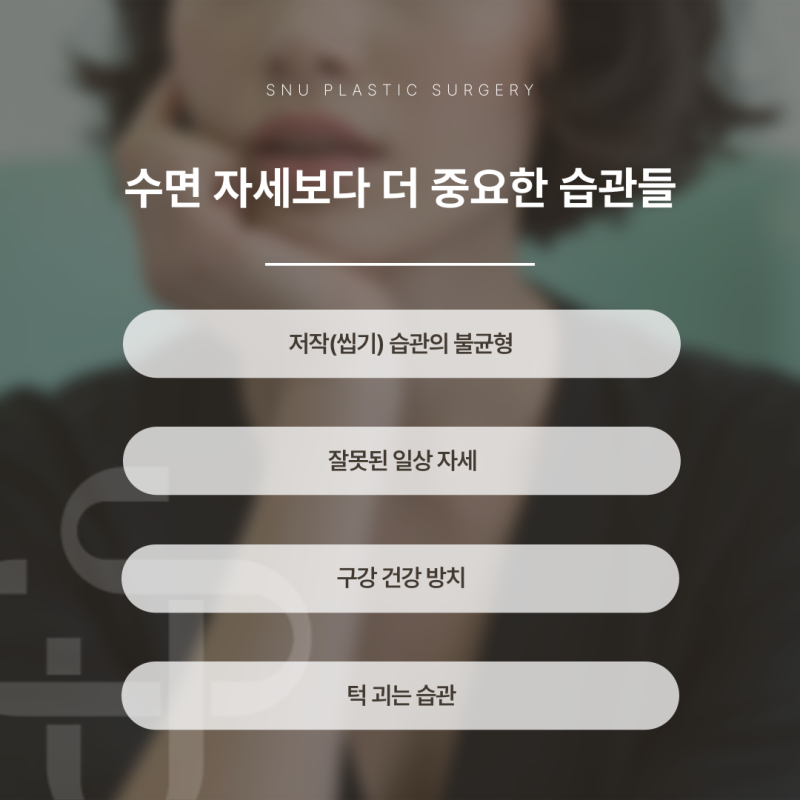
3. Neglecting Oral Health
Ignoring missing teeth changes chewing patterns,
which has long-term effects on
facial muscles and shape.
4. Chin Resting Habit
Resting your chin on one hand while working or studying
can affect facial shape due to sustained pressure.
Expert's Final Thoughts
"My face seems to be getting crooked bit by bit"
If this is your concern, try checking
the following in front of a mirror:
1. Are your eyes, nose, and lips symmetrical on both sides?2. When you take a photo, does one side of your face look wider?3. Do you have a habit of chewing on just one side?
Facial asymmetry is mostly congenital
or develops during the growth process.
If sudden or progressive asymmetry develops
after adulthood,
it may indicate an issue beyond simple lifestyle habits,
so we recommend consulting a plastic surgery specialist.

Most importantly, "healthy balance"
is more important than "perfect symmetry."
Small asymmetries can actually add
character and charm to your face! ^^
We've covered the questions about facial asymmetry
and sleep position.
If you have more questions,
please leave a comment! 😊
Website
📌 KakaoTalk Channel (Click the image below to visit)


Frequently Asked Questions
Does sleeping on your side cause facial asymmetry?
No, this doesn't apply to most healthy adults. Healthy people unconsciously change positions 20–30 times during sleep, reflexively shift when one side is pressed to distribute pressure, and the facial skeleton is not flexible enough to be easily deformed by external pressure alone.
Can sleeping on the opposite side correct facial asymmetry?
No, it does not. Facial asymmetry that has already formed is a structural issue of bone and soft tissue, so simply changing your sleep side won't improve it. However, there is an exceptional treatment where guardians manage sleep position and use special headgear to control craniofacial deformities in growing children.
Is there a good sleep position for facial health?
Sleeping on your back in a straight position is generally recommended. It prevents pressure from concentrating on one side of the face, reduces pillow creases, doesn't obstruct lymphatic circulation to minimize morning puffiness, and helps maintain proper neck and spine alignment. However, scientific evidence for asymmetry prevention is limited.
What are the real causes of acquired facial asymmetry?
Lifestyle habits are the main cause, not sleep position. Common causes include one-sided chewing habits, incorrect oral habits like mouth breathing and teeth grinding, missing teeth and TMJ disorders, forward head posture and chin resting habits, and trauma or disease like facial nerve paralysis and fracture aftermath.
What changes happen to your face when you sleep on your side?
Only temporary changes occur. In the morning, the pressed area may appear slightly swollen or pillow creases may be visible, and skin wrinkles may temporarily appear more pronounced, but most disappear within hours. Long-term skin aging is more affected by sun exposure, smoking, and facial expression habits than side sleeping.
When should you consult a plastic surgery specialist?
Consultation is recommended if sudden or progressive asymmetry develops after adulthood. After self-checking in a mirror for symmetry of eyes, nose, and lips, face width differences in photos, and one-sided chewing habits, if you suspect an issue beyond simple lifestyle habits, it's good to see a specialist.