2026-05-18
Micro-fat Grafting vs Nano-fat Grafting vs Filler: Complete Guide to Pros and Cons
Snu Plastic Surgery compares three procedures: micro-fat grafting, nano-fat grafting, and filler. Micro-fat grafting improves volume while regenerating skin simultaneously; nano-fat grafting focuses on stem cell-based skin regeneration; filler offers immediate, predictable volume improvement with reversibility. In clinical practice, micro-fat and nano-fat grafting are often combined. Consulting with a specialist to choose based on your skin condition and goals is essential.

Micro-fat Grafting vs Nano-fat Grafting vs Filler: Complete Pros and Cons Guide!
Hello.
Welcome to Snu Plastic Surgery.
With increasing interest in skin volume improvement and regeneration,
inquiries about fat grafting and filler procedures have increased significantly.
We frequently receive questions like:
"What is nano-fat grafting?"
"How does micro-fat grafting differ from filler?"
Today, we'll provide a comprehensive comparison of the features and pros and cons of all three procedures.
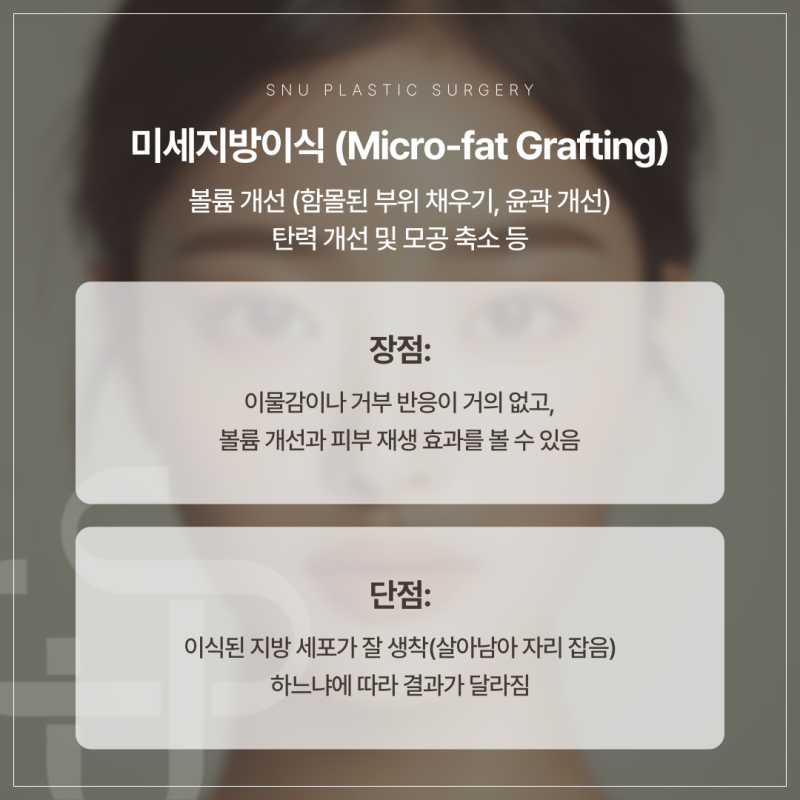
1. Micro-fat Grafting
Micro-fat grafting is a procedure where fat harvested from your own body is purified through centrifugation and similar processes, then grafted into areas requiring volume.
📍 Primary Purpose
: Volume improvement (filling sunken areas, enhancing contours)
📍 Additional Benefits
: The adipose-derived stem cells (ADSC) contained in fat can promote skin regeneration, resulting in improved elasticity, pore reduction, and similar benefits.
📍 Micro-fat Grafting Advantages
: Since it uses your own tissue, there is minimal foreign body sensation or rejection. You can achieve both volume improvement and skin regeneration effects simultaneously.
📍 Micro-fat Grafting Disadvantages
: Results depend on how well the transplanted fat cells take and survive. Take rates vary greatly among individuals, and some absorption occurs over time.
Multiple touch-up procedures may be needed to maintain desired volume.
2. Nano-fat Grafting
Nano-fat grafting involves an additional filtration step where micro-fat is passed through an even finer sieve.
In this process, larger mature fat cells are destroyed, leaving primarily a fraction rich in adipose-derived stem cells (ADSC).
📍 Primary Purpose
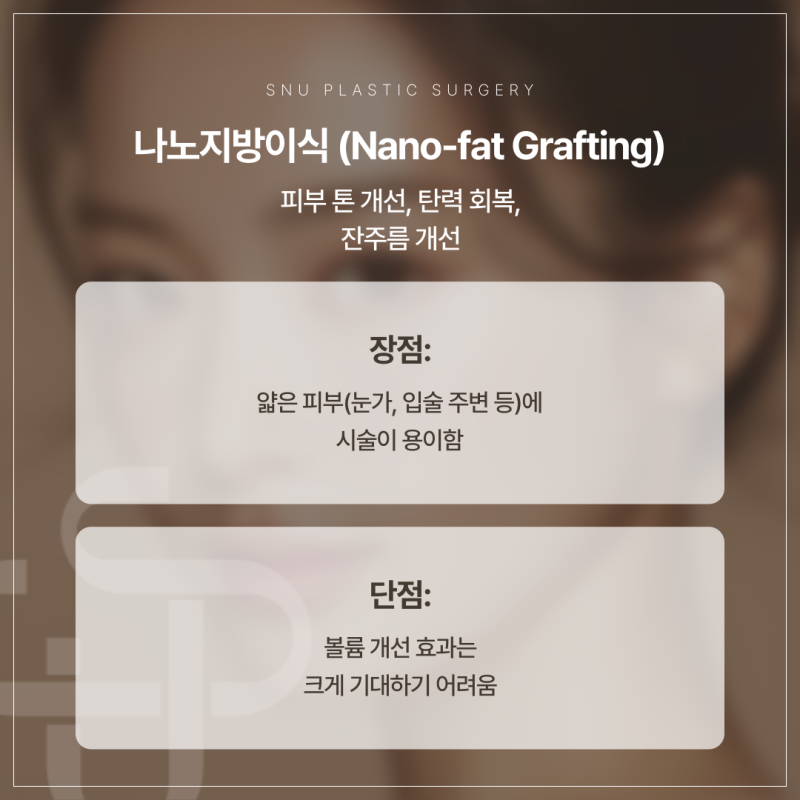
: Skin regeneration through stem cells (skin tone improvement, elasticity recovery, fine line reduction)
📍 Volume Effect
: Since it lacks fat cells, the volume-filling effect is minimal.
(However, it can be safely used for subtle volume improvement in thin-skinned areas like the eye area.)
📍 Nano-fat Grafting Advantages
: It can be injected with very fine needles, making it easy to apply to thin-skinned areas (eye area, around lips, etc.), with emphasis on skin regeneration benefits.
📍 Nano-fat Grafting Disadvantages
: Generally, significant volume improvement effects are difficult to expect.
💡 Tip
In actual clinical practice, it is common to combine both procedures: using micro-fat grafting to fill volume, with nano-fat grafting additionally applied to the skin layer to achieve both volume improvement and skin regeneration effects.
3. Filler (Primarily Hyaluronic Acid)
Filler is a procedure where synthetic substances such as hyaluronic acid are injected into desired areas to create immediate volume.
📍 Primary Purpose
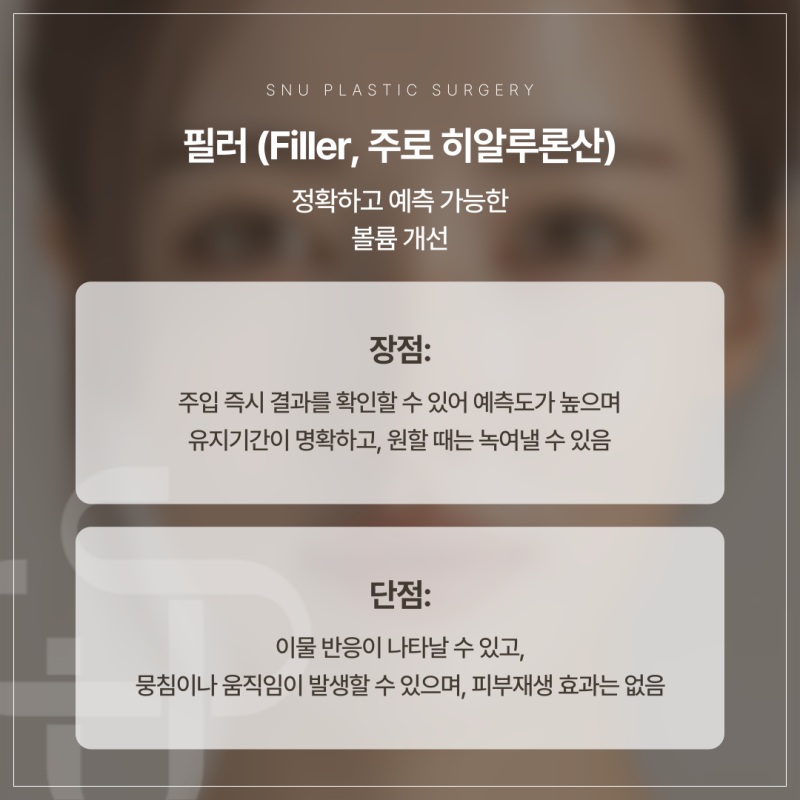
: Precise and predictable volume improvement
📍 Filler Advantages
: High Predictability
Unlike fat grafting, results can be seen immediately upon injection without waiting for cell survival. Correction of nearly 100% is possible during the procedure.
: Clear Duration
It typically lasts 1-2 years and naturally breaks down over time.
: Reversibility
It can be dissolved immediately using an enzyme called hyaluronidase, offering significant safety advantages.
(This is why it has been proven safe over the past 20-30 years.)
📍 Filler Disadvantages
: Foreign Material
Since it's a synthetic substance, foreign body reactions (swelling, redness, etc.) can rarely occur.
: Lack of Natural Integration
Unlike fat that integrates naturally, filler can feel separate from surrounding tissue.
If injected incorrectly, clumping or movement can occur.
: No Regeneration Effect
You cannot expect skin regeneration effects from stem cells as you can with fat grafting.
✨ Which Procedure Is Right for You?

Considering all these characteristics, you may be wondering which procedure is best for you.
I'll provide some recommendations.
Fat Grafting (Micro + Nano) Is Recommended For:
✅ Those seeking both volume improvement and skin regeneration benefits (elasticity and tone improvement)
✅ Those who prefer to avoid synthetic foreign materials (fillers)
✅ However, you must be comfortable accepting that multiple touch-up procedures may be needed as part of the natural process.
✅ Especially for middle-aged and older individuals whose skin regeneration capacity may be relatively reduced, fat grafting can be a better long-term choice.
Filler Is Recommended For:
✅ Those seeking immediate results and predictable changes
✅ Those who want reversibility—the option to dissolve it immediately if unsatisfied
✅ Those seeking straightforward volume improvement with a clear duration of effect
✅ Due to these characteristics, it may be more suitable for relatively younger individuals wanting to try aesthetic changes.

🪄 Additional Tips
Fat Grafting: Myths and Facts
In the past, over-correction (approximately 120%) was often recommended for fat grafting.
However, the current trend is to achieve 100% correction in the first procedure and supplement any deficiencies with additional grafting.
Additionally, while frozen fat was previously thawed and re-grafted in many cases, fat cells separated from the body experience rapidly declining survival rates over time.
Therefore, nowadays it is more common to harvest and graft fresh fat rather than using previously frozen fat.
I hope this article has helped resolve some of your concerns.
Before making a decision, be sure to consult thoroughly with a specialist
to choose a method suited to your skin condition and goals, which is most important.
Remember this! 🙏🏻
Website
📌 KakaoTalk Channel (Click the image below)



Frequently Asked Questions
What is the difference between micro-fat and nano-fat grafting?
The biggest difference is the primary purpose. Micro-fat grafting uses harvested and purified fat to improve volume, while also delivering stem cell-based regeneration benefits. Nano-fat grafting involves an additional filtration process to retain only the stem cell-rich fraction, focusing on skin regeneration.
How long does filler last?
It typically lasts 1-2 years. Hyaluronic acid fillers naturally break down over time, and if desired, can be immediately dissolved using hyaluronidase enzyme, offering a major reversibility advantage.
Do I need just one fat grafting procedure?
No, multiple touch-up procedures may be needed. Fat cell survival rates vary significantly among individuals, and some absorption occurs over time. Additional grafting is often needed to maintain desired volume.
Can procedures be done on thin-skinned areas like the eye region?
Yes, it's possible. Nano-fat grafting can be injected with very fine needles, making it ideal for thin-skinned areas like the eyes and around the lips. It delivers subtle volume improvement with skin regeneration benefits.
Should I choose fat grafting or filler?
It depends on your goals. If you want both volume and skin regeneration effects and prefer your own tissue, fat grafting is ideal. If you prefer immediate, predictable results with reversibility, filler is the better choice. Consulting with a specialist is important for your decision.
Do doctors still use over-correction for fat grafting?
No, the modern approach is different. Current practice achieves 100% correction in the first procedure, with any deficiencies supplemented through additional grafting. Also, fresh fat is now preferred over thawed frozen fat, as frozen cells lose viability over time.