2026-05-18
Creating Beautiful Eye Shapes with Ptosis Correction Surgery - Incision vs Non-Incision Methods
Eye correction surgery improves tired-looking eyes, corrects asymmetrical eyes, and is used for double eyelid revision. The customized procedure is tailored to each eye shape. Two methods are available: non-incision (useful for approximately 1mm eye enlargement with faster recovery) and incision (effective for severe ptosis or skin laxity with diverse technique options, commonly used for revisions).

What is Eye Correction Surgery?
Eye correction surgery can improve tired-looking eyes, correct asymmetrical eyes, and be used for double eyelid revision. The surgery is customized to each person's eye shape, determining whether to lift or lower the eye corners. Gangnam Seoyeon Plastic Surgery
↑Video of the model above.
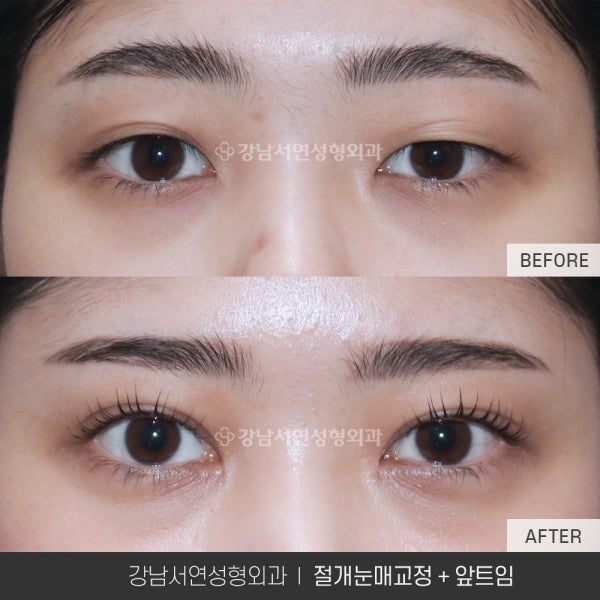
Before surgery, 6 months after surgery
https://youtu.be/kEsjWclVDL0 Video of patient with before/after photos above
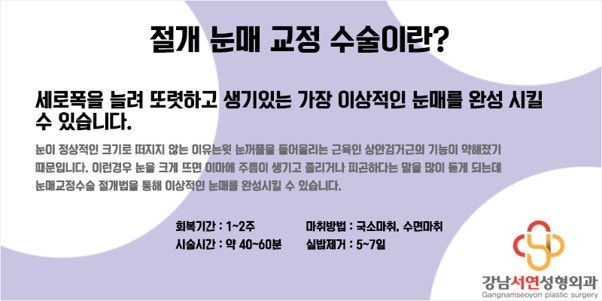
Incision vs Non-Incision Methods
The surgery can be divided into incision and non-incision methods.
.png?type=w800)
.jpg?type=w800)
.jpg?type=w800)

Method of incision eye correction surgery.
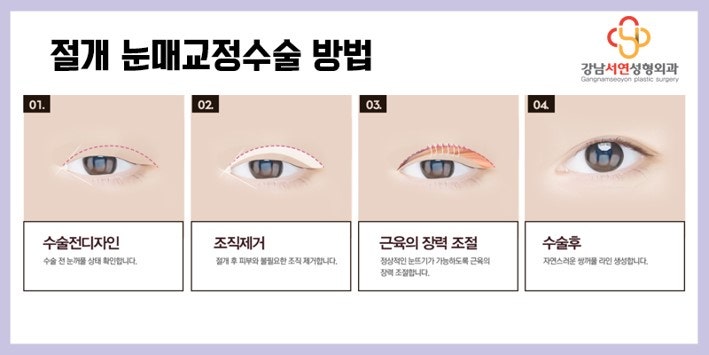
.png?type=w800)
Appearance 6 months after surgery
For eye correction surgery as well,
there is an incision method and a non-incision method.
Non-incision eye correction surgery
is usually useful when enlarging the eyes by approximately 1mm,
and is possible when there is no skin laxity.
Compared to the incision method, recovery is faster and there are no scars, but
it has limitations as a surgical method.
Incision eye correction surgery
is especially useful when there is severe ptosis or sagging skin,
and is a surgical method that can create diverse shapes.
Making an incision does not necessarily result in severe scars.
Of course, scars cannot be completely eliminated, but they can be minimized by using appropriate methods and following proper principles.
And because various techniques can be applied, it is especially useful for revision surgery
—it is a double eyelid surgery.
.jpg?type=w800)
.jpg?type=w800)
.jpg?type=w800)
.jpg?type=w800)
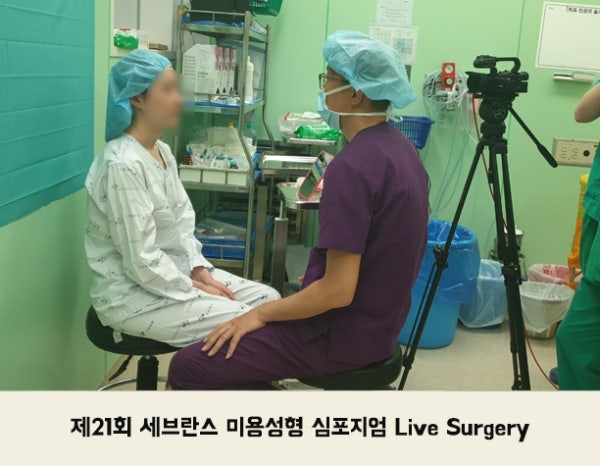
June 23, 2019
'21st Severance Cosmetic Plastic Surgery Symposium'
Incisional blepharoplasty for mild ptosis
(Incision eye correction and medial canthoplasty) Live surgical lecture
Frequently Asked Questions
What improvements can eye correction surgery provide?
It can be used to improve tired-looking eyes, correct asymmetrical eyes, and perform double eyelid revision surgery. The surgery is customized to each person's eye shape, determining whether to lift or lower the eye corners.
When is non-incision eye correction suitable?
It is suitable when you want to enlarge the eyes by approximately 1mm and there is no skin laxity. It has the advantages of faster recovery and no scars compared to the incision method, but it is a surgical method with limitations.
When is incision eye correction recommended?
It is a highly useful method when there is severe ptosis or sagging skin. It can create diverse shapes and apply multiple techniques, making it a double eyelid surgery that is particularly useful for revision cases.
Will many scars remain after incision eye correction surgery?
Scars can be minimized by using appropriate methods and following proper principles. Making an incision does not necessarily result in severe scarring, and while some scarring is unavoidable, it can be managed to be barely noticeable.
When can results be seen after eye correction surgery?
This article presents the appearance 6 months after surgery through before and after photos and videos. With both incision and non-incision methods, you can see naturally settled eye appearance at 6 months post-surgery.