2026-05-25
Myths and Truths About Forehead Lift: Insights from Vibe Plastic Surgery in Gangnam
Discover the truth about forehead lifts with Vibe Plastic Surgery. Learn about forehead size, midface length, sensory changes, and hair loss risks.
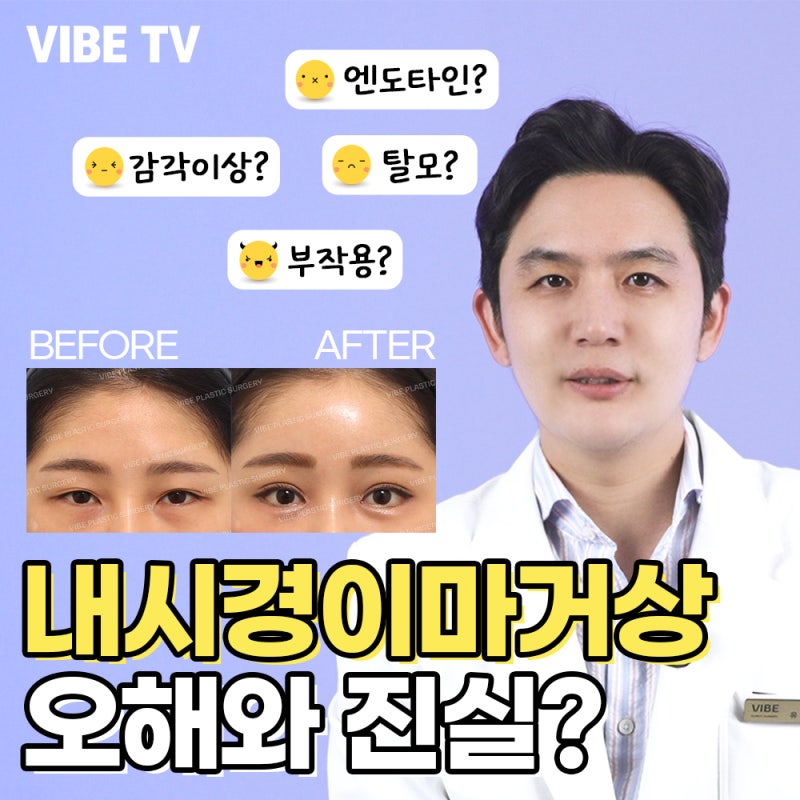
Hello!
This is Vibe Plastic Surgery.
One of the most popular procedures performed at our clinic is the endoscopic forehead lift.
Those considering a forehead lift likely gather a wide range of information through various media outlets.
While much of that information is accurate, there are also several misconceptions floating around.
Today, Vibe Plastic Surgery—a premier destination for forehead lifts in Gangnam—will briefly discuss the myths and truths surrounding this procedure :)

Does a forehead lift make the forehead wider?
This is one of the most frequently asked questions regarding forehead lifts.
Those with wide foreheads worry about them becoming even wider, while those with narrow foreheads might hope for a widening effect.
In conclusion, it can become wider, or it can stay the same.
If it does widen, it is usually within a few millimeters, depending on skin elasticity, wrinkles, and the shape of the forehead.
If significant widening is expected, we often recommend combining the forehead lift with a forehead reduction procedure :)

Will the midface look longer after a forehead lift?
The midface refers to the area from the eyebrows to the tip of the nose where it meets the philtrum.
Since a forehead lift changes the position of the eyebrows, the midface may appear slightly longer.
However, when looking at the face as a whole, the proportions often become more harmonious and improved, so patients rarely notice a negative difference and overall satisfaction remains high.

Does the forehead lose sensation after the surgery?
Patients who are about 1 to 3 months post-op often report that their forehead feels ‘numb,’ the incision site feels ‘itchy’ or ‘tingly,’ or they experience a ‘tugging’ sensation.
The tugging sensation is a natural symptom because the forehead is physically lifted and fixed in place.
Sensory abnormalities almost always return to normal after about 3 to 6 months. Itching and tingling are signs of nerve recovery, so you can rest assured :)

Is it better to have more fixation points?
Forehead lifts use materials like sutures or Endotine for fixation.
Some patients wonder if using more Endotine devices is better, but this is determined by your specific condition.
Using a high number of devices is not necessarily better; what matters is using the appropriate amount at the correct fixation points.

Does Endotine cause hair loss?
While hair loss can occur very rarely after a forehead lift, the cause is usually related to hair follicles being disturbed or damaged during the surgical incision.
In such cases, it can be resolved through simple injection therapy during a follow-up visit, and the hair will eventually grow back in that spot.
Hair loss is a side effect that can be largely avoided when the procedure is performed by a skilled specialist. There is currently no data suggesting that using Endotine significantly increases the probability of hair loss.
In fact, some explanations suggest that fixation using sutures may carry a higher risk of hair loss.
If you are concerned about side effects, the best way to minimize risk is to be treated by a board-certified plastic surgeon with extensive experience and knowledge at a reputable Gangnam clinic.
Today, we explored the myths and truths of endoscopic forehead lifts here at Vibe Plastic Surgery!
You can find more detailed information on this topic on our Vibe TV YouTube channel. See you there! ^^