2025-11-11
#17 How to Correct Asymmetrical Eyes Without Ptosis Correction — Symmetrical Design by Facial Designer Dr. Kim Sung-hoon
Many people perceive asymmetrical eyes as a facial imbalance. While ptosis correction surgery is often considered, design-based approaches can alleviate asymmetry without surgery. This article explains how to reduce asymmetrical eyes through structural differences, psychological optical illusions of double eyelid lines, and surgical design, emphasizing subtle balance over excessive correction.
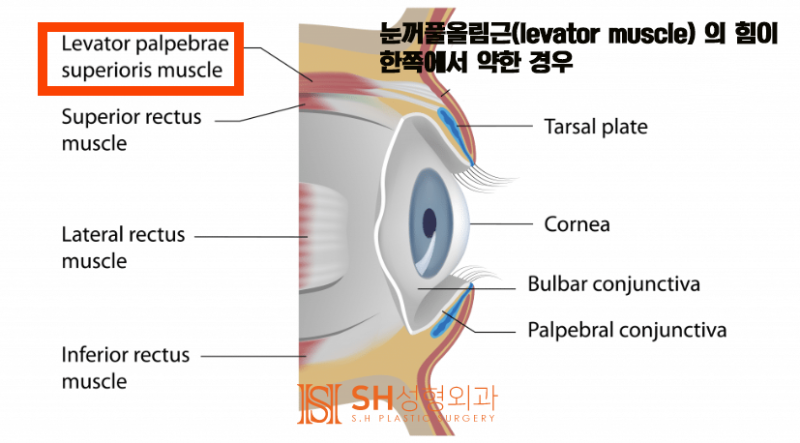
Asymmetrical eyes are the first facial imbalance many people notice when looking in the mirror. Most believe ‘asymmetrical eye correction surgery (ptosis correction)’ is necessary, but in reality, there are design-based approaches that can alleviate asymmetry without surgery. Through this blog, I will explain the structural differences in the eyes, the psychological optical illusion of double eyelid lines, and methods to reduce asymmetrical eyes during the surgical design phase, focusing on clinical cases. I will clearly present why delicate balance adjustment is more important than excessive correction, and the criteria for when ptosis correction is absolutely necessary and when it is not. — Dr. Kim Sung-hoon, Facial Designer at SH Plastic Surgery Clinic
‘I have asymmetrical eyes, do I really need correction surgery?’
Hello. I am Dr. Kim Sung-hoon from SH Plastic Surgery Clinic.
This is a question I always hear from patients who visit with concerns about asymmetrical eyes.
‘Doctor, my asymmetrical eyes are severe, do I really need ptosis correction?’
Many people immediately think of ‘correction surgery’ when they see asymmetrical eyes.
However, not all asymmetrical eyes require ptosis correction.
No one's face can be perfectly symmetrical on both sides.
The size, position, and degree of opening of the left and right eyes differ slightly.
The issue is whether that difference is ‘visible or not’.
In other words, the extent to which the asymmetry is noticeably perceived becomes the criterion for correction.
In this article, I will explore the somewhat paradoxical topic of ‘can asymmetrical eyes be corrected without ptosis correction?’
from the perspective of double eyelid design, unique to me, Facial Designer Kim Sung-hoon.
Anatomical Reasons for Asymmetrical Eyes
Asymmetrical eyes are not simply a difference in eye size.
Anatomically, the following three factors interact:
1. Weakness of the levator muscle on one side
2. Differences in skin and fat layer thickness — one eyelid being slightly thicker
3. Differences in eyebrow position and compensatory forehead muscle movement — using one side of the forehead more when opening the eyes
When these differences act together,
consequently, one eye may appear less open,
or the double eyelid line may form higher or lower.
How to Reduce Asymmetry with Design
Many people think this way:
‘Shouldn't I create a larger double eyelid for the smaller eye to make them look similar?’
However, the opposite is actually true.
The smaller the eye, the larger the double eyelid line you create,
the more counterproductive it is, making the eye appear even smaller.
The reason is simple:
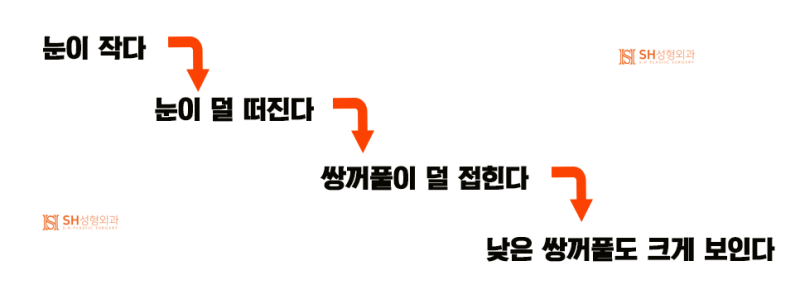
Small eye → Less open → Double eyelid folds less → Even a low double eyelid appears relatively large
Therefore, for smaller eyes, designing a smaller double eyelid line makes both eyes appear to have a similar impression.
CASE
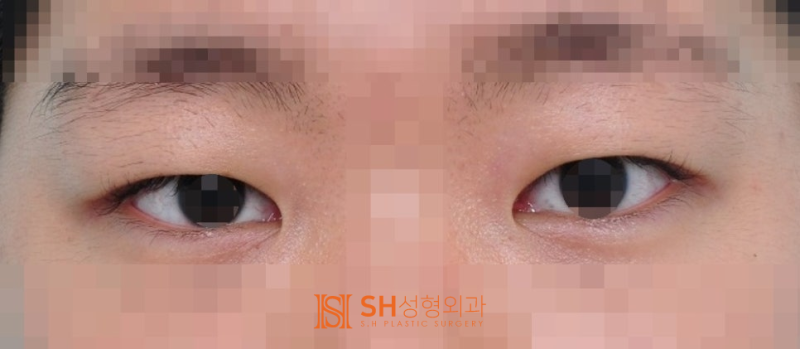
The patient in the photo had a right eye that was smaller and less open than the left.
Usually, in such cases, ‘let's match the size with ptosis correction’ is suggested,
but I adjusted only the double eyelid line without ptosis correction.
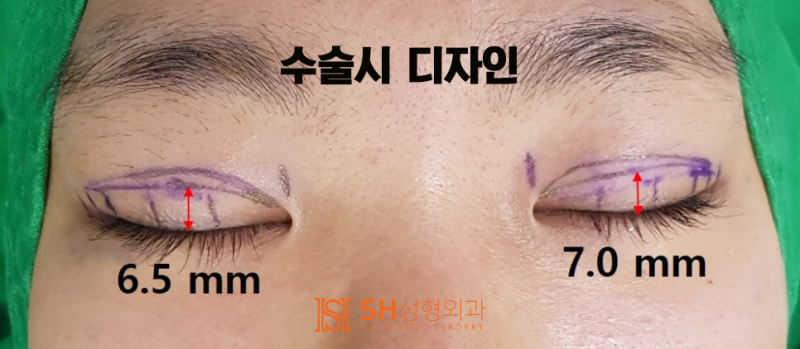
For the smaller eye, I applied a lower and more natural line,
and for the larger eye, a line slightly more stable in height than before.
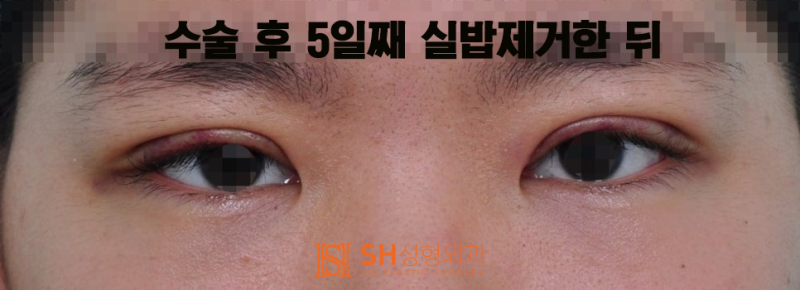
As a result, although the actual sizes of both eyes are still different,
in the perception of the viewer, they were completed as ‘eyes that look similar’.
This is the meaning of
‘correcting asymmetrical eyes without ptosis correction’.
Dr. Kim Sung-hoon's Reflection as a Facial Designer
The left-right symmetry of the eyes is not a matter of numbers, but a matter of impression.
A difference of 0.5mm can be perceived as a large size difference,
while a 1mm difference may not be felt at all.
The most important thing when correcting asymmetrical eyes is ‘a design that makes them look similar’.
Not all problems are solved by surgical correction.
Sometimes, adjusting the balance of the line can be more effective than ptosis correction.
When designing a surgery, I always base it on the ‘visible impression’.
Creating a naturally harmonious face lasts longer
than making the left and right perfectly identical.

FAQ
Q1. Is it always possible to correct asymmetrical eyes without ptosis correction?
No. If there is a significant difference in muscle strength or if ptosis is present,
ptosis correction is absolutely necessary.
Q2. Can adjusting only the double eyelid line change the impression?
Yes. By adjusting only the line height, width, and angle,
sufficient visual symmetry effects can be achieved.
Q3. What is the criterion for asymmetrical eyes?
If there is a difference of 1 to 1.5mm or more in photos
and one eyebrow moves excessively when opening the eyes, correction should be considered.
Q4. Which method, incision or non-incision, is more advantageous?
It depends on the degree of asymmetry.
If the skin is thin and the left-right difference is small, non-incision is better.
If the skin is thick and the muscle difference is large, the incision method is advantageous.
Q5. Can asymmetry reappear over time even after asymmetrical eye correction?
Depending on lifestyle habits (e.g., using forehead muscles, habitual eyebrow lifting),
slight differences may reappear over time.
Q6. Should ptosis correction always be avoided?
No. When necessary, it is best to perform it according to precise indications.
However, if it is simply asymmetrical eyes, reducing the intensity of the surgery is safer.
SH Plastic Surgery Clinic
How long will you live with asymmetrical eyes? Want to successfully escape asymmetrical eyes? [Kim Sung-hoon Plastic Surgery]
Next, I will introduce various ways to resolve asymmetrical eyes.