2026-05-25
1. Endoscopic Forehead Lift
Plastic surgeon Dr. Young-moon Yoo explains the principles, ideal candidates, and procedure of endoscopic forehead lifts for natural eye rejuvenation.
Hello.
I am Dr. Young-moon Yoo, a specialist in plastic surgery.
When people think about eye surgery,
they often only consider:
‘Should I get double eyelid surgery if I don’t have them?’
‘Should I get ptosis correction if my eyes look sleepy?’
‘Is upper blepharoplasty only for older people?’
You might have had double eyelid surgery or ptosis correction,
and while your eyes became larger and clearer...
there are definitely those who are dissatisfied because
their impression looks too ‘sharp’ or ‘aggressive,’
or their upper eyelids look even more puffy.
In such cases, what we need to examine is
the position of the eyebrows—
specifically, the distance between the eyebrows and the eyes.
This is a crucial factor that requires careful attention.
Therefore, today we will look into the
Endoscopic Forehead Lift, a surgical method to place eyebrows in their ideal position. ^^
* Ideal Eyebrow Position
1. With eyes open: A gap of about 1 to 1.5 times the size of the black pupil.
2. With eyes closed: A distance of 20–26mm between the eyelashes and the eyebrow.
3. The eyebrow should be positioned on the most prominent part of the brow bone.
These are the general standards.
However, what is even more important is!
Whether it ‘suits you’ when you manually lift the eyebrows.
Everyone has a different face shape (round, long, angular...), and the width of the forehead and hair density are also important factors.
(We wouldn’t want someone to be dissatisfied because lifting the brows made their face look too long or their forehead too wide.)
Therefore, you should decide after receiving a direct consultation from an experienced plastic surgeon.
* Who will be most satisfied with this surgery?
1. Those whose eyebrows are too low, making the space between the eyes and brows narrow.
2. Those with a narrow forehead and severe wrinkles.
3. Those with long, deep wrinkles around the eyes, between the brows, or on the bridge of the nose.
4. Those whose upper eyelids look puffy or swollen.
5. Those whose puffiness worsened as the eyebrows dropped after double eyelid or ptosis surgery.
It has been about 5 years since I started performing endoscopic forehead lifts, and the biggest change compared to back then is
that the patient demographic has become much younger.
In the past, it was mainly the middle-aged and older population who chose this surgery.
(Even then, I had to explain thoroughly why it was necessary and persuade them... many mothers who came in for just an upper blepharoplasty were surprised when I suggested a forehead lift ^^;)
Nowadays, demand among the younger generation seems to be increasing.
Like case number 5 above, they thought double eyelid surgery or ptosis correction alone would make their eyes look refreshed and large, but they experienced the brows dropping and looking even puffier.
Patients who visit after feeling this necessity firsthand
tend to have extremely high satisfaction with the surgery. ^____^
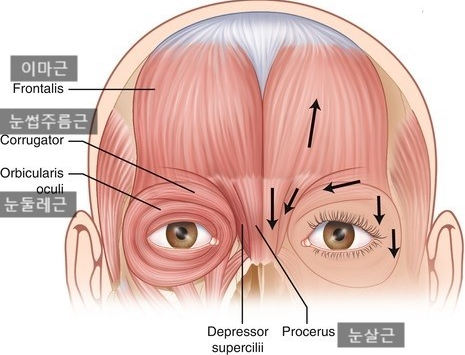
* Principles of Surgery Based on Anatomical Understanding
Muscles that lift the eyebrows | Muscles that pull the eyebrows down |
Frontalis muscle | Corrugator |
Procerus | |
Depressor supercili muscle | |
Orbicularis oculi muscle |
The principle of the surgery is to use an endoscope to properly dissect and release the muscles that pull the eyebrows down, allowing the eyebrows to rise naturally.
* The Process
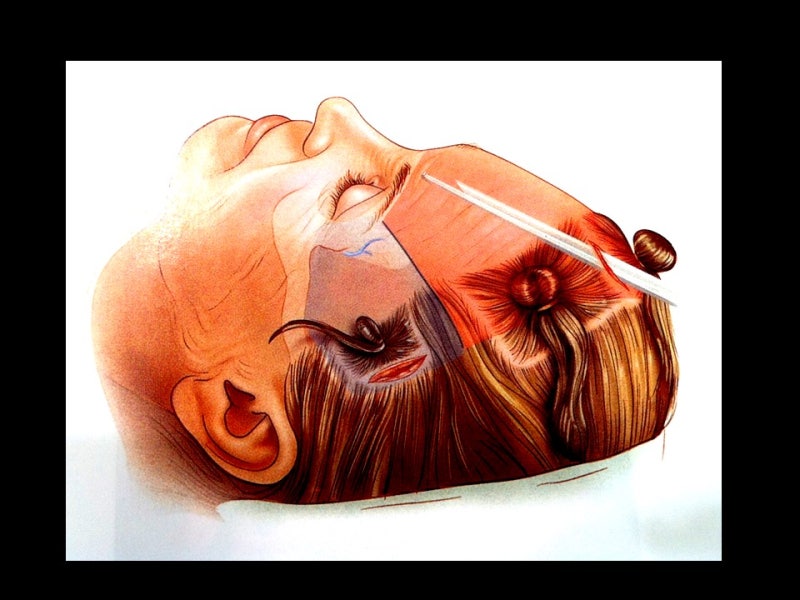
As you might expect,
performing surgery using an ‘endoscope’ means
less bleeding and faster recovery.
(It’s the same logic as laparoscopic surgery being simpler and having a faster recovery than open abdominal surgery.)
1. Under sleep anesthesia
2. The hair is neatly braided (this process actually takes quite a long time)
3. 5 (sometimes 3) incisions are made
4. Careful dissection is performed while viewing through the endoscope to avoid damaging nerves and blood vessels
5. Retaining ligaments are carefully dissected
6. The forehead is lifted to the desired amount
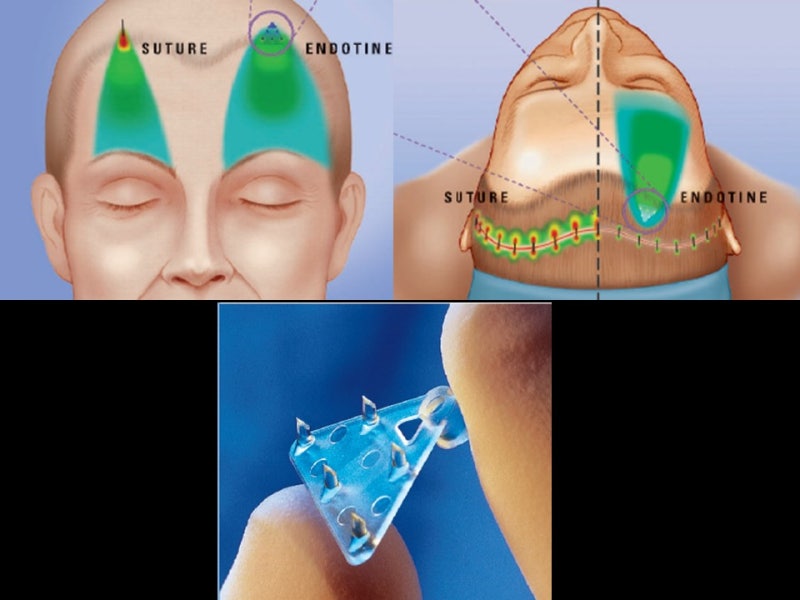
7. Fixed using Endotine or sutures
8. The incisions are sutured
9. Dressing is applied
And it’s finished.
Even with these steps, it can be completed in 40 minutes to an hour, so I want to emphasize that it is not a burdensome or ‘major’ surgery.
* Possible Post-operative Complications and Treatments
1. Hematoma
Since the endoscope allows for direct visualization and meticulous dissection of blood vessels, bleeding significant enough to cause a hematoma rarely occurs. Furthermore, a hemovac (drain) is inserted preventatively, further reducing this risk.
However, if it does occur, it is important to reopen the existing incision immediately and stop the bleeding at the source using the endoscope.
2. Sensory Abnormality
In the past, when surgery was performed without an endoscope, the supraorbital and supratrochlear nerves were sometimes damaged during dissection, causing sensory issues from the forehead to the scalp—such as numbness or paresthesia. However, with the use of an endoscope for careful dissection around the nerves, you don’t need to worry about permanent sensory loss. Temporary sensory changes may last for 1–3 months, but it is very rare for them to persist beyond that.
3. Eyebrow Asymmetry
If the fixed sutures or Endotine have loosened, re-fixation may be necessary. If there was a difference in the extent of dissection, further dissection using the endoscope may be required.
4. Forehead Skin Necrosis
In very rare cases, if the bandage is wrapped too tightly during dressing, the forehead skin can be compressed and undergo necrosis (especially along the drain line). Therefore, it is important to apply the dressing lightly enough so as not to interfere with blood circulation.
5. Feeling the Endotine
In patients with thin skin, the Endotine may occasionally be felt as a sharp point under the skin. However, since it is an absorbable implant that dissolves within 3 months, patients rarely complain of such discomfort over time.
Today, I prepared an archive after a long while.
I hope this helped resolve the curiosity of those interested,
and I will return with more useful topics next time!
Thank you.