2026-05-23
1. What Double Eyelid Line Suits Me?
Board-certified plastic surgeon Dr. Yoo Young-moon explains ethnic differences in eyelid anatomy and how to identify the double eyelid crease that naturally suits your features.
Hello.
I am Dr. Yoo Young-moon, a board-certified plastic surgeon.
'Archive' is a space where I organize the theoretical knowledge I have studied — and continue to study and reflect on every day — about each area of the face, presented in a way that is easy for everyone to understand.
I hope this becomes an opportunity for you to develop the discernment needed to make truly informed choices about cosmetic surgery.
When people describe
'the feature that defines your first impression,
the very first thing others notice' —
what comes to mind?
It is almost always the eyes. First impressions are largely made — or broken — by them.
That is why, for so many people, eye surgery ends up being their very first cosmetic procedure.
Koreans — and East Asians more broadly — often have fuller, fattier eyelids with either no crease at all (monolid) or a very faint hidden inner crease. This can sometimes give the eyes a slightly sharp or heavy appearance.
Western eyes, on the other hand, tend to have thinner skin with less fat and a more prominent double eyelid crease, which lends them a fresher, more striking look.
These days, it seems many people are drawn to that Western-style eye aesthetic.
Cited from Aesth Plast Surg (2010) 34: 800–801, Aesth Plast Surg (2006) 30: 729–730, Rhee SG. MD., PhD.
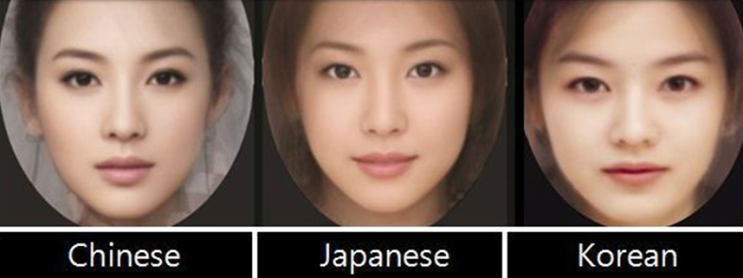
The images above are composite photographs of beautiful women from various ethnic backgrounds.
Looking at them...
..
.
They are all lovely and attractive in their own right.
If there is a difference to note, it seems East Asians tend to favor a more natural infold-to-in-and-out crease, while those with Western features lean toward a more pronounced outfold crease.
These differences appear to stem from the distinct eye structures, anatomical characteristics, and cultural backgrounds unique to each ethnic group.
So — what is the right crease line for me?
I think this style looks beautiful and I would love to have it... but would it actually suit me?
When these questions start swirling, the first thing most people do is grab a mirror and something pointy — a toothpick, for instance — and start experimenting with different crease lines. They try this line, that line, all kinds of variations.
Those who want to feel the effect of an epicanthoplasty start lifting the skin with their fingers, pulling the outer corners down, and so on. (Many people, in particular, tend to lift the skin near the inner corners of the eyes.)
Then they spend hours scrolling through Instagram looking at photos — especially of attractive everyday people who seem to have a face shape similar to their own...
'Her eyes look kind of like mine — if I got a double eyelid done, I could end up looking like this.' Holding that image in mind, they go ahead and book a consultation at a clinic. (That is honestly what most people seem to do.)
Patients like these know exactly what they want. They have saved at least two or three reference photos on their phones. During consultations, they ask thoughtful questions and demonstrate the crease they are envisioning by lifting their eyelid with a finger.
In fact, patients like this are often easier to consult with — precisely because they have a clear sense of what they are after. (As long as the requests stay within reason, of course.)
One interesting shift worth noting: where patients used to show photos of celebrities, these days they are far more likely to pull up photos of everyday people and influencers they follow on Instagram.
The bottom line: the natural crease you create in the mirror using a pointer — a toothpick, a fine brush handle, whatever you have on hand — is your closest approximation of what your own double eyelid would actually look like. Other people's photos are just references. The crease that forms most naturally for you will ultimately follow the natural contours of your own skin.
After all this deliberation, visiting a board-certified plastic surgeon for a consultation will help you visualize — far more concretely — the crease line you have only been imagining.
At that point, listening carefully to your surgeon's explanation is, of course, essential. But having at least a basic understanding of your own eye anatomy beforehand certainly does not hurt, does it?
So, the topic of the next post will be:
'What factors should be considered?' (a.k.a. what plastic surgeons actually evaluate)
See you in the next post!
Right thinking, right surgery — Dr. Yoo Young-moon