2026-09-03
Lower Blepharoplasty Procedure and Precautions: Key to Correcting Sagging Skin and Under-Eye Fat
Learn about lower blepharoplasty, a procedure to correct sagging lower eyelids, under-eye fat, and deep wrinkles. Understand the conservative approach, incision, fat management, and crucial precautions like avoiding excessive skin removal to prevent complications.
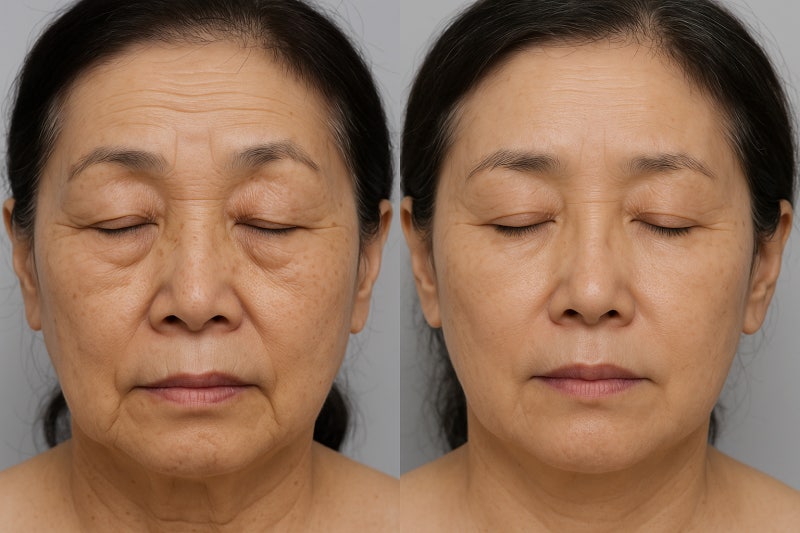
What is Lower Blepharoplasty?
A 70-year-old woman visited the hospital due to sagging lower eyelids.
The lower eyelid is commonly referred to as the ‘lower bleph’. When the skin of the lower bleph sags, deep horizontal wrinkles often form under the eyes, and the under-eye fat appears bulging, often accompanied by tear troughs that look like dark circles.
Recent Trends in Lower Blepharoplasty: Conservative Methods
Recently, lower blepharoplasty primarily employs conservative methods that minimize the removal of skin and fat.
This is not merely a ‘trend’ but rather a new principle aimed at achieving natural results and reducing side effects.
It has the advantages of preventing unnecessary tissue loss, faster recovery, and natural-looking results.
Incision and Scars in Lower Blepharoplasty
Typically, the incision is made just below the eyelashes.
After recovery, the scar is not very noticeable and usually does not pose a significant problem.
Methods for Treating Under-Eye Fat
The most crucial part of lower blepharoplasty is the under-eye fat.
Simple removal
Repositioning to the tear trough
Septal reinforcement (strengthening the weakened septum to prevent re-protrusion)
Especially since the weakening of the septum that holds the fat in place due to aging is one of the main causes, repositioning and reinforcement are more important than simple removal.
Side Effect of Lower Blepharoplasty: Ectropion
After surgery, ectropion, where the lower eyelid appears to be turned outwards, may occur.
This can happen due to:
Excessive skin/tissue excision
Pre-existing lack of lower eyelid elasticity
Therefore, it is crucial to accurately assess the condition of the lower eyelid before surgery and to firmly fix it to stable tissue.
Importance of Skin Excision Amount
Excessive skin excision is strictly prohibited.
If too little is removed, additional correction is possible,
but if too much is excised, correction is extremely difficult.
Therefore, determining the appropriate amount of excision based on the patient's skin condition is key.
Conclusion
This patient also underwent surgery with full consideration of the above points and achieved good results without major issues.
After the swelling subsides and the recovery period passes, a natural and satisfactory under-eye line can be expected.
Frequently Asked Questions
When is lower blepharoplasty necessary?
Lower blepharoplasty is necessary when the skin of the lower eyelid sags, deep horizontal wrinkles form under the eyes, and under-eye fat bulges, creating shaded tear troughs. It is most commonly sought by patients in their 60s and 70s experiencing these symptoms.
What is the current trend in lower blepharoplasty?
The current trend in lower blepharoplasty is a conservative approach that minimizes the removal of skin and fat. This is considered a new principle for preventing unnecessary tissue loss, promoting faster recovery, achieving natural results, and reducing side effects.
Are scars noticeable after lower blepharoplasty?
No, typically the incision is made just below the eyelashes, so after recovery, the scars are not very noticeable and usually do not pose a significant problem. They heal naturally over time and become almost invisible.
How is under-eye fat handled during lower blepharoplasty?
In lower blepharoplasty, rather than simple removal, it is important to reposition under-eye fat into the tear trough or to strengthen the weakened septum to prevent re-protrusion (septal reinforcement). This is because the weakening of the septum due to aging is a primary cause.
What are the possible side effects after lower blepharoplasty?
After surgery, ectropion, where the lower eyelid appears to be turned outwards, may occur. This can happen due to excessive skin or tissue excision, or if the lower eyelid's elasticity was originally insufficient. Therefore, accurate pre-surgical assessment and proper fixation are crucial.
Why is the amount of skin excised important?
The amount of skin excised is very important. Excessive skin excision can lead to side effects like ectropion, which is very difficult to correct. If too little skin is excised, additional correction is possible. Therefore, determining the appropriate amount of excision based on the patient's skin condition is key.