2026-09-03
Nasolabial Fold Botox, Thread Lift, and Filler: A Comprehensive Guide to the Differences Between Procedures
Confused about nasolabial fold treatments? This guide explains the differences between Botox, thread lifts, and fillers, helping you understand which option is best for your specific concerns and facial aging patterns.
※ This article is intended to provide medical information.
It is not subject to deliberation under Article 56, Paragraph 2 and Article 57 of the Medical Act,
and is not an advertising post unrelated to the deliberation content.
Hello,
I am Dr. Park Jeong-geun,
Director of Faceplus Plastic Surgery Clinic.

Nasolabial folds are one of the areas on the face that make one look older first.
Many people are bothered by deepening nasolabial folds every time they look in the mirror, but when they research treatments, they find various methods like nasolabial fold Botox, thread lifts, and fillers,
leaving them wondering which option is right for them.
However, nasolabial fold Botox, thread lifts, and fillers each have
different principles of improvement and suitable candidates.
Today, I will easily explain the differences between nasolabial fold Botox, thread lifts, and fillers, and in what cases each can be considered.

Table of Contents | ||
1. Reasons for Nasolabial Folds 2. Differences Between Nasolabial Fold Botox, Thread Lift, and Filler 3. When is Each Treatment Suitable? 4. What to Check When Choosing a Procedure |
1. Reasons for Nasolabial Folds
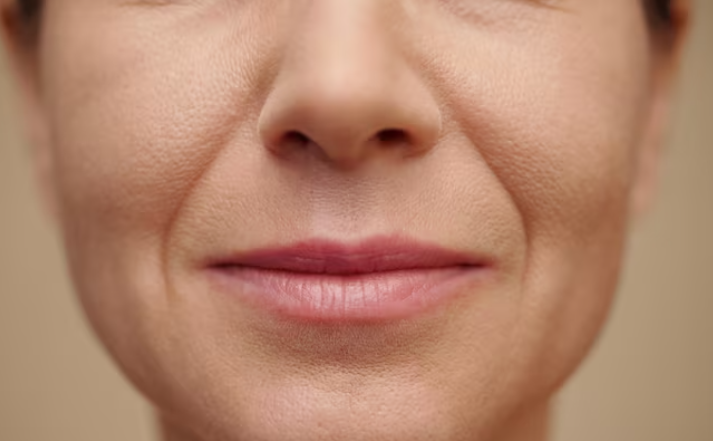
Many people simply think of nasolabial folds as skin wrinkles, but in reality, multiple causes often act together.
As we age, skin elasticity decreases,
and the downward migration of cheek fat can deepen the nasolabial area.
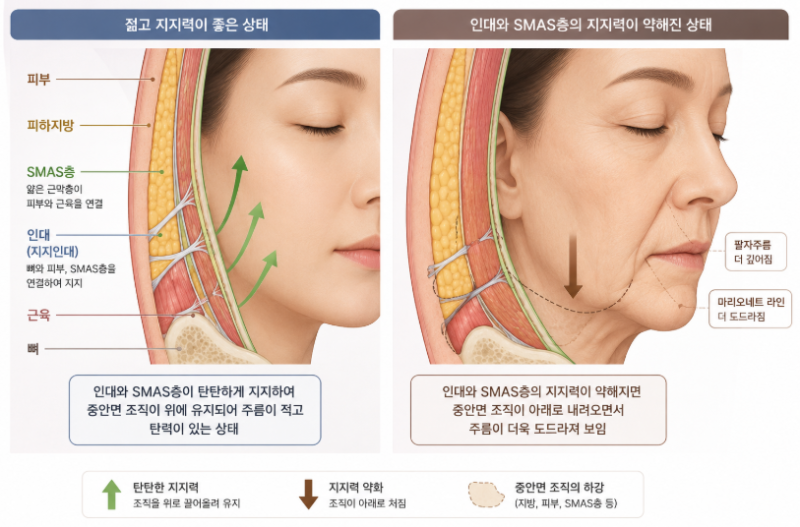
Additionally, if the supporting strength of the ligaments and SMAS layer weakens,
the mid-face tissue descends, making the wrinkles
appear even more prominent.
In other words, it's not just a problem of volume deficiency,
but rather a process involving changes in the skin, fat, and muscle layers.
Accurately identifying these causes is crucial to determine
which method among nasolabial fold Botox, thread lifts, and fillers is appropriate.
2. Differences Between Nasolabial Fold Botox, Thread Lift, and Filler

Nasolabial fold Botox, thread lifts, and fillers are
all used to improve nasolabial folds,
but they approach the problem differently.
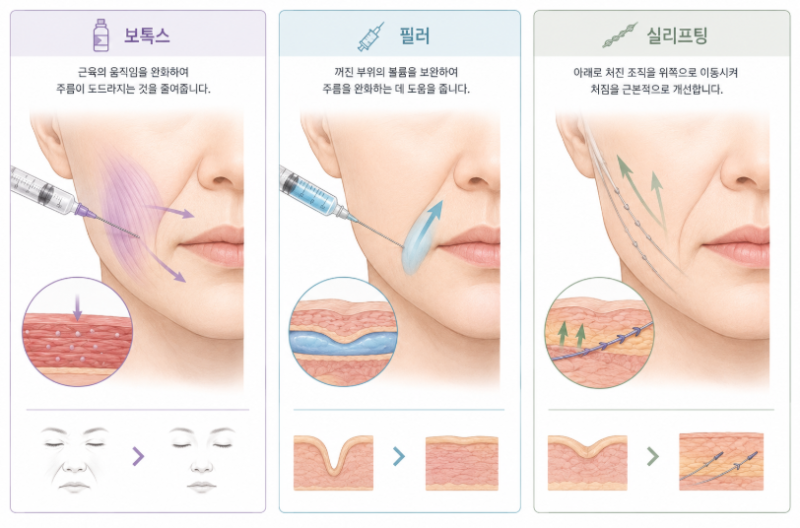
Among nasolabial fold Botox, thread lifts, and fillers, Botox can be used restrictively
when wrinkles are more prominent due to muscle movement around the mouth or facial expression habits.
Fillers can help alleviate nasolabial folds by supplementing volume in sunken areas,
and thread lifts approach the problem by lifting sagging tissue upwards,
improving the sagging that causes wrinkles.
Therefore, the choice between nasolabial fold Botox, thread lifts, and fillers
may vary depending on the cause rather than just the procedure's name.
3. When is Each Treatment Suitable?

If movement is the cause, Botox is often considered;
if volume loss is the main cause, fillers are considered;
and if cheek sagging is also present, thread lifts are often considered.
However, in reality,
it's more common for multiple causes to be present than just one.
Therefore, instead of choosing just one among nasolabial fold Botox, thread lifts, and fillers,
a combination of treatments may be planned depending on the condition.
The important thing is not to choose a trendy procedure,
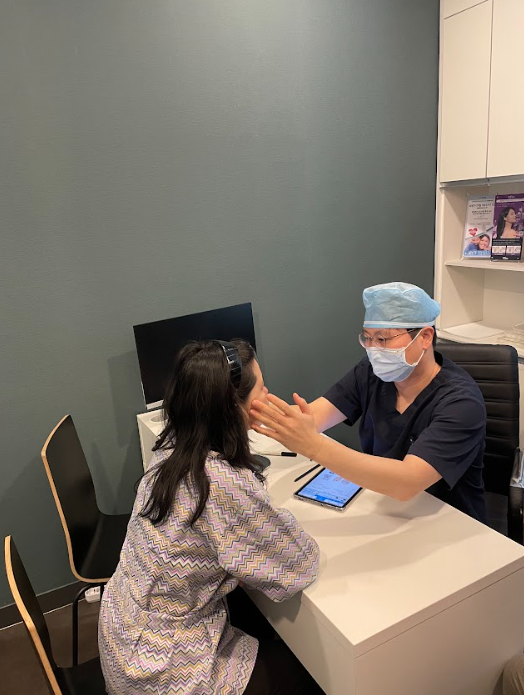
but to analyze the current facial structure and aging patterns
to determine the most suitable method.
4. What to Check When Choosing a Procedure
For nasolabial folds, it's not just about looking at the wrinkles;
mid-face volume, skin elasticity, cheek sagging,
and facial proportions must all be considered together.
Even if nasolabial folds are of the same depth,
the appropriate approach may differ if the causes are different.
Nasolabial fold Botox, thread lifts, and fillers are procedures with clear advantages and
distinct characteristics.

Therefore, when comparing nasolabial fold Botox, thread lifts, and fillers,
it is important to first understand the current facial condition and the causes of aging rather than the procedures themselves.
The more a plan aligns with the cause,
the more natural and satisfying results can be expected.
-Operating Hours-
Weekdays 9:00 ~ 18:00 Saturdays 9:00 ~ 16:00 Holidays / Sundays Regular closure |
-Contact Us-
Faceplus Plastic Surgery Clinic | ||
Consultation Phone: 02-541-8500 Inquiries: KakaoTalk Inquiry |
-Directions-
Frequently Asked Questions
Why do nasolabial folds appear?
Yes, nasolabial folds appear due to a combination of several factors. As we age, skin elasticity decreases, cheek fat moves downwards, and the supporting strength of the ligaments and SMAS layer weakens, causing the mid-face tissue to sag and deepen the folds.
In what cases is nasolabial fold Botox suitable?
Nasolabial fold Botox is suitable when wrinkles are prominent due to muscle movement around the mouth or facial expression habits. It can be used restrictively when excessive muscle movement is the primary cause.
In what cases are nasolabial fold fillers suitable?
Nasolabial fold fillers are suitable when volume loss is the main cause. Fillers can help alleviate nasolabial folds by supplementing volume in sunken areas.
In what cases is nasolabial fold thread lifting suitable?
Nasolabial fold thread lifting is suitable when sagging tissue is the cause of the wrinkles. It helps improve the sagging that causes wrinkles by moving the sagging mid-face tissue upwards.
What is the most important consideration when choosing a nasolabial fold procedure?
The most important consideration is to analyze the individual's facial structure and aging patterns rather than choosing a trendy procedure. Determining the most suitable method for your current condition can lead to natural and satisfying results.
Are nasolabial folds merely a wrinkle problem?
No, nasolabial folds are not just a wrinkle problem. Various factors such as mid-face volume, skin elasticity, cheek sagging, and facial proportions must be considered together. Even if the wrinkles are of the same depth, the appropriate approach may differ if the causes are different.