2026-07-20
Today LASEK: Why CoWave Technology Reduces Glare | Gangnam Station Eye Clinic
Learn how Today LASEK with CoWave technology at Gangnam Smile Eye Clinic minimizes glare and improves vision quality after surgery.


Hello, this is Gangnam Smile Eye Clinic😊💙
If you're considering vision correction surgery,
you've probably heard of ‘Today LASEK’, which has recently gained attention.
It offers advantages in terms of fast recovery and pain management,
making it a popular choice for many.
However, along with anticipation, concerns often arise.
Specifically, the phenomenon of ‘glare’ after surgery
is a common worry for many.
This includes experiencing lights scattering at night,
or discomfort due to dazzling brightness while driving at night.
Even if vision has improved, such discomfort in night vision
can cause unpleasantness in daily life.
For this reason, there's growing interest in technologies that consider overall visual quality after surgery,
rather than simply aiming for vision correction.
Among these, ‘CoWave’ is a particularly noteworthy technology.
Today, at Gangnam Smile Eye Clinic,
we'll explore how CoWave technology improves visual quality
for those concerned about glare after LASEK.
Why does glare occur after Today LASEK?

One of the biggest reasons for glare after LASEK surgery
is the mismatch between the corneal ablation zone and pupil size.
Surgery typically ablates the cornea based on an area narrower than the central pupil,
and when the pupil dilates in a dark environment,
light enters through the peripheral areas not reached by the laser.
This causes light to scatter and appear spread out, which is ‘glare’.
Additionally, the same symptoms can occur if corneal asphericity (abnormal curvature changes) develops during surgery,
or if higher-order aberrations increase.
Higher-order aberrations are not easily correctable with glasses, like myopia or astigmatism,
but rather subtle degradations in visual quality caused by distortions in the light's refractive path.
This can lead to light appearing scattered or objects appearing doubled,
and can feel more severe at night.
Furthermore, visual distortion can also occur if the cornea heals unevenly after surgery
or if haze remains.
Ultimately, glare is the result of various factors interacting, such as individual eye structure, healing process, and pupil size.
Corneal structure and higher-order aberrations, as unique as fingerprints
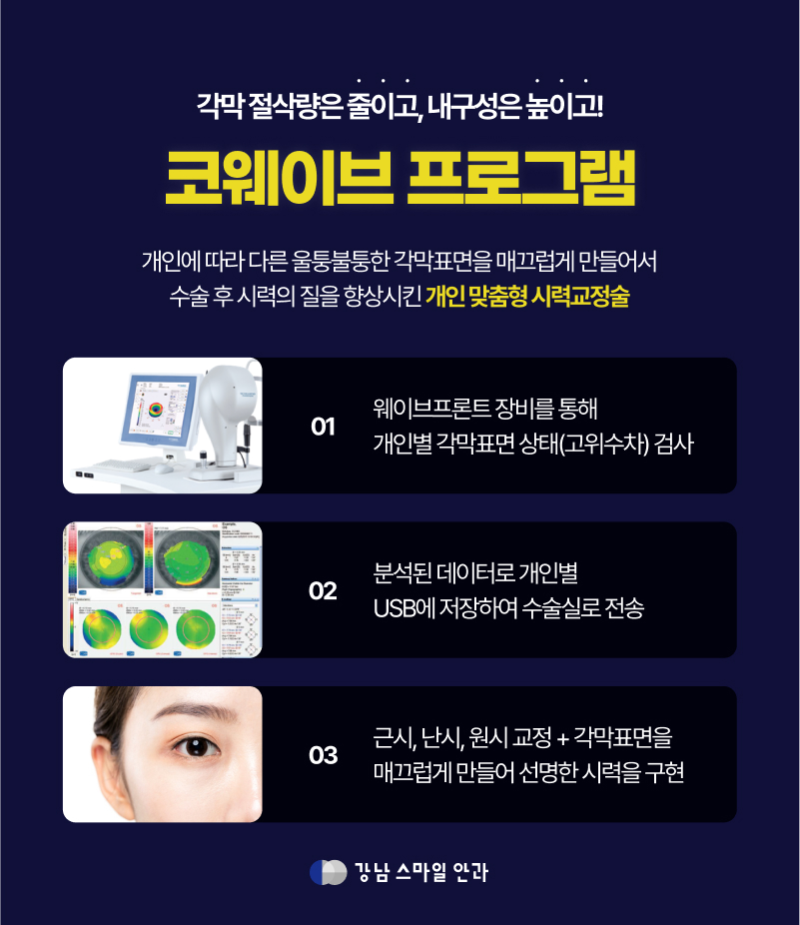
The cornea is the transparent structure at the outermost part of our eye that refracts light.
The thickness, curvature, and shape of this cornea vary for each individual.
It possesses a unique form, much like a fingerprint.
Higher-order aberrations also stem from these structural differences.
These refer to high-dimensional distortions occurring in the optical system of the eye,
not just simple refractive errors.
Their impact typically increases when the pupil dilates at night,
and can manifest as symptoms of scattered light.
Therefore, it is crucial to accurately analyze one's corneal structure and higher-order aberrations
through precise pre-operative examinations,
and to establish a customized correction plan accordingly.
Gangnam Station Eye Clinic, What is Today LASEK CoWave?
CoWave is a technology that performs customized surgery
based on corneal surface topography information.
Through precise corneal topography analysis, the patient's eye condition is stored on a USB memory chip,
and this is linked with the FDA-approved ‘Amaris Red SPT’ equipment,
to perform surgery accurately tailored to that specific structure.
While traditional vision correction surgery simply relied on vision metrics,
CoWave incorporates higher-order aberrations and individual optical characteristics.
This can be particularly advantageous for people with large pupils or those sensitive to night vision.
In summary, CoWave is a precise correction technology that enhances ‘visual quality’,
not just simple correction.
Post-operative satisfaction is determined by visual quality

If you're concerned about glare,
simply correcting vision may not be enough.
Only when your eye condition is precisely analyzed
and customized surgery considering higher-order aberrations is performed,
can you expect clear and comfortable results, even for night vision.
Everyone's eyes are different.
Finding the most suitable surgical method through sufficient examination and analysis before surgery
is the most important starting point for increasing satisfaction with the surgical outcome.
Gangnam Smile Eye Clinic sets the standard for Today LASEK
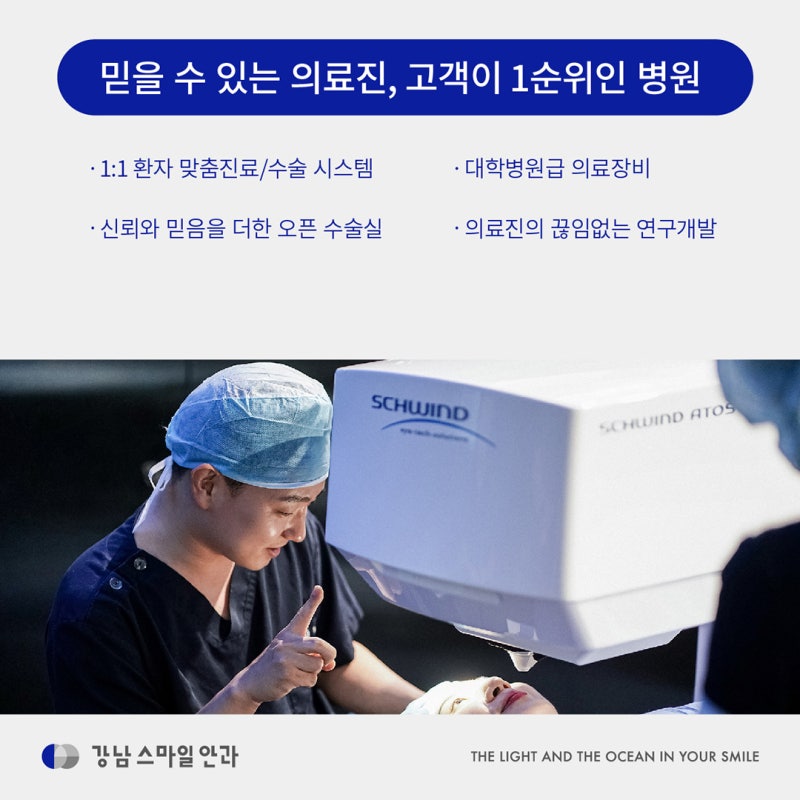
Gangnam Smile Eye Clinic strives to provide clearer and more comfortable vision
through customized Today LASEK based on CoWave technology.
Various national sports stars, including archer An San, have visited our clinic
and experienced stable vision even during high-intensity sports.
With accurate diagnosis, extensive surgical experience, and post-operative care,
you can trust Gangnam Smile Eye Clinic.
Your precious eyes,
receive the most precise care.
💙 Smile Surgery is indeed at Gangnam Smile Eye Clinic 💙
💙🤍 𝖦𝖠𝖭𝖦𝖭𝖠𝖬 𝖲𝖬𝖨𝖫𝖤 𝖤𝖤 𝖢𝖫𝖨𝖭𝖨𝖢💙🤍
𝗧𝗛𝗘 𝗟𝗜𝗚𝗛𝗧 𝗔𝗡𝗗 𝗧𝗛𝗘 𝗢𝗖𝗘𝗔𝗡 𝗜𝗡 𝗬𝗢𝗨𝗥 𝗦𝗠𝗜𝗟𝗘














Frequently Asked Questions
Why does glare occur after 2-Day LASEK?
Yes, glare can occur due to several reasons. The biggest reason is that the corneal ablation area during surgery is narrower than the pupil size, causing light to scatter from the untouched periphery when the pupil dilates in a dark environment. Additionally, corneal asphericity, increased higher-order aberrations, and uneven corneal healing can also be causes.
What is CoWave technology?
CoWave is a technology that performs customized surgery for each individual patient based on the surface topography information of the cornea. It aims to improve not only visual acuity but also the quality of vision by precisely analyzing corneal topography and reflecting higher-order aberrations and individual optical characteristics.
Who can particularly benefit from CoWave technology?
CoWave technology can be particularly advantageous for individuals with large pupils or those sensitive to night vision. By precisely analyzing the individual's eye structure and higher-order aberrations to perform customized correction, it is effective in reducing visual discomforts such as night glare.
What are higher-order aberrations, and how are they related to glare?
Higher-order aberrations are subtle degradations in vision quality caused by distortions in the light's refractive pathway that are not easily corrected with glasses, unlike myopia or astigmatism. They can cause symptoms such as light scattering or double vision, and their impact can be greater, leading to glare, especially when the pupil dilates at night.
Why is a precise examination important before 2-Day LASEK?
Yes, a precise examination before surgery is very important. It is necessary to accurately analyze the corneal structure and higher-order aberrations, which are as unique as fingerprints for each individual, and to establish a customized correction plan accordingly. This allows for not only vision correction but also satisfactory results that consider the quality of night vision after surgery.