2026-07-14
Main Materials Used for the Nasal Tip
Learn about the various materials used for nasal tip surgery, including ear cartilage, septal cartilage, autologous costal cartilage, and donated costal cartilage, and their respective benefits and considerations.



The nose, situated in the center of the face, plays a crucial role in determining the overall facial proportion, harmony, and three-dimensionality. For example, an upturned nasal tip can make the face appear brighter and more vibrant, while a lower nasal tip can convey a calm or sophisticated look. When undergoing rhinoplasty, the height of the nasal bridge and the height of the nasal tip are primary considerations. While the nasal bridge height can typically be adjusted using silicone, the nasal tip, which is elevated to match, can be supported and adjusted using various materials. Today, we will explain the materials used for the nasal tip.
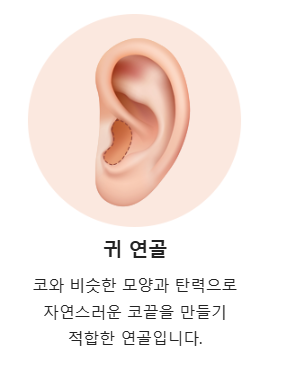
1. Ear Cartilage
Ear cartilage is suitable for creating a natural-looking nasal tip due to its similar shape and elasticity to the nose. It is often used as an additional material to supplement cases of nasal asymmetry or when the existing nasal cartilage (septal cartilage) is insufficient or weak. Its excellent elasticity and flexibility make it easy to sculpt into various forms to achieve the desired shape. The cartilage is harvested by making a small incision in the skin behind the ear. After ear cartilage harvesting, both the ear and nose areas will have small sutures, and a compression bandage or protector may be worn for a certain period to protect the ear.

2. Septal Cartilage
Septal cartilage is cartilage from inside the nose used for columellar support and nasal tip angle adjustment. It supports the middle structure of the nose and plays a vital role in maintaining its shape. It is harvested from inside the nose, avoiding incisions on other parts of the body. Furthermore, it is firmer than ear cartilage, making it excellent for creating a firm and prominent nasal tip, and it is the most commonly used material for primary surgeries. However, in Asians, the size is often smaller than in Westerners, and since the septum forms the supporting structure of the nose, a certain width must be left intact during harvesting to maintain the nose's normal support, which may necessitate the additional use of other cartilage.
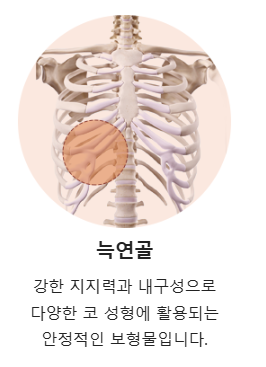
3. Autologous Costal Cartilage
Autologous costal cartilage is stable cartilage utilized in various rhinoplasty procedures due to its strong supportive power and durability. It possesses a stronger structure compared to other cartilages, meaning its shape is less likely to deform over time, allowing the nasal shape to be maintained for longer. In particular, when existing septal cartilage or ear cartilage is insufficient, autologous costal cartilage is used as an alternative. It is harvested from the cartilage located at the end of one's own ribs. The harvestable area is limited, so it is mostly used for revision surgeries rather than primary surgeries. To obtain sufficient cartilage, it may be necessary to take cartilage from several ribs in the chest area. Additionally, a thoracic incision is required after rib harvesting, making scar management essential.
4. Donated Costal Cartilage
Donated costal cartilage is material harvested from another person's ribs and processed to prevent rejection by the body. Donated cartilage undergoes rigorous testing to minimize immune rejection and becomes an important alternative option for patients who lack autologous cartilage. Furthermore, because it uses another person's ribs, there is no concern about scars, and rapid recovery is possible. It also possesses strong supportive power and durability, similar to autologous costal cartilage. However, there may be differences in strength or quality depending on the product, and the absorption rate may be higher compared to autologous costal cartilage.

The most crucial aspect of rhinoplasty is to accurately diagnose the patient's condition and then select the appropriate materials and surgical method. Nasal tip surgery encompasses various types, such as cases where the nasal tip is large and blunt, or drooping, or when an implant in the nasal tip has caused inflammation. Correspondingly, a variety of materials can be used. Therefore, before considering materials, it is essential to consult with an experienced specialist to obtain sufficient information and compare the pros and cons of the surgery before making a decision.



Frequently Asked Questions
How is ear cartilage used in nasal tip surgery?
Ear cartilage is suitable for creating a natural-looking nasal tip due to its similar shape and elasticity to the nose. It is particularly used as an additional material when there is nasal asymmetry or insufficient existing nasal cartilage, and its flexibility makes it easy to sculpt into various forms to achieve the desired shape.
What are the characteristics of septal cartilage?
Septal cartilage is harvested from inside the nose and is firmer than ear cartilage, making it excellent for creating a prominent nasal tip. It is the most commonly used material for primary surgeries, but in Asians, its size may be small, so it might be used in conjunction with other cartilage.
When is autologous costal cartilage primarily used?
Autologous costal cartilage has strong supportive power and durability, leading to minimal shape deformation over time. It is mainly used as an alternative in revision surgeries when existing septal cartilage or ear cartilage cannot adequately address the issue.
What are the advantages of donated costal cartilage?
Donated costal cartilage is processed from another person's ribs, resulting in minimal rejection by the body. It is a good alternative option for patients who lack autologous cartilage, allows for quick recovery without concerns about scars, and possesses strong supportive power similar to autologous costal cartilage.
What is the most important factor when choosing nasal tip surgery materials?
The most important factor when choosing nasal tip surgery materials is to accurately diagnose the patient's condition and select the appropriate materials and surgical method. It is crucial to consult with an experienced specialist to obtain sufficient information and compare the pros and cons before making a decision.