2026-07-14
What are the best materials for rhinoplasty? | All about rhinoplasty materials, a comprehensive guide
Choosing the right material for rhinoplasty is crucial. This article details the pros and cons of various options, from autologous tissues like costal cartilage and septal cartilage to synthetic implants, helping you make an informed decision for a safe and aesthetically pleasing outcome.

For those planning rhinoplasty, the most significant concern is undoubtedly ‘the choice of material’.
This is because there is such a wide variety of materials, from silicone to autologous tissues like septal cartilage, ear cartilage, and costal cartilage, and each possesses different characteristics.
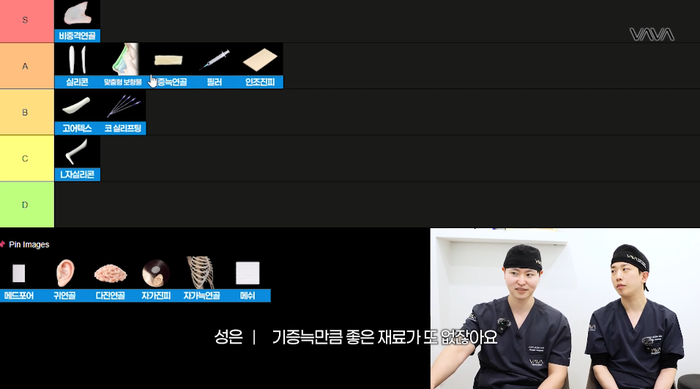
Today, we will delve into the objective advantages and disadvantages of each material, based on a list of analyzed rhinoplasty materials.
The Most Ideal Autologous Tissue Materials

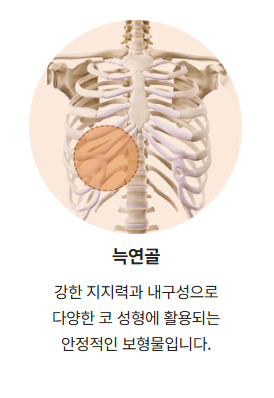
▶ Autologous Costal Cartilage
The material that received the highest score is autologous costal cartilage.
This method involves harvesting cartilage from the patient's own ribs.
It offers very strong support and is abundant in quantity, yielding optimal results for significantly increasing nose height or extending its length.
It boasts irreplaceable stability, especially in revision surgeries or for correcting contracted noses.
Considerations include the possibility of a scar from an incision below the chest, a somewhat longer surgery time, and financial burden.
However, it is undoubtedly the superior material in terms of both ‘safety’ and ‘shape’.
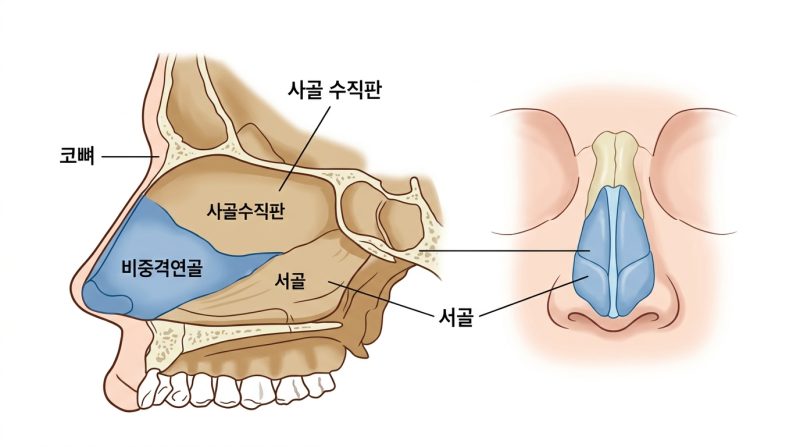

▶ Septal Cartilage
This cartilage acts as a partition inside the nose and is the most commonly used autologous tissue for primary rhinoplasty.
Since it is harvested directly from inside the nose, no additional external incision is required.
A major advantage is that, as autologous tissue, there is no foreign body reaction.
A consideration is that for East Asians, the septal cartilage is often small in size or thin in thickness.
It becomes the most ideal material when a sufficient amount can be harvested.
Materials with High Stability and Proven Results
▶ Donated Costal Cartilage
This is an excellent alternative when harvesting autologous costal cartilage is burdensome or when the patient's own septal cartilage is insufficient.
It provides strong support comparable to autologous costal cartilage,
and since there is no need to remove cartilage from the patient's own body, recovery is faster, and there is no concern about scars.
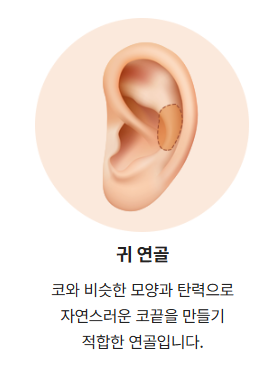
▶ Ear Cartilage
Harvested from behind the ear, this cartilage is elastic and soft.
It is primarily used to refine the tip of the nose into a natural, rounded shape.
It is effective in preventing the tip from showing through the skin and creating a flexible nasal tip.

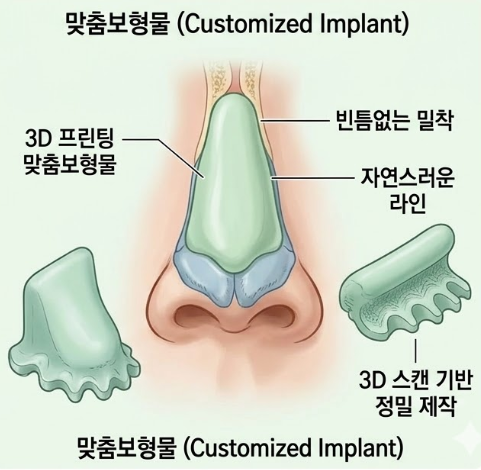
▶ Silicone and Custom Implants
This is the most long-standing and proven material for smoothly increasing the height of the nasal bridge.
Recently, custom implants, created based on the patient's CT data, are used to enhance adhesion to the bone and minimize displacement.
If inflammation is well managed, it is the most efficient material for shaping the nasal line.
Materials with Clear Pros and Cons, Requiring Caution
▶ Gore-Tex
Once widely used due to its softer feel than silicone,
over time, tissue grows into the pores of the material and compresses, leading to a reduction in height.
Most notably, a disadvantage is that during revision surgery, severe adhesion to surrounding tissues makes removal very challenging.
▶ Nose Thread Lift
While sometimes preferred as a non-surgical method,
there are physical limitations to maintaining the height of the nasal tip long-term with only the strength of threads.
Side effects such as threads clumping together or showing through the skin can occur,
and the removal process can become complicated during future surgery.

▶ Artificial Dermis
Used to reinforce thin skin areas, but it has a higher absorption rate compared to autologous dermis.
Typically, about 50% absorption occurs, making it somewhat difficult to predict the final shape.
Materials Not Recommended for Use
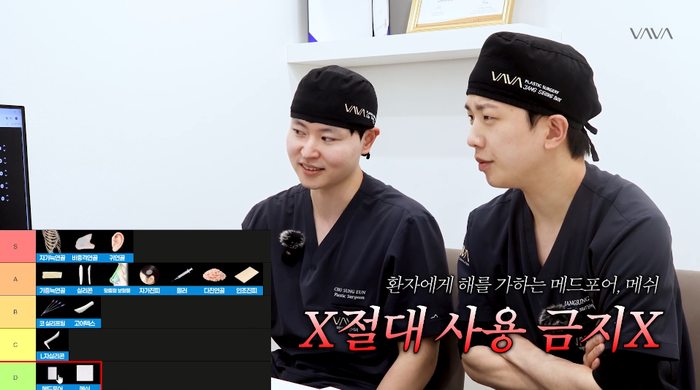
▶ Medpor and Mesh
These are artificial materials made hard for support.
While the initial shape may appear firm, the adhesion to surrounding tissues is excessively strong, posing a significant risk of damaging even healthy cartilage if inflammation occurs.
From a long-term perspective, these materials should be avoided for the patient's safety.
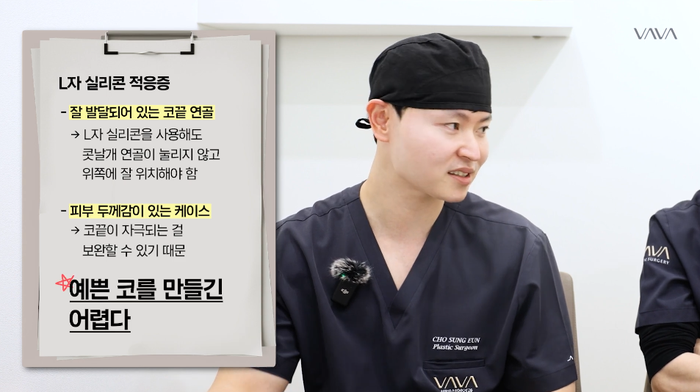
▶ L-shaped Silicone
This is an implant where the nasal bridge and tip are connected as one piece.
It continuously compresses the skin of the nasal tip, becoming a primary cause of side effects such as thinning skin or implant protrusion.
In modern rhinoplasty, the principle is to operate on the nasal bridge and tip separately.
Conclusion

There is no absolute right answer when it comes to rhinoplasty materials.
However, the principles emphasized by Baba Plastic Surgery are ‘long-term safety’ and ‘optimal selection tailored to the patient's own physical conditions’.
1. For dramatic and definite changes: Autologous costal cartilage, donated costal cartilage recommended
2. For natural and safe primary surgery: Septal cartilage, ear cartilage recommended
3. For nasal bridge line correction: Silicone or custom implants utilized
Baba Plastic Surgery accurately assesses individual cartilage size and skin thickness through precise analysis,
and proposes the most suitable materials.