2026-07-14
Rhinoplasty: Why Facial Balance, Not Just Height, Should Be Considered
Rhinoplasty is more than just increasing nose height; it's about achieving overall facial harmony. This article explains why considering the entire facial balance, not just the nose's height, is crucial for a natural and satisfying outcome.


When considering rhinoplasty, what's more important than ‘height’ is the overall change in your impression.
Many people's first thought when considering rhinoplasty is about how much the bridge of their nose can be raised.
However, simply changing the height has limitations in creating the desired image.
Since the nose acts as the central axis of the face, a balanced result can only be expected when the bridge, tip, nostrils, and their connection to the facial contours are all considered together.
Recently, improving the nose in a way that naturally suits one's face, rather than making excessive changes,
has become an important criterion.
Approaches Varying by Nose Shape

Even if the external shape of the nose appears similar,
completely different methods may be applied depending on the internal structure.
For example, if the nasal tip is round and appears spread out, rather than simply raising the height,
the process of organizing the cartilage structure and shaping it may be more important.
Conversely, if the nasal bridge is generally low, the process of forming a line may be central.
Since surgery performed without accurately distinguishing these individual causes can reduce the completeness of the result,
sufficient prior analysis is crucial.
The Design Process for Creating Natural Lines
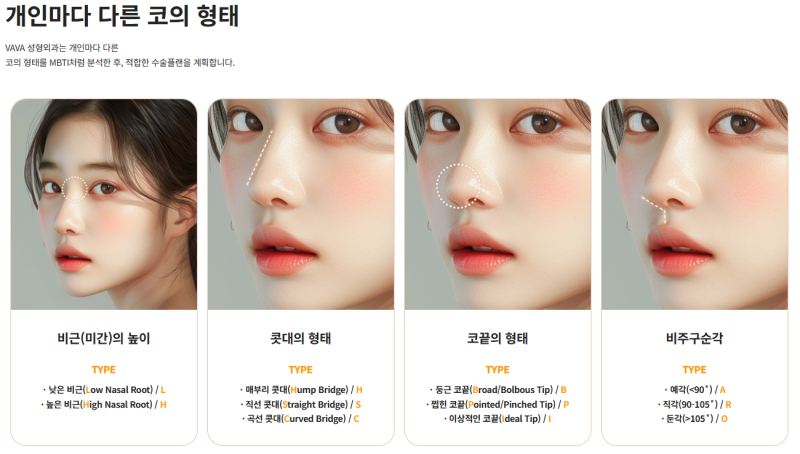
In rhinoplasty, naturalness doesn't just mean ‘not looking obvious’;
it means flowing seamlessly within the overall facial harmony without any sense of incongruity.
To achieve this, the starting point from the forehead to the nose,
the direction and height of the nasal tip, and the proportions visible from the front must be meticulously designed.
Especially for the side profile, even small differences can significantly alter the impression,
making the process of setting the angle appropriate for each individual's face shape important.
Rather than simply aiming for height,
creating a soft and stable curve is a key factor leading to natural results.
Important Criteria in Choosing a Surgical Method
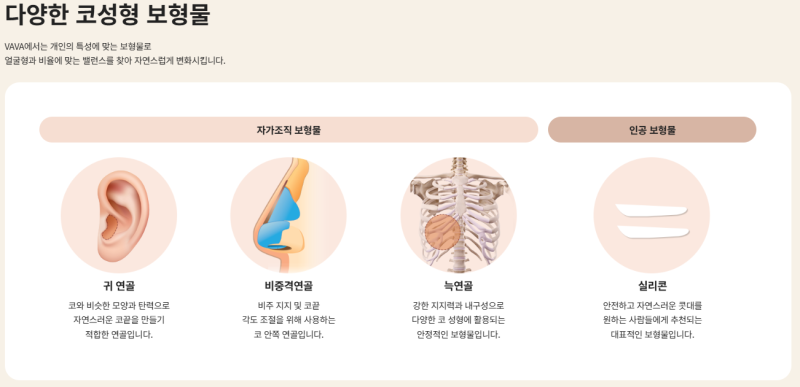
Various methods exist for rhinoplasty,
and the materials used also vary depending on the individual's condition.
Utilizing autologous cartilage has the advantage of high tissue adaptability,
and in some cases, using implants together may also be considered.
The important thing is not to conclude that a specific method is superior,
but to choose the appropriate method by comprehensively considering the current nasal structure and desired direction.
Furthermore, a design that considers not only external improvement but also functional aspects is necessary.
Natural Changes Created by Time

Rhinoplasty is characterized by a process where completeness increases over time rather than immediately after surgery.
Initially, it may feel somewhat awkward due to swelling or tissue tension,
but as recovery progresses, it gradually settles into a soft and natural form.
While there are differences depending on individual recovery speed,
after a certain period, the overall line stabilizes, and the harmony with the face becomes even more natural.
Rhinoplasty: ‘Design and Judgment’ Determine the Outcome

Rhinoplasty is not a simple procedure but a surgery that requires precise design and judgment.
Accurately understanding an individual's facial structure and setting a direction that allows for noticeable change without being excessive
are important factors in determining satisfaction with the result.
Rather than choosing based on fragmented information or only external changes,
a process of finding the right direction through sufficient consultation and analysis is necessary.
Rhinoplasty is perfected not by conspicuous changes, but by changes that blend in naturally.
Conclusion

Since the nose is an area where even small changes can significantly alter one's impression,
delicate criteria setting and a stable approach are crucial.
Rather than focusing on short-term changes,
a careful selection process based on a direction that can be maintained without difficulty over time is necessary.
When approaching with these criteria, a more balanced result can be expected.


