2026-09-07
Yaksu Station Full Mouth Implants: How to Manage Immediate Temporary Dentures After Surgery?
Learn how to manage immediate temporary dentures after full mouth implant surgery at Yaksu Station, including post-operative care, foods to avoid, and the osseointegration process.
Hello.
This is Dr. Kim Tae-young, chief director of Bareunyoung Dental Clinic at Yaksu Station.^^
In my previous article, I explained full mouth implants and immediate temporary dentures, discussing how to use temporary dentures to reduce the toothless period after full mouth implant surgery and when immediate temporary dentures are possible.
Today, building on that, we will explore how to manage immediate temporary dentures after full mouth implant surgery at Yaksu Station, and what processes occur during the implant osseointegration period.
Many people planning full mouth implants have common questions:
‘Can I eat immediately after implant surgery?’ ‘Is it okay to use temporary dentures like natural teeth?’ ‘How should I manage my implants until they bond with the bone?’
While immediate temporary dentures for full mouth implants can reduce the toothless period and alleviate daily discomfort, they are not meant to be used like final prosthetics immediately after surgery.
Today, we will cover post-implant surgery management methods, precautions, the osseointegration process, and the duration of immediate temporary denture use, one by one.
Why Post-Surgery Management is Important
When immediate temporary dentures are used after full mouth implant surgery, management during the osseointegration period, when the implant stably integrates with the jawbone, is crucial.
After surgery, it is best to take prescribed medication as instructed by the medical staff and begin brushing gently, according to the condition of the surgical site.
Especially immediately after implant surgery, as the gums are in the process of healing, care must be taken to avoid excessive force on the temporary dentures.
Smoking can affect the healing of the gums and tissues around the implant, so it is best to avoid it as much as possible. Alcohol consumption is also recommended to be refrained from during the recovery period.
Furthermore, regular visits are important to check the condition of the implants and temporary dentures, the extent of gum healing, and the occlusal state.
Avoid These Actions While Using Full Mouth Implant Temporary Dentures
Since immediate temporary dentures are not final prosthetics, repeated strong forces can cause them to break or dislodge, and unnecessary force may be transmitted to the implants.
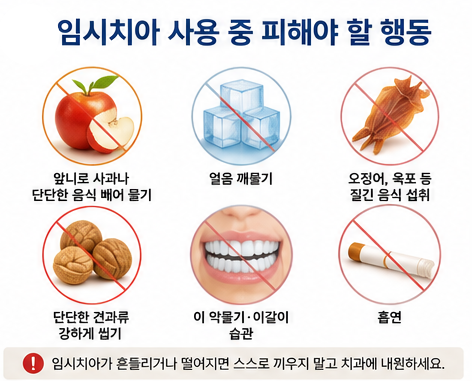
Therefore, it is advisable to be cautious with the following actions:
- Biting into apples or hard foods with your front teeth
- Biting ice
- Eating tough foods like squid or jerky
- Forcefully chewing hard nuts
- Clenching or grinding teeth habits
- Smoking
Especially when using immediate temporary dentures after full mouth implant surgery, it is crucial to follow the dietary instructions provided by the medical staff during the initial period.
If a temporary denture feels loose, breaks, or suddenly dislodges, do not attempt to reattach it yourself with adhesive; it is best to have its condition checked at the dental clinic.
What Happens During the Implant Osseointegration Period?
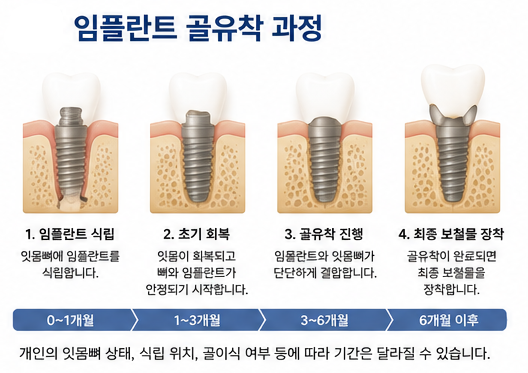
Implants do not immediately function fully after placement; they undergo an osseointegration process where the jawbone and implant firmly bond together.
Generally, osseointegration can take approximately 3 to 6 months, but this can vary depending on the condition of the jawbone, the implant placement site, and whether bone grafting was performed.
During this period, immediate temporary dentures are used while monitoring the healing status of the implant and gums.
Once osseointegration is stable and the implant's condition is confirmed, the process moves on to fabricating and placing the final prosthetic.
Therefore, immediate temporary dentures are not just temporary teeth used briefly after surgery; they are an important stage that helps the recovery process while maintaining aesthetics and basic function until the final prosthetic is made.
How Long Are Full Mouth Implant Immediate Temporary Dentures Used?
Many people ask, ‘How many months are temporary dentures used for?’
Generally, they are used during the period when implant osseointegration is stably achieved, and 3 to 6 months can often serve as a guideline.
However, not all patients use them for the same duration.
The timing for replacing them with final prosthetics is determined after comprehensively checking the implant's initial stability, the extent of jawbone recovery, and the occlusal state.
Therefore, it is not fixed that ‘final teeth must be placed after 3 months’ or ‘one must wait 6 months’.
The treatment schedule can vary depending on the patient's recovery status.
Frequently Asked Questions
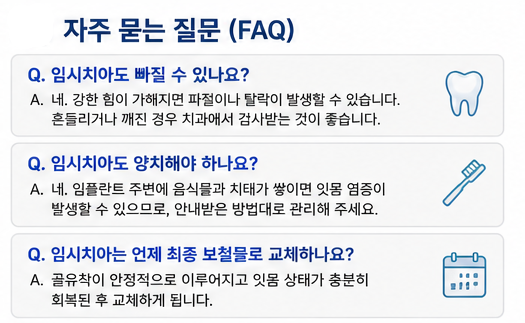
Q. Can immediate temporary dentures also fall out?
Yes. If strong force is applied to the temporary denture or if it fractures, it can dislodge.
However, a loose or dislodged temporary denture does not necessarily mean there is a problem with the implant itself.
If a temporary denture is loose or broken, it is advisable to get it checked at the dental clinic to accurately assess the implant's condition.
Q. Do I need to brush immediate temporary dentures?
Yes. Oral hygiene is very important even after full mouth implant surgery.
If food debris or plaque accumulates around the implant, gum inflammation can occur, so using appropriate oral hygiene products such as toothbrushes, interdental brushes, and oral irrigators, as guided by the medical staff, can be helpful.
However, immediately after surgery, the management method may vary depending on the surgical site and implant condition, so it is best to prioritize following the individually provided instructions.
Am I a Candidate for Immediate Temporary Dentures?
Many people who come for full mouth implant consultations at Yaksu Station ask, ‘Can I also use temporary dentures immediately after implant surgery?’
The possibility of immediate temporary dentures does not apply equally to all patients.
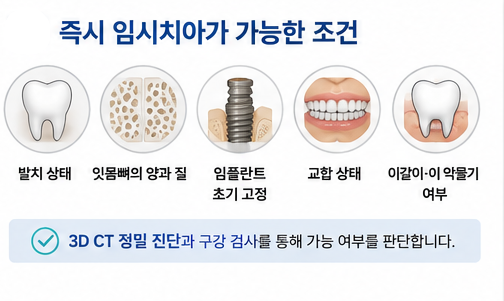
A comprehensive assessment of the extraction site, the quantity and quality of the jawbone, initial implant stability after placement, occlusal state, and the presence of teeth grinding or clenching habits is necessary.
Especially for full mouth implants, which involve placing multiple implants, not only the condition of each implant but also the overall occlusion and prosthetic plan must be considered.
Therefore, it is crucial to determine the feasibility of immediate temporary dentures after confirming the implant placement conditions through precise diagnosis and oral examination using 3D CT.
In Conclusion
Immediate temporary dentures after full mouth implant surgery can be a treatment method that helps reduce the toothless period and alleviate daily discomfort.
However, simply because immediate temporary dentures are placed does not mean they can be used like natural teeth right away.
Proper management and regular check-ups are necessary during the osseointegration period when the implant stably bonds with the jawbone.
As I provide full mouth implant treatment at Yaksu Station Dental Clinic, I believe it is more important to establish a treatment plan tailored to the patient's oral condition than to prioritize the speed of treatment.
Immediate temporary dentures are also not a treatment that is unconditionally applied to all patients; it is important to proceed safely when possible, based on a thorough diagnosis.
If you are curious about full mouth implants at Yaksu Station and whether immediate temporary dentures are possible for you, please undergo a precise examination, including 3D CT, to first check your current jawbone and implant placement conditions.
If you have any questions or need consultation regarding your full mouth implant treatment plan, please visit Bareunyoung Dental Clinic at Yaksu Station to discuss treatment options suitable for your current oral condition.
This was Bareunyoung Dental Clinic at Yaksu Station.^^
We believe that proper treatment yields proper results. We will always do our best to ensure that all visitors leave feeling more comfortable. Bareunyoung Dental Clinic
This post was written in compliance with Article 56, Paragraph 1 of the Medical Act for the purpose of providing medical information. All treatments may vary in applicability and process depending on individual oral conditions, and treatment plans are decided after sufficient diagnosis and consultation.
Frequently Asked Questions
Can I eat immediately after implant surgery?
No, it is not recommended to eat immediately after surgery. It is important to follow the dietary instructions provided by the medical staff to avoid excessive force on the temporary dentures, and especially to avoid hard or chewy foods.
Is it okay to use temporary dentures like natural teeth?
No, immediate temporary dentures are not final prosthetics and should not be used with strong force like natural teeth. Repeated strong forces can cause the temporary denture to break or dislodge, and unnecessary force may be transmitted to the implant.
How long does implant osseointegration take?
Generally, implant osseointegration can take approximately 3 to 6 months. However, this can vary individually depending on the jawbone condition, implant placement site, and whether bone grafting was performed.
Can immediate temporary dentures also fall out?
Yes, if strong force is applied to the temporary denture or if it fractures, it can dislodge. If a temporary denture is loose or broken, it is advisable to get it checked at the dental clinic to accurately assess the implant's condition.
What actions should be avoided while using immediate temporary dentures?
While using immediate temporary dentures, it is best to avoid biting into hard foods with your front teeth, biting ice, eating tough foods, chewing hard nuts, clenching or grinding teeth habits, and smoking.
Do I need to brush immediate temporary dentures?
Yes, oral hygiene is very important even after full mouth implant surgery. If food debris or plaque accumulates around the implant, gum inflammation can occur, so it is important to manage it using appropriate oral hygiene products as guided by the medical staff.