2026-07-20
Worried about dry eyes? The reason for Today LASIK's popularity
Today LASIK minimizes corneal nerve damage during surgery, significantly reducing the incidence of dry eyes compared to traditional LASIK/LASEK. This method is gaining attention as a safe vision correction option without the burden of dry eyes.

Hello. This is Gangnam Smile Eye Clinic 😊
Among those considering vision correction surgery,
many are most concerned about ‘dry eyes’.
The possibility of dry eyes after surgery often causes hesitation in making a decision.
Today LASIK is characterized by significantly reducing the incidence of dry eyes by minimizing corneal nerve damage during the surgical process compared to traditional LASIK and LASEK.
This method is gaining attention as a safe vision correction option without the burden of dry eyes.
Let's explore the distinctive advantages of Today LASIK now.
[Causes of dry eyes after vision correction surgery]
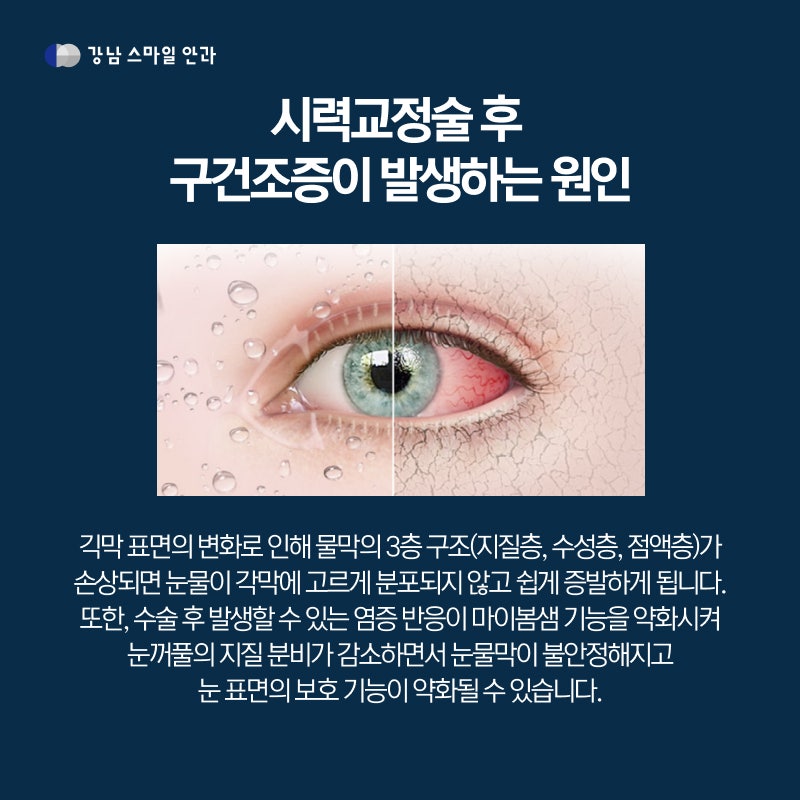
Dry eyes can occur due to corneal nerve damage and tear film instability during the surgical process.
When corneal nerves are severed during laser application to the cornea or the formation of a corneal flap,
the nerve stimulation pathway to the lacrimal glands is blocked, leading to a temporary decrease in tear production.
Compared to other surgeries, LASIK involves forming a corneal flap of about 20mm,
which increases the likelihood of corneal nerve damage.
The cornea typically has important nerves that regulate tear secretion and stability.
After surgery, damage to the trigeminal nerve reduces lacrimal gland secretion,
and the tear regeneration function on the eye surface does not occur smoothly.
Nerve regeneration can take several months to a year,
and during this period, tear secretion can become imbalanced, leading to dry eyes.
Furthermore, if the shape of the corneal surface changes,
the tear film may not be distributed normally, increasing tear evaporation.
The three-layer structure of the tear film (lipid layer, aqueous layer, mucin layer) connected to the corneal epithelium is disrupted, making the tear film easily breakable.
If you are concerned about dry eyes, choosing a different procedure that minimizes corneal nerves to prevent dry eyes
can increase surgical satisfaction.
[Can ‘Today LASIK’ reduce the incidence of dry eyes?]

Today LASIK uses state-of-the-art equipment to remove only a thin layer of the epithelial tissue without forming a flap.
What differentiates it from general LASEK is that it removes the epithelium more precisely and uniformly.
It is special because it significantly reduces the extent of corneal nerve damage.
The less corneal nerve damage, the faster the nerve regeneration after surgery,
and the quicker the normal function of tear production and secretion can recover.
The corneal surface is covered with very thin and sensitive nerves that regulate tear secretion.
Today LASIK can minimize the extent of nerve severance to preserve the Bowman's layer, where corneal nerves are distributed, as much as possible during the surgical process.
If nerve damage from LASIK flap formation was about 50-60%,
Today LASIK can achieve vision correction with less than 20% nerve damage.
While forming a corneal flap and removing the stromal layer can deform the cornea,
Today LASIK only removes a thin layer of the corneal epithelium and does not touch the stromal layer,
so the geometric structure of the cornea does not change significantly, maintaining the existing stable tear film structure,
which can reduce the risk of dry eyes.
Another advantage is that the removal range and depth of the epithelial layer are small, resulting in a shorter corneal nerve regeneration time.
Rapid corneal nerve regeneration helps the lacrimal glands function normally, promoting smooth tear secretion.
Since the tear film recovers quickly, dry eyes are alleviated early.
[Dry eye treatment available at Gangnam Smile Eye Clinic's 'Eye Care'!]
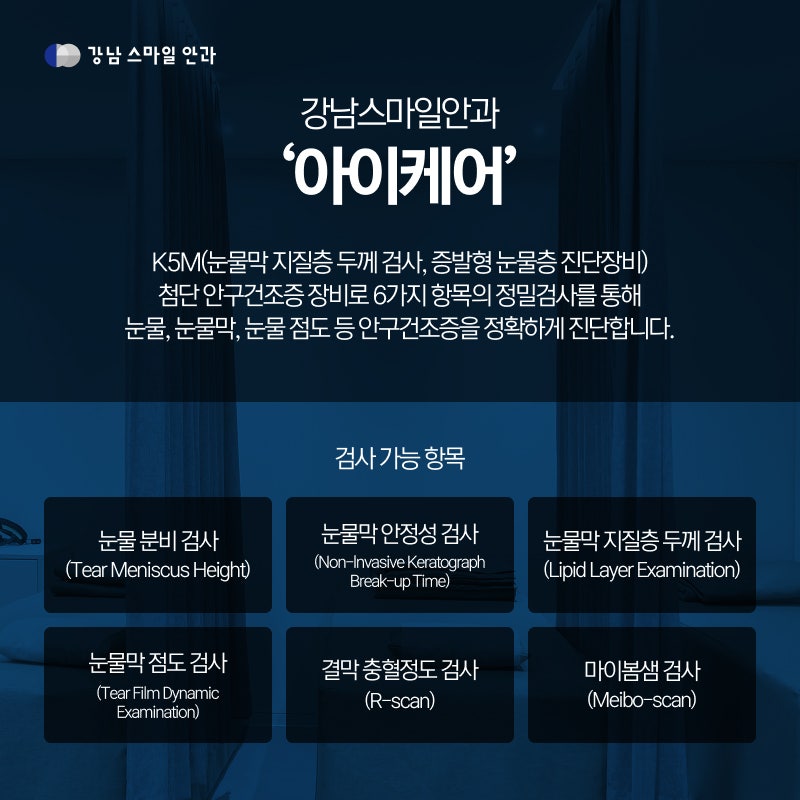
Those concerned about dry eyes can receive safe and comfortable treatment at the Eye Care Center
before and after vision correction surgery.
Through tear film stability tests, tear osmolarity tests, and tear film thickness tests before surgery,
the extent of the patient's dry eyes can be accurately determined to predict the possibility of side effects after surgery.
Based on the test results, customized treatment for each patient's condition stabilizes the tear film and
improves the eye surface environment to normal.
After surgery, to promote corneal nerve regeneration and tear film stabilization,
artificial tears are used, and Aquacel stimulates the meibomian glands of the eyelids,
strengthening the function of the lipid layer to prevent tear film evaporation, thus preventing evaporative dry eyes.
Depending on the patient's condition, we suggest methods such as warm compresses, artificial tear drops, and lifestyle improvements
to help patients effectively manage their eye health on their own, even without visiting the hospital after surgery,
allowing them to manage dry eyes in their daily lives.
Regular follow-up observations check tear film stability and corneal nerve regeneration status,
and additional treatment is provided if necessary.
To conclude this article,
we recommend Today LASIK, which minimizes corneal damage and has a low risk of dry eyes.
If you already have dry eyes, you can effectively manage them through a customized care program before and after surgery
at Gangnam Smile Eye Clinic's Eye Care Center.
Now, get safe vision correction without worrying about dry eyes!
Thank you.
💙🤍 𝖦𝖠𝖭𝖦𝖭𝖠𝖬 𝖲𝖬𝖨𝖫𝖤 𝖤𝖸𝖤 𝖢𝖫𝖨𝖭𝖨𝖢💙🤍
𝗧𝗛𝗘 𝗟𝗜𝗚𝗛𝗧 𝗔𝗡𝗗 𝗧𝗛𝗘 𝗢𝗖𝗘𝗔𝗡 𝗜𝗡 𝗬𝗢𝗨𝗥 𝗦𝗠𝗜𝗟𝗘

Today LASIK Smile Eye Clinic



Frequently Asked Questions
What is the main cause of dry eyes after vision correction surgery?
Yes, dry eyes after vision correction surgery can primarily occur due to damage to corneal nerves during the surgical process or blockage of nerve stimulation pathways to the tear glands due to the formation of a corneal flap. This leads to a temporary decrease in tear production and instability of the tear film.
What is the principle of Today LASEK in reducing the incidence of dry eyes?
Yes, Today LASEK is performed by gently removing only the epithelial layer without forming a corneal flap. This method helps to preserve the Bowman's membrane, where corneal nerves are distributed, as much as possible, minimizing nerve damage to less than 20%, thereby aiding in the rapid recovery of tear production and secretion functions.
How do the ranges of corneal nerve damage differ between LASIK and Today LASEK?
Yes, LASIK can cause approximately 50-60% corneal nerve damage due to the formation of a corneal flap. In contrast, Today LASEK does not create a corneal flap, significantly reducing the range of nerve damage to less than 20%, thereby lowering the risk of dry eye occurrence.
How long does corneal nerve regeneration take after Today LASEK?
Yes, Today LASEK involves less corneal nerve damage, so nerve regeneration time is shorter. Rapid corneal nerve regeneration helps to normalize tear gland function and tear secretion, allowing dry eyes to alleviate early.
How is the dry eye examination conducted before surgery?
Yes, at Gangnam Smile Eye Clinic's Eye Care Center, we conduct tear film stability tests, tear osmolarity tests, and tear film thickness tests before surgery. This accurately assesses the patient's degree of dryness, predicts potential side effects after surgery, and establishes a customized treatment plan.
How can dry eyes be managed after Today LASEK?
Yes, after surgery, you can use artificial tears and receive meibomian gland stimulation treatment through Aquacel to aid corneal nerve regeneration and tear film stabilization. Additionally, depending on the patient's condition, self-care methods such as warm compresses and lifestyle improvements are guided to effectively manage dry eyes.