2026-07-09
How Does Sinsa Station Mini Facelift Differ from a Full Facelift?
Discover the differences between a Sinsa Station mini facelift and a full facelift. Learn who is an ideal candidate for each procedure based on the degree and location of sagging, focusing on lower facial changes and jawline definition.


How Does Sinsa Station Mini Facelift Differ from a Full Facelift?
I noticed changes in photos before I saw them in the mirror.
There are times when a once sharp jawline suddenly starts to look blurred. You might feel like your cheek fat has descended, or your mouth area looks heavier, even without significant weight changes.
Many people simply attribute these changes to aging. Of course, a decrease in skin elasticity as we age is a natural process.
However, not all sagging progresses in the same way, and the appropriate method to consider can vary depending on the current degree of sagging.
Recently, more and more people who find a full facelift too daunting but are considering more direct lifting options are becoming interested in a
Sinsa Station mini facelift.

Why does skin sagging occur?
When skin elasticity decreases, it doesn't just cause wrinkles.
As the tissues that support the face move downwards, the jawline can appear blurred,
and the descent of the deep cheek fat can make the area around the mouth look heavier.
Especially between the ages of 30 and 50, as skin aging and tissue migration occur simultaneously,
changes in the lower face often become noticeable.
Therefore, among those considering a Sinsa Station mini facelift,
some seek consultation not just for wrinkles, but because of a compromised facial contour.

In what cases might a Sinsa Station mini facelift be considered?
Upper Face: Forehead ~ Eyebrows | Midface: Eyes ~ Nasal Tip | Lower Face: Philtrum ~ Chin |
A Sinsa Station mini facelift is known as an approach that targets a relatively limited area compared to a full facelift.
It is often considered for concerns such as lower facial sagging, changes in the jawline, or tissue migration around the mouth.
Of course, if the sagging is severe, other approaches may need to be considered.
Conversely, if the sagging is not significant, non-surgical methods may be prioritized.
Therefore, a Sinsa Station mini facelift is not universally applicable to everyone,
and the process of first analyzing the current facial condition is crucial.
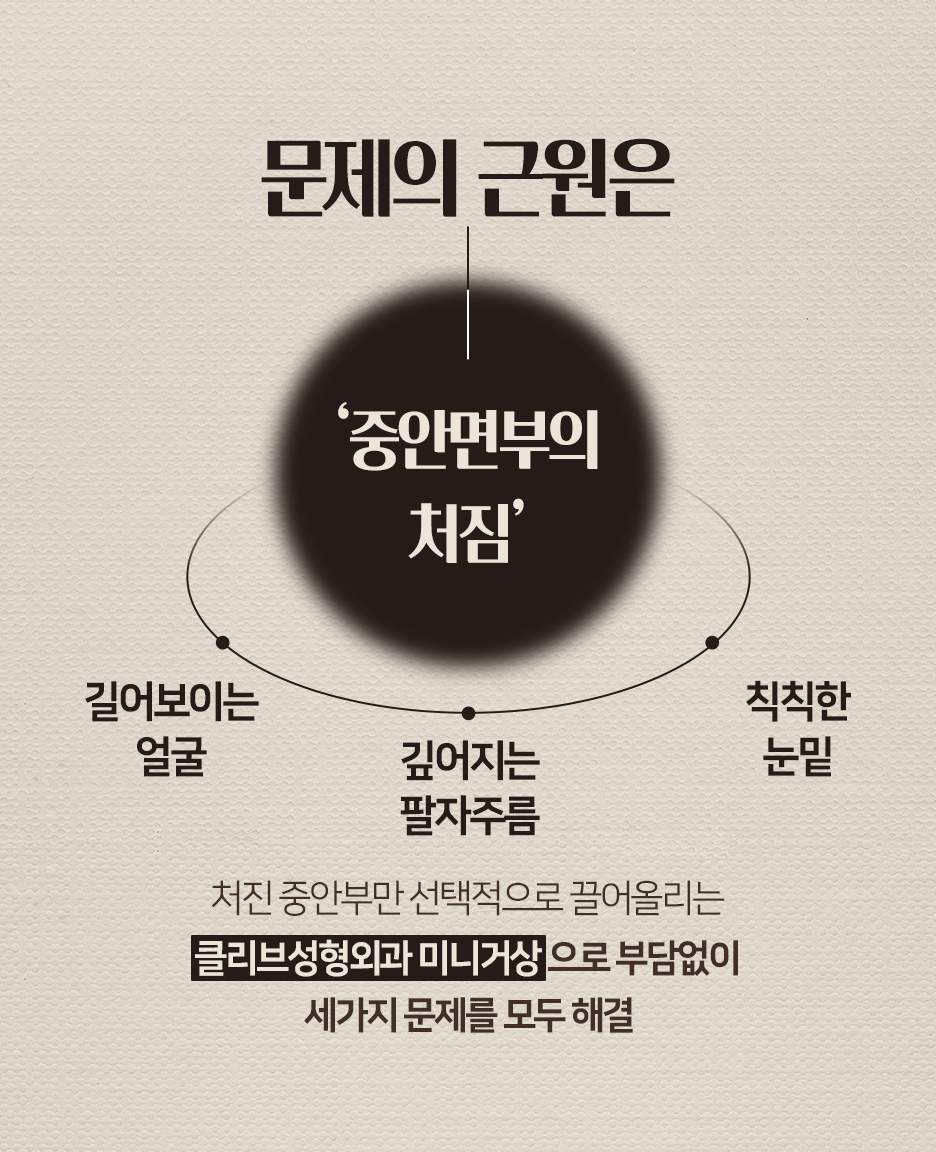
Current condition is more important than age.
Many people ask at what age a mini facelift is necessary.
However, in actual consultations, the current tissue condition is considered more important than age.
Even in their 30s, some individuals may show relatively distinct sagging,
while conversely, some maintain good skin elasticity even after their 50s.
Therefore, when planning a Sinsa Station mini facelift, it's important to consider
both skin elasticity and the degree of tissue migration, rather than judging solely by age.
When the midface sags, the face can appear longer, nasolabial folds can deepen,
and the under-eye area may look dull.
A Sinsa Station mini facelift can help improve these areas.
Who is suitable for a mini facelift?<
- The jawline is less defined than before
- Deep cheek fat sagging has begun
- Marionette lines are a concern
- A full facelift is too much, but lifting effects are desired
- Individuals in their 30s-50s with early to moderate sagging
Who might consider a full facelift?<
- Overall facial sagging is prominent
- Sagging has progressed to the cheeks, jawline, and neck area
- There is significant excess skin
- Improvement is needed not only in the lower face but also in the midface
A Sinsa Station mini facelift is an approach that primarily targets the lower face with early or moderate sagging,
whereas a full facelift is a surgery that considers a broader range of sagging and tissue migration.

Simply pulling the skin is not the only important factor.
When thinking about lifting, many envision simply pulling the skin upwards.
However, actual facial sagging can be influenced not only by the skin but also by changes in the underlying tissues.
Therefore, when planning a Sinsa Station mini facelift, it is crucial to thoroughly analyze the current facial structure and
the direction of sagging.
This is because even if it appears to be the same cheek sagging, the direction of tissue migration can vary from person to person.

A natural facial contour is important.
Many people prefer a naturally refined facial contour over an overly pulled look.
For a Sinsa Station mini facelift as well, it's not just about removing a lot of skin,
but the process of considering the current facial proportions and balance is important.
Especially since the face has left-right asymmetry, varying skin thickness, and fat distribution,
a uniform approach may have limitations.
Therefore, thoroughly analyzing the current condition and finding the necessary direction is crucial.

The important thing is to identify the cause of the current sagging.
Even if it appears to be the same sagging, the cause can differ for each person, and the necessary approach can also vary.
Therefore, if you are considering a Sinsa Station mini facelift, it is important to objectively assess your current facial condition,
rather than judging solely by age.
Ultimately, the key is to understand what changes are occurring in your face.
Planning based on thorough analysis can help in achieving a more natural facial contour and balance.
Aging does not occur at the same rate for everyone.
For some, changes in the jawline appear first,
while for others, deep cheek fat sagging or changes around the mouth may begin first.
Therefore, the timing for considering a Sinsa Station mini facelift can also vary from person to person.
What's important is not age, but the changes that are currently appearing.
If your facial contour starts to look different from before, or your lower face appears heavy, it may be helpful to assess your current condition.
Furthermore, even if it looks like the same sagging, whether it's a problem of skin elasticity, the effect of fat migration,
or a change related to facial structure can differ for each person.
Therefore, rather than judging solely by age or popular methods,
the process of objectively analyzing your current facial condition is important.
I hope this post was helpful for those considering a facelift near Sinsa Station or Gangnam Station.