2026-07-20
What causes blurry vision?
Blurry vision can stem from various eye conditions, including cataracts, presbyopia, glaucoma, and macular degeneration. Early detection through comprehensive eye exams is crucial for proper diagnosis and treatment.


Hello everyone!
Today marks the official start of a heatwave warning.
Are you all coping well with the heat?
Due to the strong, scorching sunlight,
UV rays can reflect off glass panels or cars
and enter your eyes.
So, it's best to protect our eyes with wide-brimmed hats, parasols, and sunglasses whenever possible, isn't it?
Today, I'd like to tell you about the importance of eye examinations.
If you have a stomachache or a fever,
you usually go to the hospital right away,
but if you experience unusual eye symptoms like redness, dryness, or blurry vision,
most people tend to think,
‘I'll be fine after some sleep,’
‘It'll heal naturally if I leave it alone,’
‘It'll be okay if I use artificial tears.’
Generally, after thinking this, people rarely visit an ophthalmologist directly for an eye examination.
Why do we fall into complacency, believing that eye problems will just get better?

The reason is that
even when people see others developing eye diseases,
they often think, ‘Surely it won't happen to me?’
This psychological tendency is reflected.
That's why people don't readily go to an ophthalmologist even when they have eye problems.
If you keep dismissing it as minor,
it can lead to more serious eye diseases,
and the surgery to resolve them also becomes more complicated.
Today, we will be looking into cases of blurry vision.
First, the causes of blurry vision are diverse,
so it's impossible to pinpoint a specific eye disease.
Major examples include cataracts and presbyopia.

Both cataracts and presbyopia
can cause blurry vision,
but the difference is that cataracts cause all vision to appear blurry,
whereas presbyopia causes nearby objects or text to appear blurry.
Furthermore, there's a difference in their underlying causes.
Cataracts occur when the lens itself becomes cloudy,
making all vision appear hazy,
while presbyopia occurs when the elasticity of the lens muscles decreases,
making near vision appear hazy.
This is the difference between the two.
Therefore, what's most important is to understand the condition of your eyes through 70 precise examinations
to determine the cause,
and whether there are any other diseases.
It's best to analyze from various perspectives.
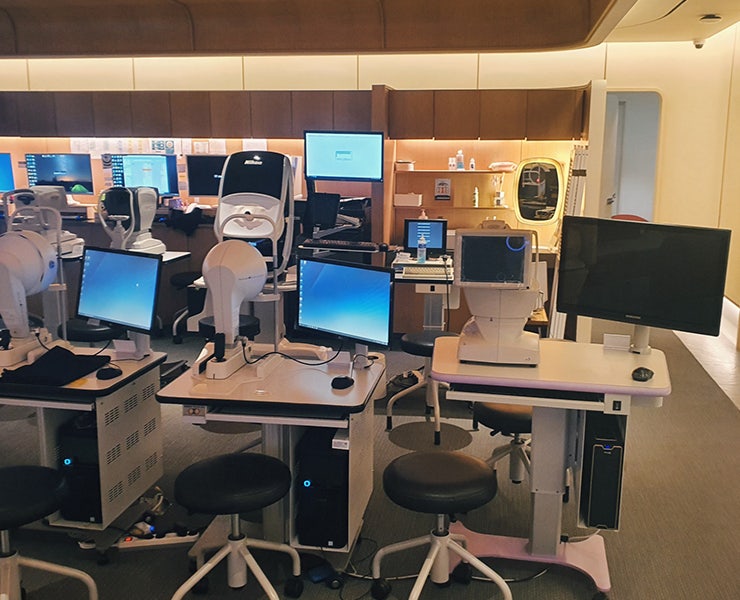
In addition to common conditions like cataracts and presbyopia,
it's also important to check for glaucoma,
macular degeneration, etc.
Since there are various types of eye diseases,
it's dangerous to self-diagnose and jump to conclusions.
Above all, our eyes have a complex and delicate structure,
so it's best to get an accurate diagnosis of your eyes
through specialized equipment for examining eye structures and consultation with experienced medical staff.

Compared to the past, modern people today
are commonly afflicted with one or more chronic eye conditions.
Representative diseases include
conjunctivitis and dry eye syndrome.
Don't overlook these conditions either;
if they occur, it's best to visit a clinic and receive immediate treatment, isn't it?

When our vision is blurry, most of us
only think, ‘It's probably just temporary because I'm tired.’
We don't usually consider,
‘Could I have cataracts? Could it be presbyopia?’
This kind of thought doesn't spread.
This tendency is even stronger among younger people.
Nowadays, presbyopia is no longer exclusive to middle-aged and elderly individuals,
due to frequent use of electronic devices
and spending excessive hours with them.
You can protect your eye health with your own interest and effort,
so don't overlook even minor symptoms.
Please visit us for a detailed examination to confirm your condition.

Frequently Asked Questions
Why do people often avoid going to the doctor when they have blurry vision?
Many people tend to postpone visiting an ophthalmologist even when they experience eye problems, often due to a complacent mindset, thinking, ‘Surely it won't happen to me?’ They might also believe it's temporary due to fatigue or that it will heal naturally.
What are the main causes of blurry vision?
The causes of blurry vision are diverse. Major causes include cataracts and presbyopia, but various other eye conditions such as glaucoma or macular degeneration can also be responsible.
How do cataracts and presbyopia differ?
Cataracts cause all vision to appear hazy due to clouding of the lens itself, whereas presbyopia is characterized by blurry vision of nearby objects or text due to decreased elasticity of the lens muscles.
Can young people also develop presbyopia?
Yes, presbyopia is increasingly common among younger individuals today. Due to frequent and excessive use of electronic devices, it is no longer exclusive to middle-aged and elderly people.
Why are eye examinations important?
The eyes have a complex and delicate structure, making self-diagnosis dangerous. It is crucial to identify the exact cause and receive appropriate treatment through 70 precise examinations and consultation with experienced medical staff.