2026-07-20
Choosing a Good SMILE LASIK Clinic in Gangnam: Key Criteria
When considering SMILE LASIK, don't just check if it's possible. Focus on the remaining corneal thickness and precise surgical design for long-term eye health and safety.

Hello, this is Gangnam Smile Eye Clinic 😊💙
When people consider SMILE LASIK, the first things they often check are
whether the surgery is possible and their corneal thickness.
However, simply checking for eligibility is not enough.
What's truly important is considering the cornea that remains after surgery and long-term eye health.
This must be taken into account.
Remaining Cornea After Surgery: The Core of Safety
Many people say during consultations,
‘I was told that SMILE LASIK is possible because my corneal thickness is sufficient.’
However,
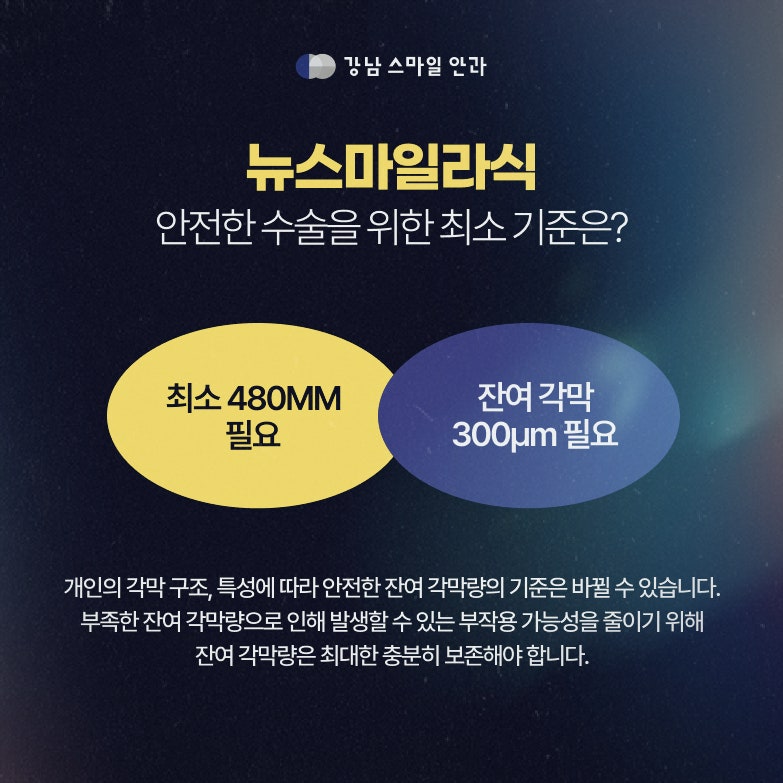
when assessing actual safety, you must also check the thickness of the cornea remaining after surgery.
SMILE LASIK corrects myopia and astigmatism by creating and removing a thin tissue called a lenticule inside the cornea.
Therefore, if the prescription to be corrected is high or if astigmatism is also present,
more corneal tissue will inevitably be removed.
In such cases, simply looking at the current corneal thickness and deciding on surgical eligibility can overlook long-term stability.
If the residual cornea is insufficient,
there is a rare possibility of problems such as corneal ectasia.
Since these changes can appear over time rather than immediately after surgery,
it's crucial to consider long-term stability, not just short-term vision improvement.
Precise Design Determines Results
It's not enough to just be deemed eligible for surgery;
precise design tailored to the individual's eye condition is paramount.
Even small differences in corneal shape, astigmatism axis, and the balance of tissue removal can lead to glare or blurred vision after surgery.
Accurately designed surgery affects the quality of vision and eye fatigue after recovery.
Therefore, when choosing a good SMILE LASIK clinic,
it's safer to prioritize a place that thoroughly understands your eye condition and meticulously explains the design process, rather than just relying on a 'good' reputation.
A Good SMILE LASIK Clinic: The Conclusion?
SMILE LASIK is a vision correction surgery that is difficult to reverse once decided.
Therefore, it's most important to choose a place that can ensure long-term eye health and precise design, rather than just checking for surgical eligibility.
If you're considering SMILE LASIK in Gangnam,
rather than simply using the criterion of 'a good place',
look for a clinic that thoroughly explains your eye condition and designs the surgery safely.
💙 SMILE Surgery is indeed Gangnam Smile Eye Clinic 💙
💙🤍 𝖦𝖠𝖭𝖦𝖭𝖠𝖬 𝖲𝖬𝖨𝖫𝖤 𝖤𝖸𝖤 𝖢𝖫𝖨𝖭𝖨𝖢💙🤍
𝗧𝗛𝗘 𝗟𝗜𝗚𝗛𝗧 𝗔𝗡𝗗 𝗧𝗛𝗘 𝗢𝗖𝗘𝗔𝗡 𝗜𝗡 𝗬𝗢𝗨𝗥 𝗦𝗠𝗜𝗟𝗘












Frequently Asked Questions
Is corneal thickness important for SMILE LASIK?
Yes, it is important. SMILE LASIK corrects vision by removing a lenticule from within the cornea, and sufficient residual corneal thickness after surgery is necessary to ensure long-term safety. Simply being eligible for surgery is not enough.
What problems can arise if there isn't enough residual cornea?
If the residual cornea is not sufficient, there is a rare possibility of problems such as corneal ectasia. These changes can appear over time rather than immediately after surgery, making long-term stability considerations essential.
Can glare or blurred vision occur after SMILE LASIK?
Yes, it can occur. If precise surgical planning, tailored to the individual's eye condition, such as corneal shape, astigmatism axis, and balance of ablation amount, is not performed, glare or blurred vision may appear after surgery.
What should I consider when choosing a SMILE LASIK clinic?
When choosing a SMILE LASIK clinic, it is important to prioritize places that thoroughly understand your individual eye condition and meticulously explain the surgical planning process, rather than just relying on a 'good' reputation. Long-term eye health should be considered.
Does a high prescription or severe astigmatism affect SMILE LASIK?
Yes, it does. If the prescription to be corrected is high or if astigmatism is also present, more corneal tissue will inevitably be removed. In this case, residual corneal thickness must be considered even more carefully.