2025-06-02
Tummy Tuck Surgery: Essential Precautions You Must Know
Considering a tummy tuck? This guide covers crucial precautions from pre-surgery prep to 10 days post-op, including medication, nutrition, recovery, and scar care, to ensure a safe and smooth recovery.

Are you considering tummy tuck surgery
for a more toned abdomen?
As this is a significant decision,
you likely have many questions
about pre- and post-operative care.
A common concern for those facing surgery is,
‘How should I prepare, and how should I manage my recovery?’
Today, we will explain the precautions step-by-step,
from the preparation phase before tummy tuck surgery
to the first 10 days post-surgery.
Knowing these in advance will help you feel much more
at ease when undergoing the procedure.
1. Before Tummy Tuck Surgery, Be Sure to Prepare
A common concern before surgery is,
‘Am I preparing properly?’
Let me share some important points
that are often overlooked during the pre-operative process
for tummy tuck surgery.
You must stop taking any medications
that can increase the risk of bleeding in advance.

Please stop taking blood thinners, Omega-3 supplements,
vitamins, and other medications you usually take
at least one week before the surgery.
These medications can increase bleeding during surgery
and affect the recovery process.
Many people wonder, ‘Should I lose more weight
before the surgery?’
Excessive dieting right before surgery is not advisable.
In a state of nutritional deficiency,
wounds may not heal properly.
It is more important to maintain your body’s condition
at its best through adequate nutritional intake.
2. Why Are Pre-Anesthesia Tests Necessary?
Some patients ask, ‘There seem to be many tests;
do I really need to do all of them?’
Tummy tuck surgery is performed under general anesthesia,
so these tests are necessary to ensure a safe procedure.
We check your health status through blood tests, liver function tests,
urinalysis, chest X-rays, and electrocardiograms.
It is especially important for those with diabetes or thyroid conditions
to manage their blood sugar and thyroid levels well in advance.
While these tests may seem inconvenient,
they are all part of ensuring a safe surgery, so we appreciate your understanding.
3. Early Recovery Management After Tummy Tuck Surgery
After surgery, you might feel a sense of relief that it’s ‘finally over,’
but also worry about how to manage your recovery.
The first 10 days after surgery are a critical period for the recovery process.
You will wear a drain for a few days after surgery.
It is usually kept in for about a week, and you can shower
after the drain is removed.
The area will be protected with waterproof tape,
so you can shower safely.
Wearing a compression garment
can be uncomfortable.
After tummy tuck surgery, you must wear a compression bandage
and a compression garment for a certain period.
If you did not undergo abdominal muscle repair,
you will wear a compression bandage for 2 weeks,
a compression garment for two months, and an abdominal binder
for about one month.
If you had abdominal muscle repair along with the tummy tuck,
you will need to wear a compression bandage for 3 weeks
and an abdominal binder for about two months.
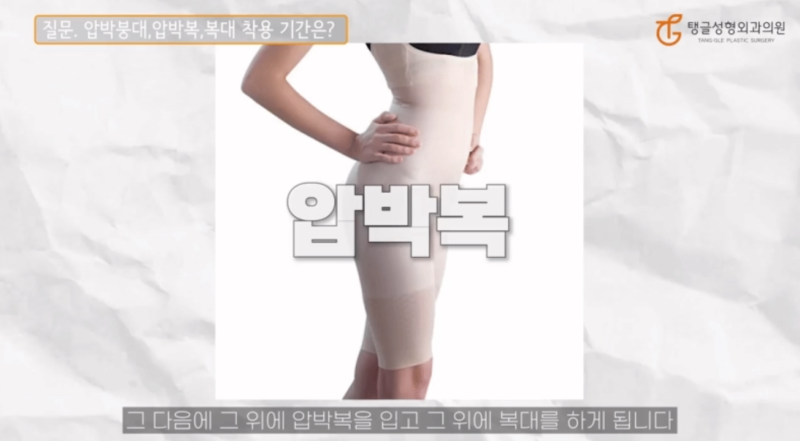
It might feel constricting and uncomfortable at first,
but it is a necessary step for good results.
It is important to maintain a sleeping position
that does not strain your abdomen after surgery.
Sleeping with a cushion under your legs to elevate them,
or sitting with your back straight, can be helpful.
Especially avoid positions that involve pushing out your stomach
or leaning your back backward.
4. Recovery and Scar Management After Tummy Tuck Surgery
We often receive questions like,
‘When can I return to my daily life?’
Complete recovery requires long-term management.
Q. When can I use a sauna and apply warm compresses?
Please avoid saunas and warm compresses
for at least two months after surgery.
It takes about 8 weeks for the wound area to fully heal.
Until then, it is best to avoid hot environments.
Q. I'm worried about scars; will they be okay?
Scar management after tummy tuck surgery
significantly impacts the outcome.
Apply an over-the-counter scar ointment twice a day
consistently for about 6 months.
Using silicone sheets along with it can compress the scar area
and yield even better results.
Initially, scars might be noticeable and cause concern,
but they will gradually fade over time.
Q. Will I be okay on my own?
After surgery, the support of family or friends is incredibly helpful.
Having a guardian accompany you upon discharge
can make your journey home more convenient,
and their support during the recovery period is a great help.
Tummy tuck surgery can bring
significant changes to your life.
However, it requires careful preparation
and appropriate care.
By familiarizing yourself with the information discussed today,
you will feel much more confident and at ease
undergoing the surgery.
If you have further questions,
we recommend consulting with a specialist at any time.