2026-07-14
Understanding Double Eyelid Surgery by Eye Type
Discover the right double eyelid surgery for your eye type, from sharp eyes to ptosis and age-related sagging, to achieve natural and harmonious results.

Understanding Double Eyelid Surgery by Eye Type
There are appropriate surgical methods depending on an individual's eye shape, eyeball depth, distance between the inner corners of the eyes, and eyelid skin. If surgery is performed using a method unsuitable for an individual's eye type, it can lead to an unnatural appearance or necessitate revision surgery. Therefore, it is best to proceed with a design and surgical method determined through detailed consultation.
For this reason, the ideal angle, length, and degree of epicanthoplasty that can create the most harmony, considering the individual's eye type, current conditions, and facial balance, must be determined through thorough consultation, and then an appropriate surgical method should be applied. In this post, we will discuss how surgical techniques were applied to different patients based on their eye and facial types.
1. Sharp Eyes
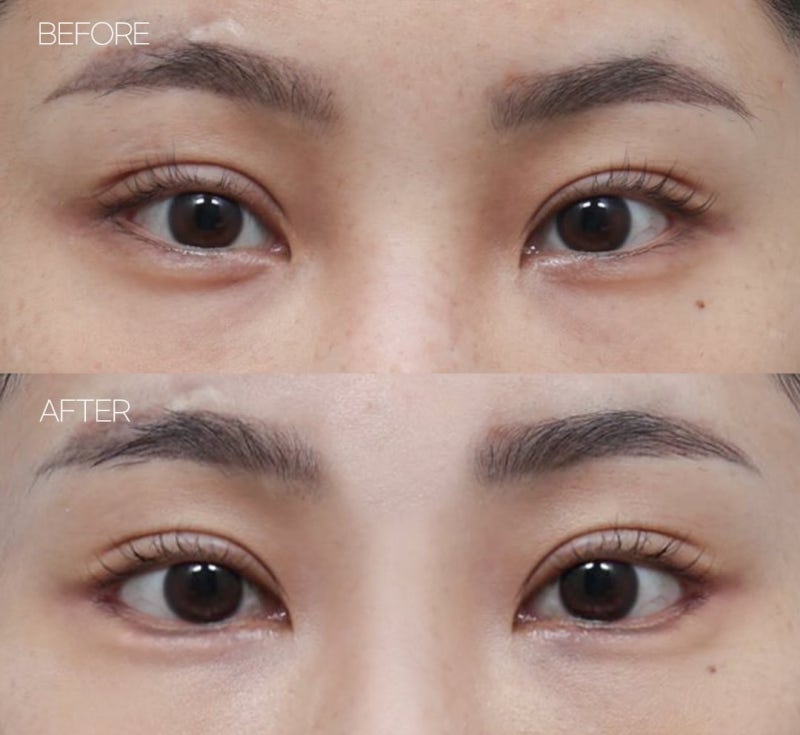
Eyes with a high anterior-posterior angle can create a sharp impression, making one appear unapproachable at first glance. In such cases, this can be compensated by adjusting both corners of the eyes through canthoplasty. However, if the lateral canthal ligament fixation is imperfect, the outer corner of the eye may appear lifted, requiring precise work to achieve perfect symmetry between both eyes.
Furthermore, in the case of lateral canthoplasty, if performed without considering the limitations of the patient's individual eyeball structure, re-correction can be difficult. Therefore, proceeding with precise measurements can lead to excellent results without the need for future revision surgery.
This patient's sharp eyes were significantly improved with lateral canthoplasty (+ lower canthoplasty) + epicanthoplasty.
2. Blurry Eyes Due to Ptosis
Ptosis refers to eyelid drooping caused by congenital or acquired factors. When the eyelid cannot open properly due to ptosis, it partially covers the pupil, creating a blurry eye appearance. While it can refer to drooping of either the upper or lower eyelid, it most commonly involves the upper eyelid.
In this case, the most suitable surgical method is an anterior approach (skin incision) to either pull or fold the levator aponeurosis and Müller's muscle, individually or together, to increase their contractile strength, which can yield effective results.
Self-diagnosis of ptosis can be confirmed with a simple test. Fix your eyebrows with your fingers, close your eyes, and then open them. If your eyes open easily, it's negative. If your eyes don't open easily without strength, it's positive.
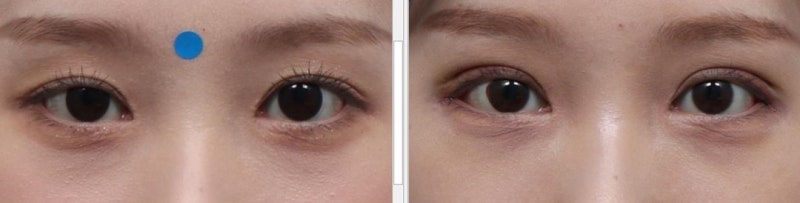
In this patient's case, clear problems were identified in the photos. On the left side of the photo, the upper eyelid is drooping, obscuring the eye's sparkle, while on the right side, the sparkle is visible. Thus, this is a case where ptosis was successfully improved within 0.1-0.2mm through an anterior approach (skin incision) for blepharoptosis correction, incisional double eyelid surgery, and lateral canthoplasty.
3. Sunken Eyes with Multiple Folds Due to Sagging Skin (Middle-aged Plastic Surgery)
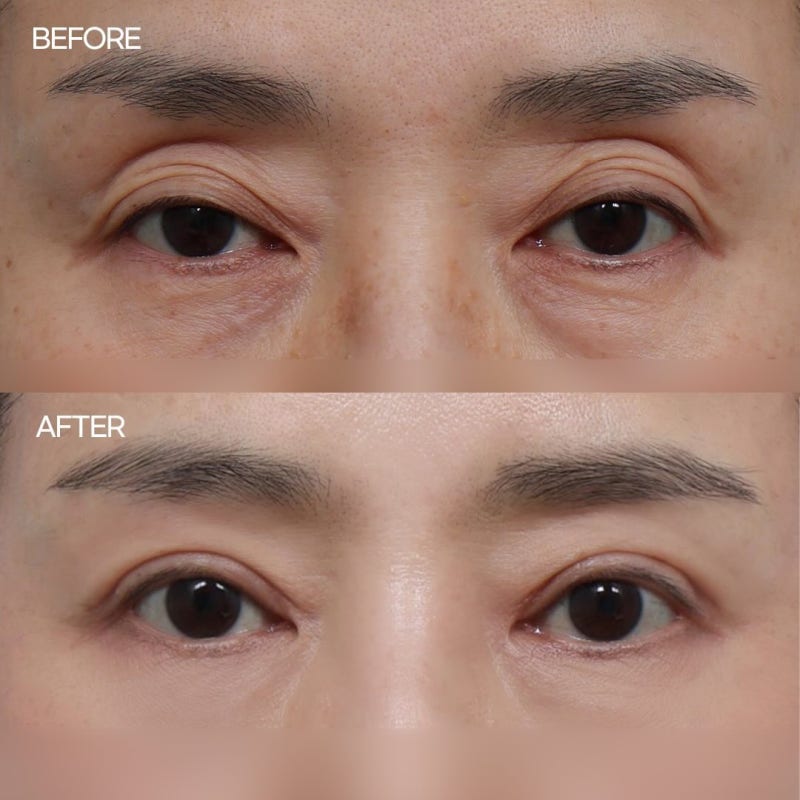
In middle-aged plastic surgery, due to aging, the skin loses elasticity and tissue sags downwards, and the upper eyelids also droop simultaneously, leading to eye fatigue. Frequent straining of the forehead or eyebrows to lift the eyelids can also cause wrinkles to form.
In this case, upper blepharoplasty with an anterior approach (skin incision) can be performed. Depending on the degree of sagging, some unnecessary tissue is removed, and the sagging is improved with reinforcement using the orbicularis oculi muscle (the facial muscle surrounding the eye). Sunken areas can be improved through upper eyelid fat repositioning.
Furthermore, if some hollowness remains later, more delicate correction is possible by injecting filler into the pre-orbital space beneath the orbicularis oculi muscle using supraorbital filler.
This patient's case involved upper blepharoplasty + upper eyelid fat repositioning + blepharoptosis correction + reinforcement using the orbicularis oculi muscle to improve sagging eyelids and sunken areas. During a follow-up, some hollowness remained, which was improved with 0.2cc of supraorbital filler.
※ Please be informed that personal consent for portrait rights was obtained for this medical column.



#EyeType #DoubleEyelidSurgery #DoubleEyelid #Ptosis #MiddleAgedPlasticSurgery #UpperBlepharoplasty #BAPAPlasticSurgery
Frequently Asked Questions
How can sharp eyes be improved?
Yes, sharp eyes can primarily be improved by adjusting both corners of the eyes through canthoplasty. Often, a combination of lateral canthoplasty, lower canthoplasty, and epicanthoplasty is used for improvement. However, if canthoplasty is performed without considering the limitations of the eyeball structure, re-correction can be difficult, so precise work with accurate measurements is crucial.
Is there a self-diagnosis method for ptosis?
Yes, you can self-diagnose ptosis with a simple test. Fix your eyebrows with your fingers, close your eyes, and then open them. If your eyes open easily, it's negative. If your eyes don't open easily without strength, it can be considered positive.
How is ptosis surgery performed?
Ptosis surgery is primarily performed through an anterior approach (skin incision). Effective results can be achieved by pulling or folding the levator aponeurosis and Müller's muscle, individually or together, to increase their contractile strength.
How are sagging eyelids in middle-aged individuals improved?
Yes, sagging eyelids in middle-aged individuals can be improved with upper blepharoplasty. After an anterior approach (skin incision), unnecessary tissue is removed, and sagging is improved with reinforcement using the orbicularis oculi muscle. Sunken areas can be delicately corrected through upper eyelid fat repositioning or supraorbital filler injection.
What problems can arise if double eyelid surgery is not suited to an individual's eye type?
If double eyelid surgery is performed using a method unsuitable for an individual's eye type, it can result in an unnatural appearance or necessitate revision surgery. Therefore, it is crucial to determine a customized surgical method through detailed consultation, considering the individual's eye shape, eyeball depth, intercanthal distance, and eyelid skin.