2026-07-20
[Presbyopia/Cataract] Learn how to improve your vision with various types of intraocular lenses!
Explore different intraocular lenses for presbyopia and cataracts to restore clear vision and enjoy daily life without reading glasses.
![[Presbyopia/Cataract] Learn how to improve your vision with various types of intraocular lenses!](/uploads/smileeye2019/221718350699/2f3732306f39929a.png)
Various ways to treat presbyopia and cataracts! Learn about intraocular lenses and restore clear vision.

Are you aware of intraocular lenses (IOLs) that replace the lens that has lost its function due to presbyopia and cataracts?
You can escape the hazy, dim vision caused by presbyopia and cataracts and enjoy daily life without reading glasses.
With Smile Eye Clinic, let's explore the types of near, intermediate, and far distance tasks in daily life,
and then find out which intraocular lens is suitable for your personal lifestyle based on the type of task.
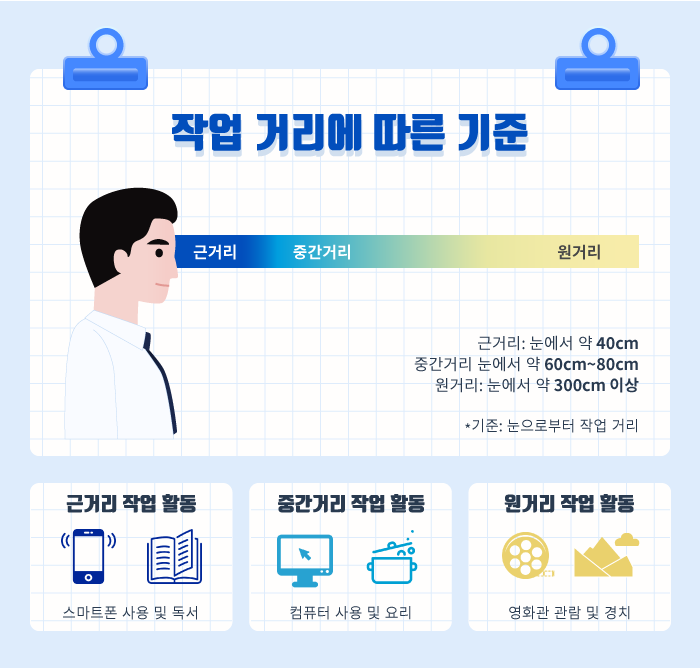
● Criteria based on working distance
1. Near distance tasks
: Approximately 40cm from the eyes
: Reading newspapers and books, using a mobile phone, etc.
2. Intermediate distance tasks
: Approximately 60-80cm from the eyes
: Cooking, using navigation, using a computer, etc.
3. Far distance tasks
: More than 300cm from the eyes
: Watching TV, watching movies, traffic lights, scenery, etc.
1. Monofocal Intraocular Lens
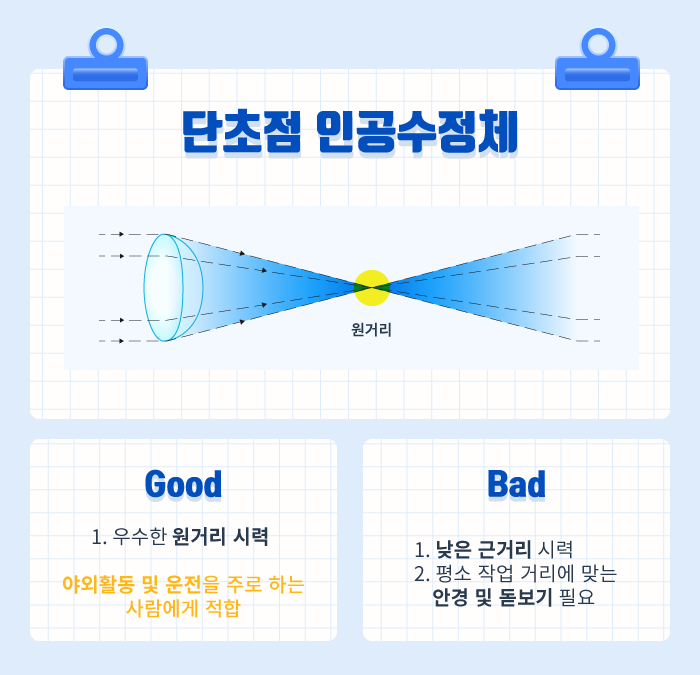
A monofocal intraocular lens is an IOL that focuses all light entering the eye onto a single point.
Because it has only one focal point, far vision is excellent,
but near vision is reduced, requiring reading glasses or spectacles.
● Far distance lifestyle
A monofocal intraocular lens is recommended for those who primarily engage in outdoor activities and driving, or who wish to wear reading glasses after surgery.
2. Multifocal Intraocular Lens
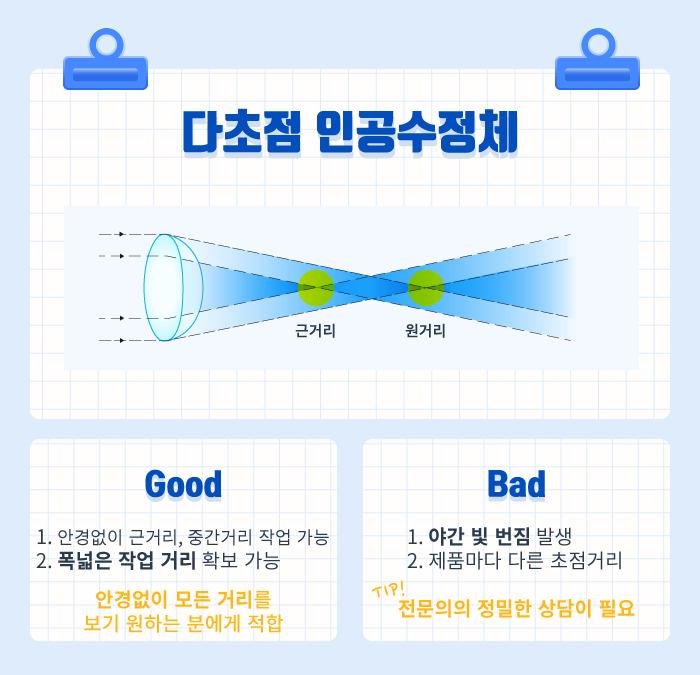
A multifocal intraocular lens divides the light entering the eye into multiple focal points,
allowing for vision at near, intermediate, and far distances.
Currently, dozens of types of multifocal intraocular lenses are available, offering a wide range of choices,
and a major advantage is the ability to secure a wide range of working distances, improving upon the shortcomings of monofocal lenses.
● All lifestyles
Multifocal intraocular lenses allow you to see everything from near tasks like reading and using a mobile phone to distant scenery.
However, since each multifocal intraocular lens differs in focal length, night vision, and the degree of glare,
a precise consultation with a specialist is necessary.
3. Extended Depth of Focus (EDOF) Intraocular Lens
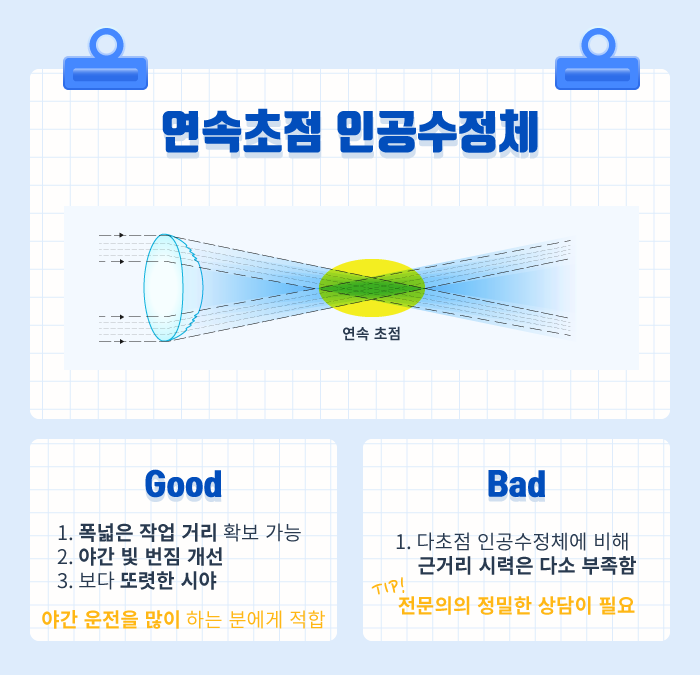
An extended depth of focus intraocular lens creates an hourglass shape for the light entering the eye,
allowing for vision at near, intermediate, and far distances.
Compared to conventional multifocal intraocular lenses, night glare and reduced clarity have been improved.
● All lifestyles
Extended depth of focus intraocular lenses allow you to see everything from near tasks like reading and using a mobile phone to distant landscapes.
Furthermore, the drawbacks of conventional multifocal intraocular lenses, such as night glare, have been improved.
Since the progression of presbyopia and cataracts varies for each individual, and lifestyle habits differ,
the appropriate intraocular lens must be implanted.
A thorough consultation with a specialist is necessary to implant the intraocular lens suitable for you.
Until now, we have explored the types of intraocular lenses used in presbyopia and cataract surgery with Smile Eye Clinic.
The technology of intraocular lenses, from monofocal and multifocal to extended depth of focus, is continuously improving,
and you can choose a customized intraocular lens according to your personal lifestyle.
Daily life without reading glasses! Goodbye to cataracts and astigmatism!
Meet medical staff who meticulously understand not only ophthalmic diseases such as glaucoma and macular degeneration, but also your individual occupation, hobbies, lifestyle habits,
and expectations for the post-surgical situation, along with the skill and know-how of medical staff with extensive experience in presbyopia and cataract surgery!





All copyrights for this content belong to ‘Smile Eye Clinic’.
Frequently Asked Questions
What types of intraocular lenses are used in presbyopia/cataract surgery?
This article introduces three types: monofocal, multifocal, and extended depth of focus intraocular lenses. Each IOL differs in how it focuses light and its focal length, allowing for selection based on individual vision and lifestyle.
What are the pros and cons of monofocal intraocular lenses?
The advantage of monofocal intraocular lenses is excellent far vision. However, since they provide only one focal point, near vision is reduced, and reading glasses or spectacles are required after surgery, which is a disadvantage.
What are the characteristics of multifocal intraocular lenses?
Multifocal intraocular lenses divide the light entering the eye into multiple focal points, allowing for vision at near, intermediate, and far distances. Dozens of types are currently available, offering a wide range of choices and the ability to secure a wide range of working distances.
How do extended depth of focus intraocular lenses differ from multifocal ones?
Extended depth of focus intraocular lenses create an hourglass shape for the light, allowing for vision at near, intermediate, and far distances. They have the advantage of improved night glare and reduced clarity compared to conventional multifocal intraocular lenses.
How can I choose the right intraocular lens for me?
Since the progression of presbyopia and cataracts, as well as lifestyle habits, vary for each individual, a thorough consultation with a specialist is essential. You should consider your occupation, hobbies, and post-surgical expectations comprehensively to choose the most suitable intraocular lens for you.