2026-07-20
Presbyopia Lens Implantation, Presbyopic Cataract Lens Type Recommendation
Learn about the different types of intraocular lenses for presbyopic cataract surgery: monofocal, multifocal, and premium monofocal (extended depth of focus). Discover how to choose the best lens based on your lifestyle and eye characteristics.


Hello, this is Gangnam Smile Eye Clinic 😊
As the weather cools down, post-operative care for surgery becomes relatively easier,
so many people inquire about eye surgeries.
Among them, the most frequently inquired surgery is presbyopic cataract surgery.
Presbyopic cataract surgery involves removing the existing lens affected by presbyopia and implanting an artificial intraocular lens.
The process of selecting the lens type through consultation with a professional optometrist and ophthalmologist is essential.
However, there are many different types of lenses,
and those visiting an eye clinic for the first time are often overwhelmed.
Usually, a professional counselor who is an optometrist and the ophthalmologist performing the surgery explain and conduct the consultation,
but because there are so many types and features of lenses,
Many people worry that they might mistakenly choose an expensive lens without knowing anything during the consultation.
So today, we will learn about the types of cataract lenses and
how to find the right lens for you.
Presbyopic cataract lens recommendation, lens implantation recommendation, presbyopic lens implantation recommendation

Lenses can be broadly categorized into three types: monofocal, multifocal, and premium monofocal (extended depth of focus).
What is a monofocal lens?
First, a monofocal lens, as the name suggests, has a single focal point.
Because it focuses on only one distance among many focal points such as far distance, intermediate distance, and near distance,
vision at distances not focused on will not improve after surgery.
This means that with a monofocal lens, glasses may still be required depending on the situation after surgery.
Generally, presbyopic cataract surgery focuses on distant vision,
so glasses are needed for intermediate or near vision depending on the situation.
Therefore, a monofocal lens might be inconvenient for those with hobbies or professions that frequently require near vision.
Presbyopic cataract lens
What is a multifocal lens?
Multifocal lenses can improve vision from near to far distances.
The big advantage is that you can see both near and far,
allowing you to live without glasses.
Since there are multiple focal points, light enters from various directions,
which can cause some glare, and consequently, a slight reduction in resolution.
However, for those who have worn glasses for a long time or
whose cataracts have progressed significantly, resulting in poor vision quality,
the ability to live with clear vision without glasses provides immense satisfaction.
The cost is relatively higher compared to monofocal lenses.
Presbyopic lens implantation recommendation, presbyopic cataract lens
Premium Monofocal / Extended Depth of Focus
The intermediate step that is often considered is premium monofocal,
or extended depth of focus.
This works by extending the depth of focus to provide clear vision at intermediate distances,
compensating for the drawback of traditional premium monofocal lenses that could only focus on one point.
Premium monofocal lenses can be described as intraocular lenses specialized for everyday intermediate distances.
Everyday intermediate distance refers to the most commonly used vision in daily life.
For example, shopping, exercising, cooking, navigation, watching TV, etc.
It can be said to be the most necessary distance in modern life.
Additionally, premium monofocal lenses are also financially
less burdensome than multifocal lenses,
making them a preferred choice for many.
Previously, the 'Tecnis Eyhance' intraocular lens was widely used,
but recently, an upgraded version of Eyhance, the 'Tecnis PureSee', has been released.
Tecnis PureSee
further improved near vision compared to the existing Eyhance lens.
While the existing Eyhance corrected only far and everyday intermediate distances,
the PureSee lens also compensates for everyday near distances of about 50cm,
securing vision even closer to daily life, such as for smartphones.
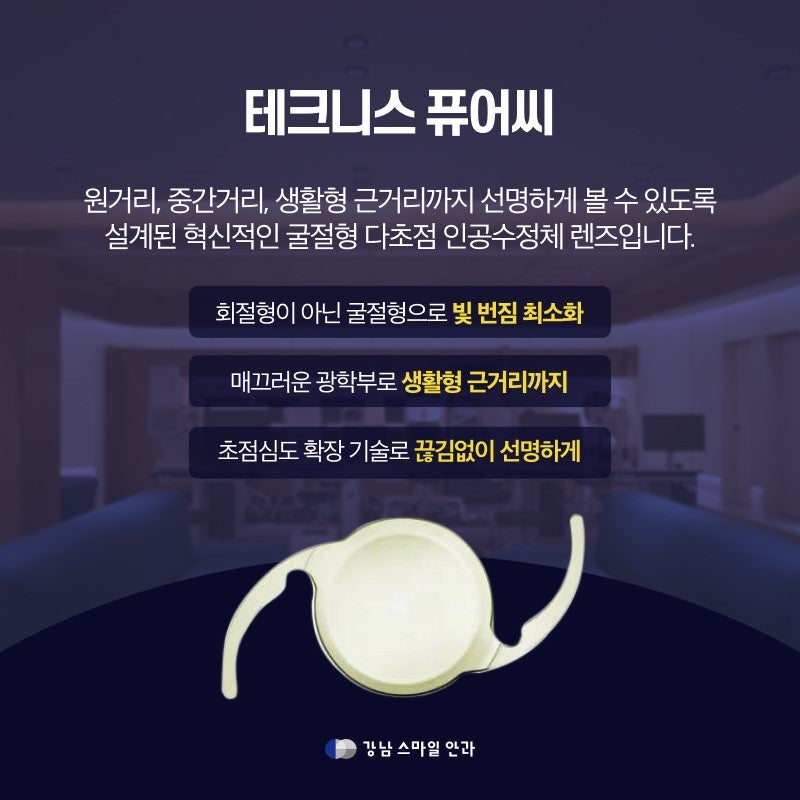
Furthermore, by using a refractive lens, it not only reduces glare,
but also blocks purple light, such as LED light from phones or headlights from cars,
further minimizing glare.
Improving color difference so that any light
is accurately focused on the retina, resulting in vivid colors,
and enhancing the quality of vision is also a significant advantage.
However, as presbyopic cataract surgery is a delicate procedure performed on the eyes,
it is important to choose comprehensively, considering individual eye characteristics, lifestyle, and medical history,
rather than insisting on superficial factors like Gangnam cataract costs.
For example, whether the patient's axial length is not too short for the lens,
whether they have a pupil size sensitive to glare,
etc., to assess individual eye characteristics,
it is crucial to visit a hospital equipped with professional examination equipment
and analyze accurate test results.
It is also important to comprehensively consider whether one has a profession or hobby that requires both near and far vision.
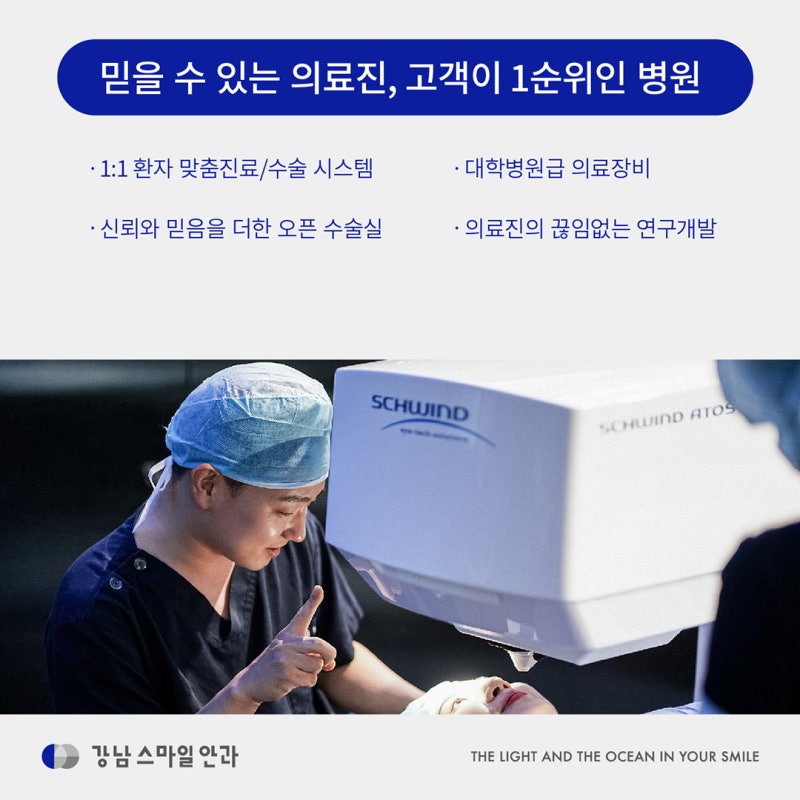
Our Gangnam Smile Eye Clinic
is equipped with university hospital-level medical and examination equipment
and a systematic examination/surgery system,
always treating each individual with sincerity
during examinations and surgeries.
We also always prioritize the patient
and place transparency and safety first.
💙🤍 𝖦𝖠𝖭𝖦𝖭𝖠𝖬 𝖲𝖬𝖨𝖫𝖤 𝖤𝖸𝖤 𝖢𝖫𝖨𝖭𝖨𝖢💙🤍
𝗧𝗛𝗘 𝗟𝗜𝗚𝗛𝗧 𝗔𝗡𝗗 𝗧𝗛𝗘 𝗢𝗖𝗘𝗔𝗡 𝗜𝗡 𝗬𝗢𝗨𝗥 𝗦𝗠𝗜𝗟𝗘




Frequently Asked Questions
Is lens selection important for presbyopia cataract surgery?
Yes, it is very important. Presbyopia cataract surgery involves removing the existing lens and inserting an artificial intraocular lens, and it is essential to choose the right lens for the individual through consultation with a professional optometrist and ophthalmologist. Depending on the type of lens, the range of vision improvement after surgery and whether glasses are needed may vary.
What are the characteristics of monofocal lenses?
A monofocal lens, as the name suggests, has a single focal point. It is usually focused on distant vision during surgery, and intermediate or near vision that is not focused may not improve after surgery, requiring glasses depending on the situation. This can be inconvenient for those with professions or hobbies that frequently require near vision.
What are the advantages and disadvantages of multifocal lenses?
The biggest advantage of multifocal lenses is that they can improve vision from near to far distances, allowing you to live without glasses. Disadvantages include the possibility of glare due to multiple focal points and a slight reduction in resolution. The cost is relatively higher than monofocal lenses.
What is a premium monofocal (extended depth of focus) lens?
A premium monofocal lens is a lens that extends the depth of focus to provide clear vision even at intermediate distances. It is specialized for everyday intermediate distances most commonly used in daily life, such as shopping, exercising, cooking, and watching TV. Many people prefer it because it is less financially burdensome than multifocal lenses.
What improvements have been made to the Tecnis PureSee lens?
The Tecnis PureSee lens has further improved near vision compared to the existing Eyhance lens. It secures vision not only for distant and everyday intermediate distances but also for everyday near distances of about 50cm, providing vision improvement more closely related to daily life, such as smartphone use. Additionally, as a refractive lens, it reduces glare and blocks purple light, enhancing the quality of vision.
What is the most important consideration when choosing a presbyopia cataract lens?
When choosing a lens, it is most important to comprehensively consider individual eye characteristics, lifestyle, and medical history rather than fragmented factors such as the cost of Gangnam cataract surgery. It is recommended to undergo accurate examinations at a hospital equipped with professional diagnostic equipment to meticulously analyze the patient's axial length, pupil size, occupation, and hobbies.