2026-07-20
Gangnam Smile Eye Clinic / Let's learn about LASIK, LASEK, and Implantable Collamer Lens (ICL) surgery!
Learn about LASIK, LASEK, and ICL surgeries at Gangnam Smile Eye Clinic. Discover which vision correction procedure is right for you based on your eye condition and lifestyle.

Hello!
We are Gangnam 'Smile Eye Clinic', dedicated to restoring your happy smile through the joy of sight.
As ophthalmic surgical technology continues to advance,
various vision correction surgeries such as LASIK, LASEK, and implantable collamer lens (ICL) surgery have become available.

While all are excellent vision correction procedures, you might be wondering which one is most suitable for you.
Smile Eye Clinic is here to help you find the answer!
So, shall we now learn about
LASIK, LASEK, and ICL surgery?!
1. LASIK OX Quiz
LASIK is a vision correction surgery that uses a laser to create and lift a corneal flap,
then reshapes the corneal stroma with a laser to correct refractive errors,
and finally repositions the corneal flap.
Answers
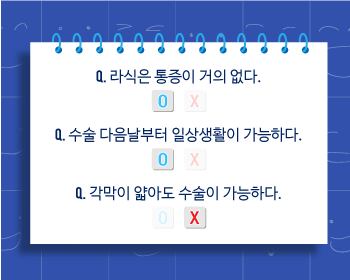
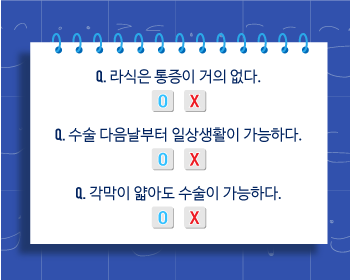
1. LASIK involves almost no pain.
2. With LASIK, daily activities are possible from the day after surgery.
3. LASIK surgery can be difficult if the cornea is thin.
2. LASEK OX Quiz
LASEK is a vision correction surgery that does not create a corneal flap.
Instead, it removes only the corneal epithelium using a laser, then reshapes the corneal stroma with a laser
to correct refractive errors.
Answers
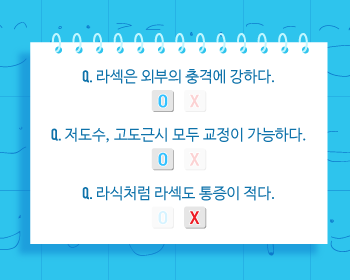
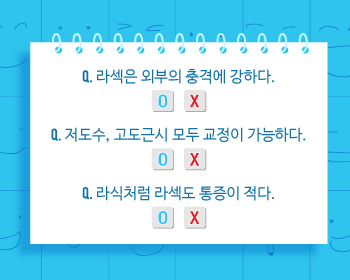
1. LASEK is resistant to external impact.
2. LASEK can correct both low and high myopia.
3. LASEK involves more pain compared to LASIK.
3. ICL Surgery OX Quiz
ICL surgery is a vision correction procedure that corrects refractive errors by implanting a corrective lens,
rather than reshaping the cornea like LASIK or LASEK.
Answers
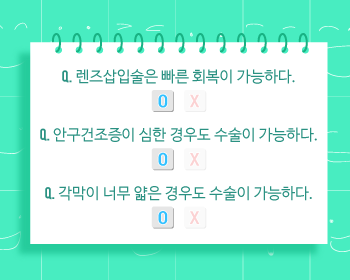
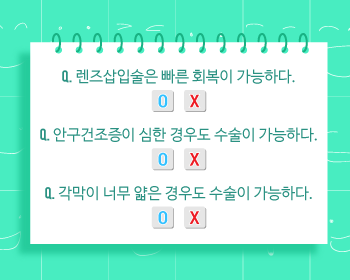
1. ICL surgery allows for quick recovery.
2. ICL surgery is possible even for severe dry eyes.
3. ICL surgery is possible even if the cornea is very thin.
Choose the right surgery for you!

While there might be a more suitable surgery depending on your eye condition, there isn't one that is inherently 'better' or 'worse'.
If you have high myopia or a thin cornea, LASIK might be difficult,
so a precise examination and consultation with a specialist are necessary!
We hope that those planning vision correction surgery
clearly understand the suitable procedure for them and achieve excellent surgical results.
For more questions, please check with Smile Eye Clinic, your vision problem solver!



Frequently Asked Questions
Is LASIK surgery very painful?
No, LASIK involves almost no pain. It proceeds by creating a corneal flap with a laser, correcting the corneal stroma, and then repositioning the flap. Recovery is fast enough that daily activities are possible from the day after surgery.
Is LASEK surgery resistant to external impact?
Yes, LASEK is generally resistant to external impact. It involves removing only the corneal epithelium with a laser and then correcting the corneal stroma, without creating a corneal flap. While it may involve more pain than LASIK, its advantage is its resistance to external impact.
Is vision correction surgery possible even with thin corneas?
Yes, there are vision correction procedures possible even with thin corneas. While LASIK might be difficult if the cornea is thin, ICL surgery does not involve shaving the cornea but rather inserting a corrective lens, making it possible even for thin corneas.
How long does recovery take for ICL surgery?
ICL surgery allows for quick recovery. Since it involves inserting a corrective lens into the eye rather than directly reshaping the cornea like LASIK or LASEK, vision can be restored relatively quickly after the surgery.
Can I undergo vision correction surgery even with severe dry eyes?
Yes, ICL surgery is possible even with severe dry eyes. Since ICL surgery does not directly reshape the cornea but involves inserting a lens, patients with severe dry eyes can also consider this surgery. However, a consultation with a specialist is necessary for an accurate diagnosis.