2026-07-20
Gangnam Station Ophthalmology | Is a continuous-focus lens better than a multifocal lens for cataracts?
Considering cataract surgery? Learn about continuous-focus (EDOF) lenses, their benefits over multifocal lenses, and who they're best for.
Hello, this is Gangnam Smile Eye Clinic 😊💙
If you are considering cataract surgery,
you are likely concerned about choosing an intraocular lens.
Recently, continuous-focus lenses (EDOF),
which surpass traditional multifocal lenses, are gaining attention.
Today, we will explain in detail the characteristics of ‘cataract continuous-focus lenses’,
suitable patient types, and important points when choosing a lens, as informed by Gangnam Station Ophthalmology.
What is a continuous-focus lens (EDOF)?
A continuous-focus lens, as its name suggests,
is an intraocular lens where the ‘focus is continuously connected’.
While traditional multifocal lenses focus on two points, distant and near,
continuous-focus lenses provide a more naturally connected field of vision
from intermediate to distant ranges.
This means it's possible to secure a smooth and continuous field of vision without focus interruption,
making it advantageous for seeing more naturally in daily life.
Another significant advantage is the relatively reduced glare and night glare.
Types of Representative Continuous-Focus Lenses
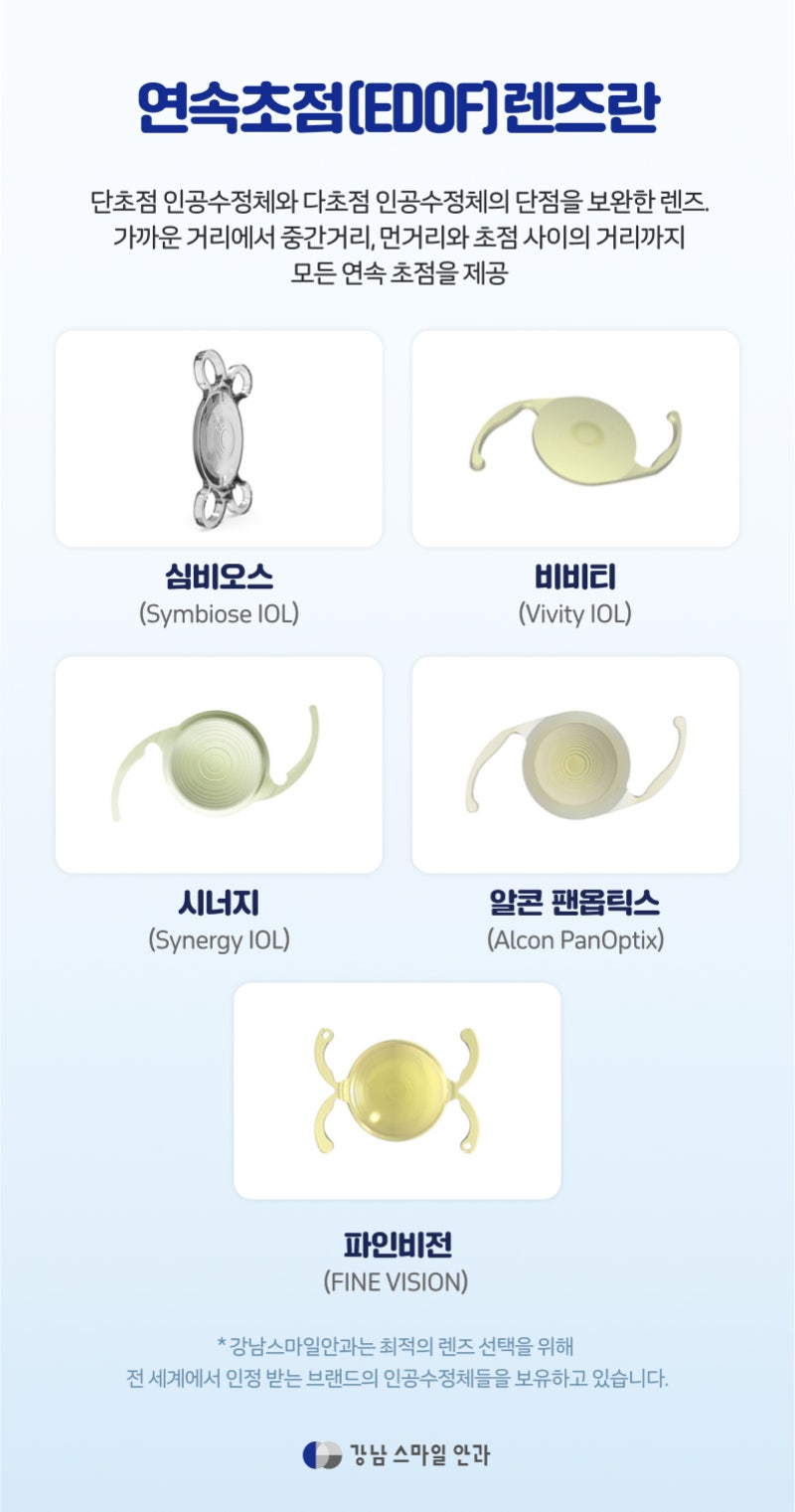
The main continuous-focus lenses currently used domestically and internationally include:
- Symbios
The latest EDOF lens that seeks harmony between near, intermediate, and distant vision. - Vivity
Emphasizes clarity of vision and securing a natural field of vision. - Synergy
Combines continuous-focus characteristics with optical technology to cover full-range vision. - PanOptix
A product from Alcon, USA, widely used in all ophthalmology clinics,
providing high-quality vision with a wide range of focus. - FineVision
Complements the limitations of existing multifocal lenses and improves intermediate vision quality.
Who is a cataract continuous-focus lens suitable for?
Continuous-focus lenses are not suitable for everyone.
They can be particularly effective in the following cases:
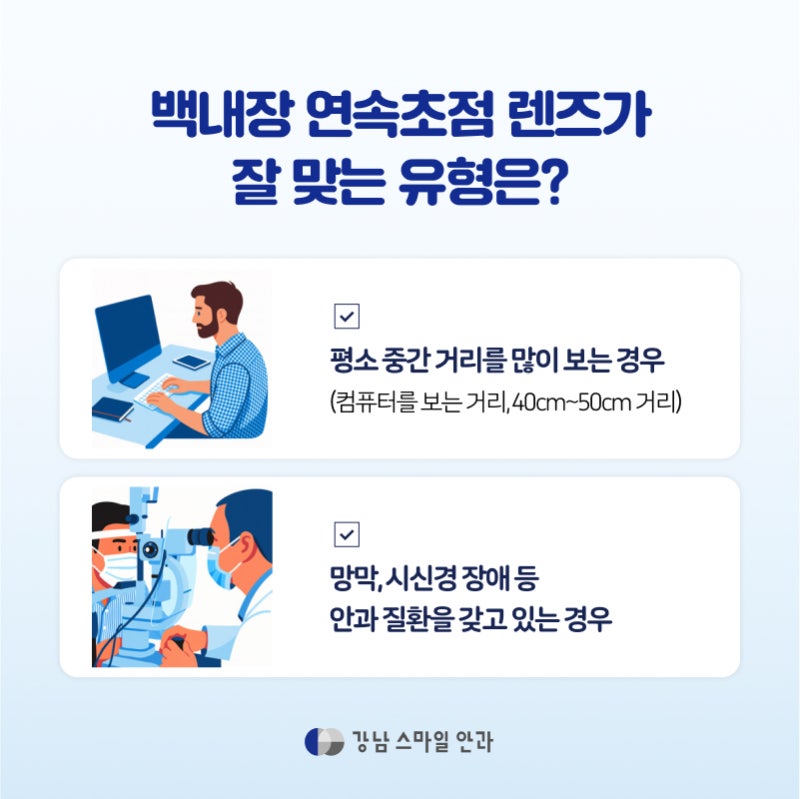
- If you frequently view at intermediate distances
Such as office work, driving, cooking, playing musical instruments, etc.,
where there is a lot of activity at intermediate distances. - If you have retinal optic nerve disease
In cases of underlying eye diseases such as glaucoma, macular degeneration, or diabetic retinopathy,
traditional multifocal lenses can cause discomfort due to side effects like glare.
In contrast, continuous-focus lenses are effective in improving vision quality with less reduction in contrast sensitivity.
More important than lens selection is the ‘skill of the medical team’
While cataract continuous-focus lenses come in various types and functions,
their selection is equally challenging and requires professional judgment.
Precisely selecting the most suitable lens based on the patient's eye condition, lifestyle, and vision goals is key.
Such accurate judgment stems from the medical team's skill, based on extensive clinical experience and state-of-the-art equipment.
Simply because a lens is good does not guarantee a good outcome.
Cataract Surgery, Safely at Gangnam Station Ophthalmology!
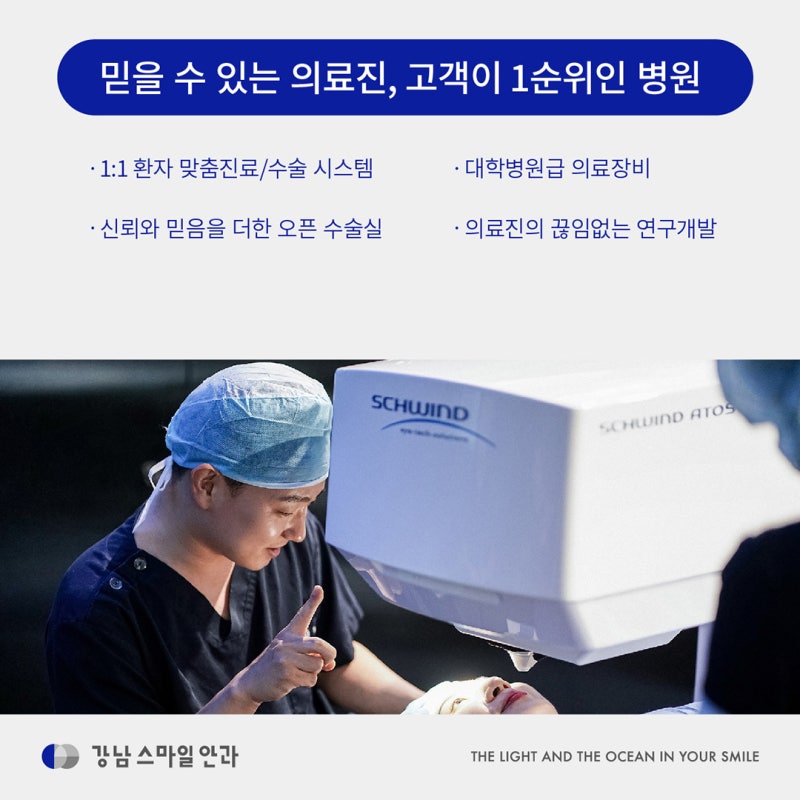
Gangnam Smile Eye Clinic accurately recommends the most suitable intraocular lens for each patient,
based on the latest examination equipment and extensive experience in cataract surgery.
It's just one surgery,
but it determines the quality of life thereafter, so choose carefully.
Consultation and precise examination for continuous-focus lenses
are conveniently available at Gangnam Smile Eye Clinic, Gangnam Station Ophthalmology.
💙🤍 𝖦𝖠𝖭𝖦𝖭𝖠𝖬 𝖲𝖬𝖨𝖫𝖤 𝖤𝖸𝖤 𝖢𝖫𝖨𝖭𝖨𝖢💙🤍
𝗧𝗛𝗘 𝗟𝗜𝗚𝗛𝗧 𝗔𝗡𝗗 𝗧𝗛𝗘 𝗢𝗖𝗘𝗔𝗡 𝗜𝗡 𝗬𝗢𝗨𝗥 𝗦𝗠𝗜𝗟𝗘












Frequently Asked Questions
What is an Extended Depth of Focus (EDOF) lens?
An Extended Depth of Focus (EDOF) lens is an intraocular lens that provides a continuous range of focus. Unlike traditional multifocal lenses that focus on two distinct points, EDOF lenses offer a naturally connected field of vision from intermediate to far distances.
What are the advantages of EDOF lenses?
EDOF lenses allow for a smooth and continuous field of vision without focal discontinuities, enabling more natural vision in daily life. A significant advantage is also the relatively reduced incidence of glare and halos, especially at night.
Who is suitable for EDOF lenses?
EDOF lenses are effective for individuals with active lifestyles who frequently use intermediate vision, such as office workers, drivers, cooks, and musicians. Furthermore, they can help improve visual quality even for those with retinal nerve diseases like glaucoma or macular degeneration, as they cause less reduction in contrast sensitivity.
Are there different types of EDOF lenses?
Yes, there are several types. Prominent examples include Symfony, Vivity, Synergy, PanOptix, and FineVision, each emphasizing different characteristics such as the balance of near, intermediate, and far vision, visual clarity, or a wider range of focus.
What is the most important factor when choosing a lens?
The most important factor when choosing a lens is the skill of the medical team. A precise and professional judgment is required to select the most suitable lens based on the patient's eye condition, lifestyle, and vision goals, which comes from medical professionals with extensive clinical experience and state-of-the-art equipment.